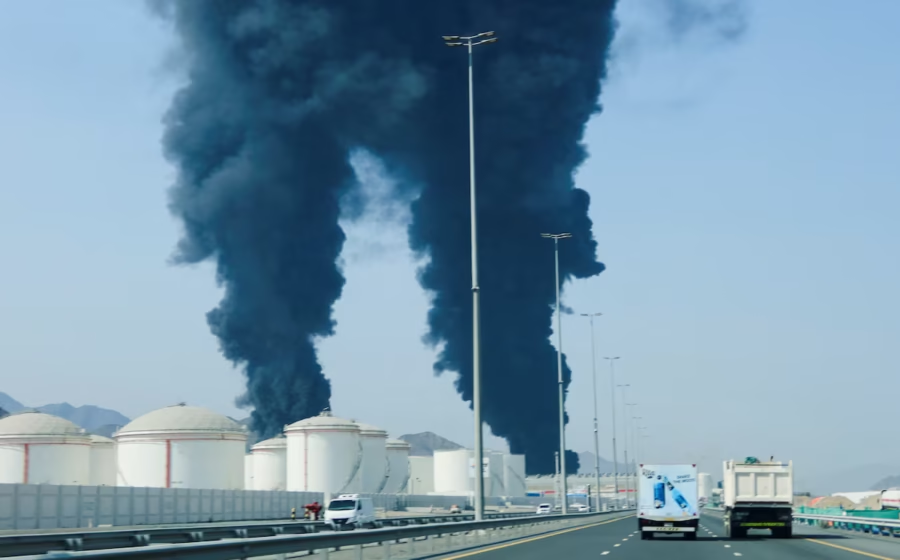



DOHA — Doha described the memorandum as a step towards sustainable peace and economic growth, with the Strait of Hormuz at the centre of implementation.
Qatar’s official response
Qatar has welcomed the agreement on a memorandum of understanding between the United States and Iran, saying it addresses outstanding issues and includes freedom of navigation in the Strait of Hormuz. Qatar News Agency reported that Doha views the development as an important step towards sustainable peace and stronger regional and international economic growth.
The statement is significant because Qatar has maintained communication with multiple parties during the crisis and has a direct interest in the security of Gulf shipping and liquefied natural gas trade.
Navigation and economic confidence
Freedom of navigation is not an abstract diplomatic principle for Gulf economies. It affects energy exports, food imports, industrial supply chains, freight costs and the confidence of international investors. A credible reopening of Hormuz would reduce one of the largest sources of uncertainty facing the region.
Qatar’s LNG sector depends on reliable maritime access. Even when production remains stable, interrupted shipping can change delivery schedules and force buyers to seek replacement cargoes.
The role of mediation
QNA separately described Qatari diplomacy as contributing to efforts to narrow differences between Washington and Tehran. That account places Qatar within a broader network of mediation involving regional and international actors.
Effective mediation usually depends on confidentiality, sustained access and the ability to translate political positions into practical options. Public recognition often comes only after the main parties believe that an understanding is possible.
From MoU to implementation
The memorandum still requires formal and operational follow-through. Qatar and other Gulf states will watch whether military activity stops, ports reopen and commercial vessels receive clear safety assurances.
Doha’s emphasis on sustainable peace suggests that the regional objective extends beyond a temporary decline in attacks. The longer-term test is whether the framework creates a process capable of addressing nuclear issues, sanctions and recurring security disputes.
What businesses should watch
Energy companies, banks and logistics providers should monitor official navigation instructions and insurance conditions. Headlines may improve sentiment before contracts and risk assessments are updated.
Investors should also watch whether lower geopolitical risk supports capital-market activity, tourism and cross-border projects. The scale of the economic benefit will depend on stability lasting beyond the initial announcement.
Editorial context
Implementation will matter more than announcement language. A memorandum, framework or political understanding may establish direction, but governments, armed actors, regulators and commercial institutions still need a shared sequence for carrying it out. The most credible indicators will be observable steps: a durable halt in attacks, formal instructions to forces, access for monitors, published sanctions decisions and safe commercial movement through the Strait of Hormuz.
What to watch
The distinction between a ceasefire, a preliminary memorandum and a final settlement is especially important in a fast-moving regional crisis. Markets can reprice immediately, while security arrangements and legal obligations take much longer. Telegraph Middle East therefore treats claims about future implementation as conditional until they are confirmed by the responsible institutions and reflected in events on the ground.
Regional diplomacy is also linked directly to economic confidence. Airlines, insurers, shipping companies, banks and investors respond not only to the wording of an agreement but to whether it reduces operational risk. A diplomatic breakthrough can improve sentiment within hours, yet the recovery of physical trade, transport and investment may require weeks of verified stability.
For Gulf governments, the immediate objective is to convert de-escalation into predictable rules. That includes freedom of navigation, protection of civilian infrastructure, clear communication between militaries and a process for resolving alleged violations. Without those mechanisms, even a limited incident could revive uncertainty and delay commercial normalisation.
Implementation will matter more than announcement language. A memorandum, framework or political understanding may establish direction, but governments, armed actors, regulators and commercial institutions still need a shared sequence for carrying it out. The most credible indicators will be observable steps: a durable halt in attacks, formal instructions to forces, access for monitors, published sanctions decisions and safe commercial movement through the Strait of Hormuz.
The distinction between a ceasefire, a preliminary memorandum and a final settlement is especially important in a fast-moving regional crisis. Markets can reprice immediately, while security arrangements and legal obligations take much longer. Telegraph Middle East therefore treats claims about future implementation as conditional until they are confirmed by the responsible institutions and reflected in events on the ground.
Regional diplomacy is also linked directly to economic confidence. Airlines, insurers, shipping companies, banks and investors respond not only to the wording of an agreement but to whether it reduces operational risk. A diplomatic breakthrough can improve sentiment within hours, yet the recovery of physical trade, transport and investment may require weeks of verified stability.