

DOHA — July 4, 2026: Negotiations hosted in Qatar are shifting from ceasefire language to the practical mechanics of maritime security, shipping access and energy flows. The development is relevant to Telegraph Middle East readers because it connects directly with the publication’s core coverage of Gulf business, public policy, investment, markets and regional affairs.
The story is not only about a headline figure or a single official decision. It is about how the Middle East is adjusting to a period in which energy routes, capital flows, government policy, consumer confidence and geopolitical risk are moving together. In that environment, a development in one sector can quickly shape decisions in another.
Reuters reported that US and Iranian officials held technical talks in Doha focused on shipping through the Strait of Hormuz.
Qatar played a facilitation role, with regional diplomacy centred on implementing a fragile framework.
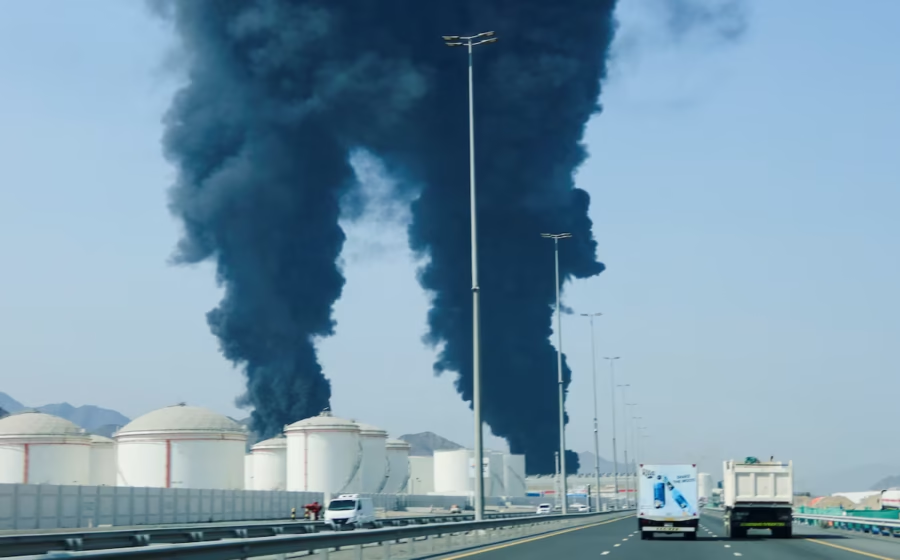
The negotiations followed weeks of disruption to Gulf shipping and energy flows.
No comprehensive final settlement had been publicly confirmed at the time of reporting.
Taken together, these details indicate that the region is moving through a phase of cautious adjustment rather than simple recovery or deterioration. The facts point to measurable activity, but they also show why decision-makers remain careful about treating one week of data as a lasting trend.
For Gulf governments, diplomacy is not an abstract exercise. It is the operating system beneath energy exports, aviation, ports, finance and investor confidence. A single maritime corridor can affect oil buyers in Asia, insurers in London, shipping companies in Greece and budget planners across the Gulf. This is why technical talks can sometimes matter more than political declarations: ships need rules, not slogans.
The role of Qatar, and of other regional facilitators, also reflects the Gulf’s evolving diplomatic architecture. Smaller states can use credibility, discretion and relationships to keep channels open when direct communication is politically difficult. Yet mediation carries its own risks. If expectations rise faster than implementation, markets may price in calm before the underlying security questions are actually resolved.
The next phase will therefore be judged less by communiques and more by measurable indicators: tanker traffic, airspace reopening, insurance rates, port activity, export volumes and the language used by military commanders. For now, the region is moving from crisis management into the more difficult work of enforcement and verification.
The technical phase matters because declarations of peace must become workable rules for ships, insurers, ports and navies.
Qatar’s role reinforces the Gulf’s reliance on small-state mediation during periods of high military risk.
For regional economies, the measure of success will be lower insurance costs, stable tanker traffic and predictable air and maritime corridors.
For policymakers, the priority is to preserve confidence while avoiding overstatement. For companies, the priority is operational flexibility: the ability to adapt procurement, pricing, staffing, financing and customer strategy as conditions change. For investors, the key question is whether short-term uncertainty is masking durable structural growth or exposing weaknesses that were previously hidden by abundant liquidity.
The next indicators to watch will be official follow-up data, sector-level statements, shipping and travel activity, lending conditions, company guidance and the tone of regional diplomacy. Telegraph Middle East will continue to treat confirmed data as the basis for analysis and will avoid presenting projections or source-based claims as settled outcomes.
The wider context is that the Gulf is attempting to protect its reputation as a reliable centre for capital, trade and services while operating in a region where security developments can change the cost of doing business quickly. The strongest economies will be those able to maintain institutional clarity, transparent communication and practical continuity during periods of stress. That is why today’s news should be read as part of a wider operating picture rather than as an isolated event.
The wider context is that the Gulf is attempting to protect its reputation as a reliable centre for capital, trade and services while operating in a region where security developments can change the cost of doing business quickly. The strongest economies will be those able to maintain institutional clarity, transparent communication and practical continuity during periods of stress. That is why today’s news should be read as part of a wider operating picture rather than as an isolated event.