

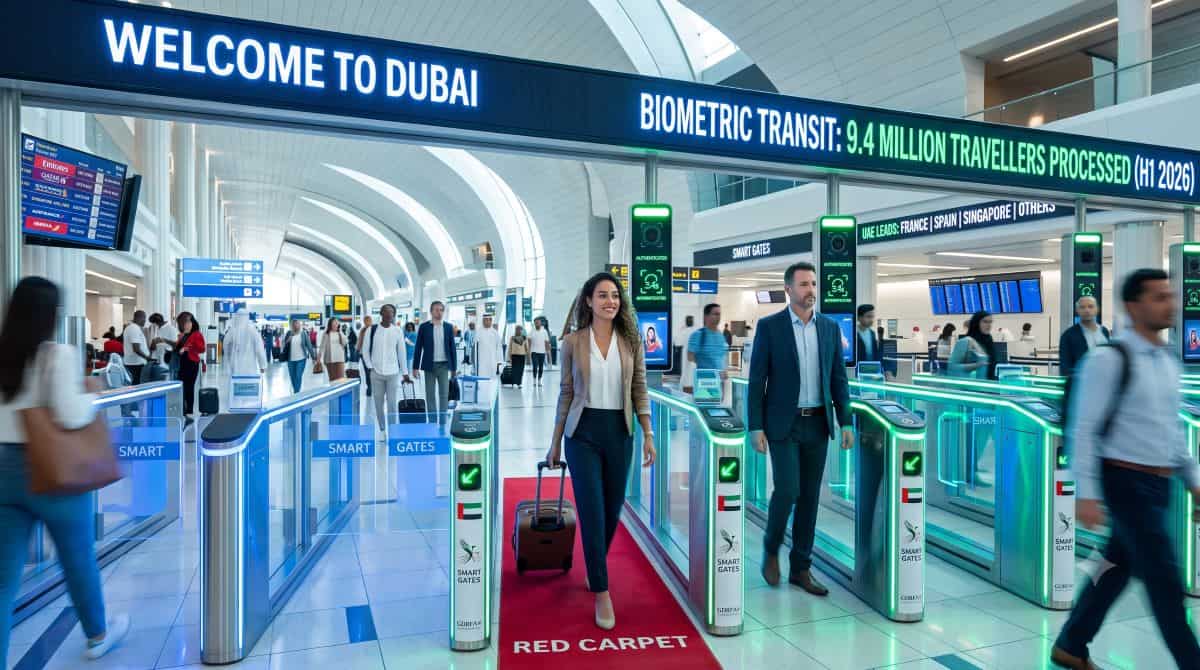
DUBAI — Dubai’s AI-powered Smart Travel ecosystem processed more than 9.4 million travellers in the first half of 2026, underlining the emirate’s use of digital border systems to protect its position as a global aviation hub.
Gulf News reported, citing GDRFA Dubai, that 9,024,736 passengers used Smart Gates as their primary border-crossing channel, while 439,321 travellers used the advanced Travel Without Borders Red Carpet service. The Red Carpet service recorded an average processing time of 3.4 seconds per traveller.
What changed
The figures show that smart border technology has moved beyond pilot status. Processing more than 9 million passengers through Smart Gates in six months indicates that automated immigration has become a mainstream part of Dubai’s airport experience.
Scale matters because airport technology delivers its full value only when adoption is broad. A biometric corridor used by a small number of passengers may be innovative, but a system used by millions can change terminal planning, staffing and passenger-flow management.
Why it matters for the Gulf
Dubai’s economy depends on aviation, tourism, trade, business travel and global connectivity. Faster border processing supports all of those sectors by reducing friction at one of the most important points in the visitor journey.
Airports increasingly compete on passenger flow. Travellers judge hubs not only by airlines and lounges, but by how quickly they can move through immigration, baggage and security. Efficient borders can support tourism, events and stopover traffic.
The economic reading
The Red Carpet service points to the next phase of airport infrastructure: identity verification that is fast, contact-light and heavily digital. But speed must be balanced with accuracy, cybersecurity and clear governance of biometric data.
For aviation and technology investors, Dubai’s data signals demand for AI systems, identity platforms, airport automation and secure data infrastructure. The airport is becoming a market for technology as much as a transport facility.
What to watch next
The next indicators will be wider eligibility, passenger satisfaction, system reliability and whether the technology scales during peak holiday periods. Authorities will also need to maintain public trust around data protection.
Dubai’s Smart Gates performance shows that aviation competitiveness increasingly depends on digital infrastructure. For the emirate, faster border control is not only a convenience. It is part of the operating system behind tourism, investment and global mobility.
The Telegraph Middle East reading
Dubai’s smart-gate performance should be seen as part of a larger aviation strategy. Passenger growth is valuable only when the airport can move people efficiently. Border speed, baggage handling, terminal flow and digital identity systems are therefore becoming economic infrastructure, not merely customer-service improvements.
For airlines and tourism operators, shorter processing times can improve the attractiveness of Dubai as a hub and destination. For government, the system helps manage capacity without relying only on physical expansion. For passengers, the value is simple: less waiting and more predictability.
The next phase will require continued trust. Biometric and AI systems must be accurate, secure and easy to understand. If passengers trust the process, adoption will rise. If they are uncertain about eligibility or data protection, the full efficiency benefit will be harder to realise.
The story will remain important because it connects policy decisions with boardroom planning. Companies operating in the Gulf increasingly need to understand not only what happened, but how it changes risk, cost, demand and the timing of investment decisions across the region.
The story will remain important because it connects policy decisions with boardroom planning. Companies operating in the Gulf increasingly need to understand not only what happened, but how it changes risk, cost, demand and the timing of investment decisions across the region.
The story will remain important because it connects policy decisions with boardroom planning. Companies operating in the Gulf increasingly need to understand not only what happened, but how it changes risk, cost, demand and the timing of investment decisions across the region.
The story will remain important because it connects policy decisions with boardroom planning. Companies operating in the Gulf increasingly need to understand not only what happened, but how it changes risk, cost, demand and the timing of investment decisions across the region.
The story will remain important because it connects policy decisions with boardroom planning. Companies operating in the Gulf increasingly need to understand not only what happened, but how it changes risk, cost, demand and the timing of investment decisions across the region.