

ÉVIAN-LES-BAINS — The agreement has shifted the summit agenda towards implementation, energy security, sanctions and the unresolved regional fronts.
A changed summit agenda
G7 leaders meeting in France are expected to focus heavily on the preliminary US-Iran framework and the reopening of the Strait of Hormuz. The diplomatic breakthrough arrived as leaders were preparing to address energy security, inflation, global growth and the regional conflict.
The framework gives the summit an opportunity to coordinate support, but it also exposes differences over sanctions, nuclear conditions and the relationship with Israel.
Energy and inflation
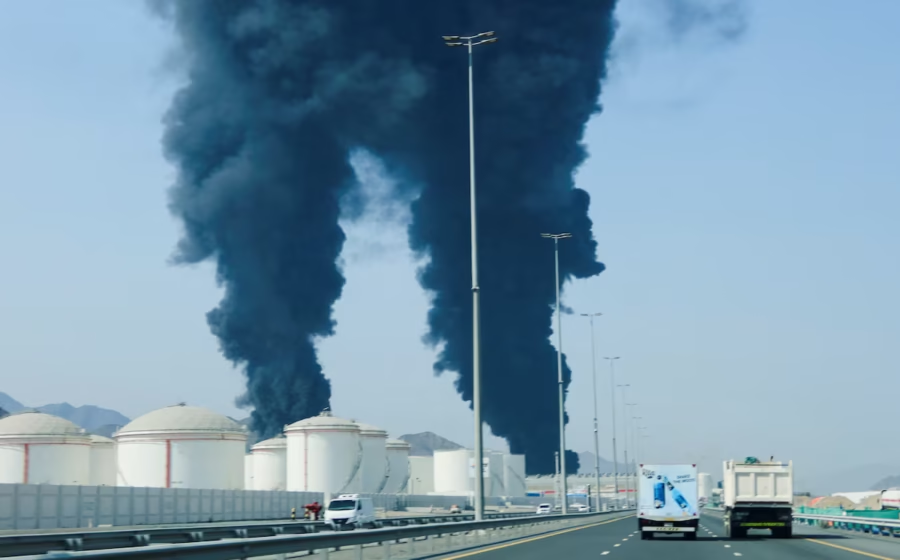
Hormuz disruption has affected oil and LNG flows, shipping insurance and inflation expectations. G7 governments have used emergency measures and diplomatic pressure to limit the economic impact.
A reopening could ease some pressure, yet central banks and governments will be cautious about assuming an immediate return to normal supply. Physical exports and inventories recover more slowly than futures prices.
Sanctions coordination
Several major economies will need to decide how sanctions relief should be sequenced with Iranian commitments. Premature relief could reduce leverage, while excessive delay could weaken incentives for implementation.
A coordinated approach matters because fragmented rules create uncertainty for banks, insurers and commodity traders. Companies need clear legal guidance before resuming transactions.
Regional representation
Middle Eastern guests and partners bring direct operational interests to the summit. Gulf states are concerned with navigation and economic stability, while Lebanon, Syria and other affected states face immediate security and humanitarian questions.
Their participation can help prevent the agreement from being treated only as a bilateral US-Iran matter.
Possible outcomes
The G7 may issue political support, call for restraint and establish technical work on sanctions, maritime security and nuclear verification. The value of any communiqué will depend on whether it produces coordinated action.
Leaders will also need to avoid language that claims a final settlement before the memorandum is signed and implemented.
Editorial context
Implementation will matter more than announcement language. A memorandum, framework or political understanding may establish direction, but governments, armed actors, regulators and commercial institutions still need a shared sequence for carrying it out. The most credible indicators will be observable steps: a durable halt in attacks, formal instructions to forces, access for monitors, published sanctions decisions and safe commercial movement through the Strait of Hormuz.
What to watch
The distinction between a ceasefire, a preliminary memorandum and a final settlement is especially important in a fast-moving regional crisis. Markets can reprice immediately, while security arrangements and legal obligations take much longer. Telegraph Middle East therefore treats claims about future implementation as conditional until they are confirmed by the responsible institutions and reflected in events on the ground.
Regional diplomacy is also linked directly to economic confidence. Airlines, insurers, shipping companies, banks and investors respond not only to the wording of an agreement but to whether it reduces operational risk. A diplomatic breakthrough can improve sentiment within hours, yet the recovery of physical trade, transport and investment may require weeks of verified stability.
For Gulf governments, the immediate objective is to convert de-escalation into predictable rules. That includes freedom of navigation, protection of civilian infrastructure, clear communication between militaries and a process for resolving alleged violations. Without those mechanisms, even a limited incident could revive uncertainty and delay commercial normalisation.
Implementation will matter more than announcement language. A memorandum, framework or political understanding may establish direction, but governments, armed actors, regulators and commercial institutions still need a shared sequence for carrying it out. The most credible indicators will be observable steps: a durable halt in attacks, formal instructions to forces, access for monitors, published sanctions decisions and safe commercial movement through the Strait of Hormuz.
The distinction between a ceasefire, a preliminary memorandum and a final settlement is especially important in a fast-moving regional crisis. Markets can reprice immediately, while security arrangements and legal obligations take much longer. Telegraph Middle East therefore treats claims about future implementation as conditional until they are confirmed by the responsible institutions and reflected in events on the ground.
Regional diplomacy is also linked directly to economic confidence. Airlines, insurers, shipping companies, banks and investors respond not only to the wording of an agreement but to whether it reduces operational risk. A diplomatic breakthrough can improve sentiment within hours, yet the recovery of physical trade, transport and investment may require weeks of verified stability.
For Gulf governments, the immediate objective is to convert de-escalation into predictable rules. That includes freedom of navigation, protection of civilian infrastructure, clear communication between militaries and a process for resolving alleged violations. Without those mechanisms, even a limited incident could revive uncertainty and delay commercial normalisation.