


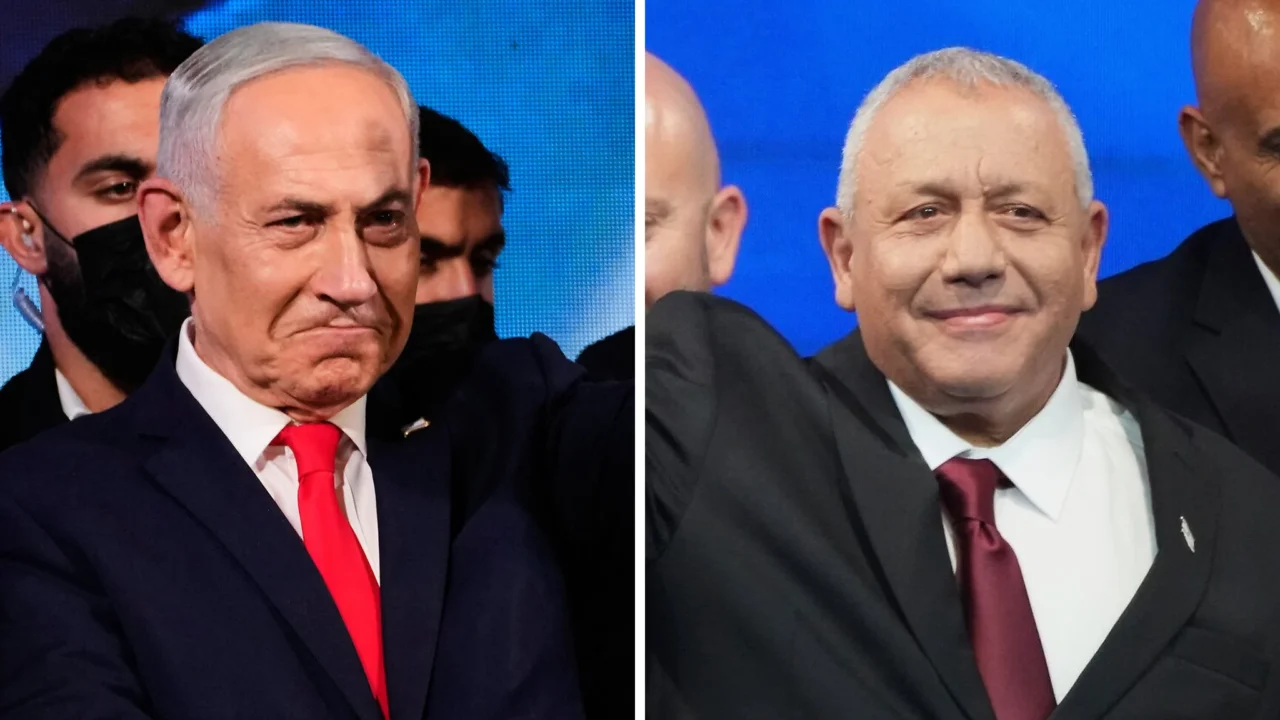
Israel’s election has left Prime Minister Benjamin Netanyahu’s political future uncertain after his Likud-led bloc fell short of the parliamentary majority required to form a government, setting the stage for potentially difficult coalition negotiations.
The completed vote count gave Netanyahu’s bloc 53 seats in the 120-member Knesset, while the main opposition bloc led by former military chief Gadi Eisenkot secured 48 seats. Arab-led parties won the remaining 19 seats, placing them in a potentially influential position as political leaders consider their options.
A government requires the support of at least 61 members of parliament. Neither of the two principal political blocs reached that threshold independently, leaving Israel facing uncertainty over who will lead its next administration.
The results represent a setback for Netanyahu, whose coalition previously controlled a substantially larger parliamentary bloc. They also present an opportunity for opposition parties seeking to replace him, although ideological divisions and disagreements over cooperation with Arab-led parties could complicate their efforts.
The central question now is whether Netanyahu can assemble enough parliamentary support to remain in office, whether his opponents can negotiate an alternative arrangement, or whether the political deadlock will eventually lead to another election.
According to reporting published on 30 October, the election results were awaiting formal certification, while allegations of electoral interference made by Netanyahu’s Likud party had not been substantiated by evidence of systematic manipulation.
Netanyahu’s bloc falls short of a parliamentary majority
Netanyahu’s Likud remained the largest individual party, securing 27 seats. However, the combined strength of his right-wing and far-right allies was insufficient to guarantee another term in office.
The bloc’s 53 seats leave it eight short of the 61 required for a parliamentary majority.
The result highlights a distinction between winning the largest share of parliamentary representation and possessing the numbers necessary to govern. Under Israel’s parliamentary system, parties must negotiate with other political groups to assemble a coalition capable of winning the confidence of the Knesset.
Netanyahu’s political future will therefore depend not only on Likud’s performance but also on the willingness of potential partners to support his government.
His existing relationships with right-wing, far-right and ultra-Orthodox parties may offer opportunities for negotiation. However, the election result means that securing sufficient support will require difficult discussions over political priorities and the distribution of influence within a prospective government.
The reduced size of Netanyahu’s bloc also creates uncertainty over whether all its existing partners will remain committed to the same coalition strategy.
For the prime minister, the challenge is no longer simply to lead the largest party. It is to demonstrate that he can command the parliamentary support necessary to govern.
Gadi Eisenkot faces his own coalition challenge
The opposition bloc led by Gadi Eisenkot secured 48 seats, leaving it 13 short of an outright majority.
Eisenkot, a former chief of staff of the Israel Defense Forces, has emerged as a central figure in efforts to challenge Netanyahu’s political leadership.
His bloc includes parties with differing ideological positions and policy priorities. Although their opposition to Netanyahu provides a common political objective, that shared position does not automatically translate into agreement on the composition or programme of a future government.
The opposition must determine whether it can establish a sufficiently broad coalition, negotiate support from parties outside its core grouping or pursue another parliamentary arrangement.
Arab-led parties are particularly important to this calculation. Their combined 19 seats could provide a numerical route towards a majority if the necessary political agreements could be reached.
However, cooperation would carry significant political complications. Some opposition leaders have resisted working with Arab-led parties, limiting the available options despite the arithmetic of the election.
Eisenkot’s challenge is therefore twofold: maintaining unity among opposition parties while determining whether a workable arrangement can be established with political groups outside their existing bloc.
Without such an agreement, the opposition may struggle to translate its combined electoral support into a government.
Arab-led parties emerge as potential kingmakers
The election gave Arab-led parties a combined 19 seats, making them an important factor in the struggle to form Israel’s next government.
The Joint List secured 11 seats, while Ra’am won eight. Their combined representation gives them potential leverage in parliamentary negotiations, although the parties remain distinct political organisations and should not automatically be treated as a single negotiating bloc.
Their position is significant because neither Netanyahu’s bloc nor the main opposition grouping has enough seats to govern alone.
In numerical terms, cooperation between the opposition and Arab-led parties could provide a route towards the required parliamentary majority. Yet the political feasibility of such an arrangement remains uncertain.
Arab-led parties have their own policy priorities, including issues affecting Arab citizens of Israel and the treatment of Palestinian communities. Any negotiations would therefore involve more than simply agreeing on who should become prime minister.
The opposition would also have to decide whether Arab-led parties should formally enter a government, support a minority administration from outside the cabinet or cooperate on specific parliamentary votes.
These arrangements are not interchangeable. A party can support a government on particular issues without accepting ministerial positions or joining the governing coalition.
The election has consequently increased the potential parliamentary influence of Arab-led parties without guaranteeing them a role in the next administration.
Their ability to convert that influence into political outcomes will depend on negotiations, the positions adopted by individual parties and the willingness of rival blocs to compromise.
Election interference allegations add to political tensions
The election results have been accompanied by controversy over allegations that the vote was influenced by improper activity involving Arab-led parties.
Likud claimed that the election had been stolen and raised allegations of foreign interference. However, reporting published on 30 October said the claims were not supported by evidence establishing systematic manipulation of the result.
The Central Elections Committee had rejected claims that the integrity of the ballot had been systematically compromised. President Isaac Herzog also urged caution against casting suspicion on Arab voters as a community.
The distinction between allegations and established findings is particularly important in a closely contested election.
Claims of electoral misconduct can affect public confidence, intensify political divisions and complicate the process of accepting the outcome. They should therefore be assessed through evidence and established investigative procedures rather than treated as proven facts.
The dispute also carries wider implications for relations between Jewish and Arab citizens of Israel.
Arab citizens participate in Israel’s electoral system through political parties and parliamentary representation. The political influence gained through that participation can become especially significant when the largest blocs fail to secure a majority.
Attempts to delegitimise the participation of an entire community risk deepening social divisions at a time when political leaders must negotiate an outcome capable of commanding parliamentary support.
The handling of the allegations will therefore remain an important part of the political aftermath, alongside the negotiations over government formation.
What happens next under Israel’s parliamentary system?
Israel’s next government will depend on a process of consultations and coalition-building rather than simply the identity of the largest party.
After the results are formally submitted, President Isaac Herzog is expected to consult political representatives before selecting a candidate to attempt to form a government.
The candidate will need to assemble sufficient parliamentary support to establish an administration. If the first attempt fails, another candidate may have an opportunity to seek support, subject to the applicable constitutional procedures and deadlines.
Three broad scenarios could shape the next phase of Israeli politics.
First, Netanyahu could attempt to rebuild a governing majority. This would require securing additional support or negotiating a new arrangement with potential partners. The feasibility of that strategy will depend on the demands of other parties and whether they consider continued cooperation politically advantageous.
Second, Eisenkot’s opposition could seek an alternative government. The opposition would need to reconcile its internal differences and determine whether it can obtain sufficient support from parties outside its existing bloc. Arab-led parties could play an important role in such an arrangement, although political resistance remains a significant obstacle.
Third, coalition negotiations could fail. If no candidate can establish a viable government within the required timeframe, Israel could face another election. That outcome would extend political uncertainty and require parties to return to voters without a settled governing arrangement.
None of these scenarios should be treated as inevitable. The election has established the distribution of parliamentary seats, but the eventual government will depend on negotiations that remain unresolved.
Implications for Israel’s regional policy
The election outcome matters beyond domestic politics because the next government will inherit major security and diplomatic challenges.
Israel’s approach to Gaza, its relations with neighbouring countries, the confrontation involving Iran and the security situation along the Lebanese border will remain central issues for the incoming administration.
Coalition composition can influence how a government approaches these questions. Parties with different positions on military operations, negotiations and relations with Palestinians may seek to shape government policy as a condition of providing parliamentary support.
A prolonged period of political uncertainty could also complicate decision-making. A government focused on coalition negotiations may have less political room to make difficult compromises, while rival parties may disagree over the balance between military objectives and diplomatic initiatives.
However, it would be premature to assume that a change in government would automatically produce a major shift in Israel’s regional policy. Any new administration would face the same underlying security challenges, institutional constraints and competing political pressures.
The implications will become clearer once the composition of the government and its policy priorities are established.
What the election means for Israel’s political future
The 30 October results have created a difficult parliamentary calculation for both Netanyahu and his opponents.
Netanyahu’s bloc emerged with 53 seats, while Eisenkot’s opposition grouping secured 48. Arab-led parties hold the remaining 19 seats, potentially giving them an influential position in negotiations.
The arithmetic is clear, but the political outcome is not.
Netanyahu must determine whether he can retain enough support to govern, while the opposition must decide whether it can overcome its internal divisions and negotiate a viable alternative.
Arab-led parties may gain greater influence over parliamentary decisions, but their ability to shape the next government will depend on the willingness of other parties to cooperate.
For Israel, the immediate challenge is to establish a government capable of commanding parliamentary support while addressing the country’s domestic divisions and regional security concerns.
Until negotiations produce a viable arrangement, the election’s most consequential result may be the uncertainty it has created over who will govern Israel and what political direction the country will take next.