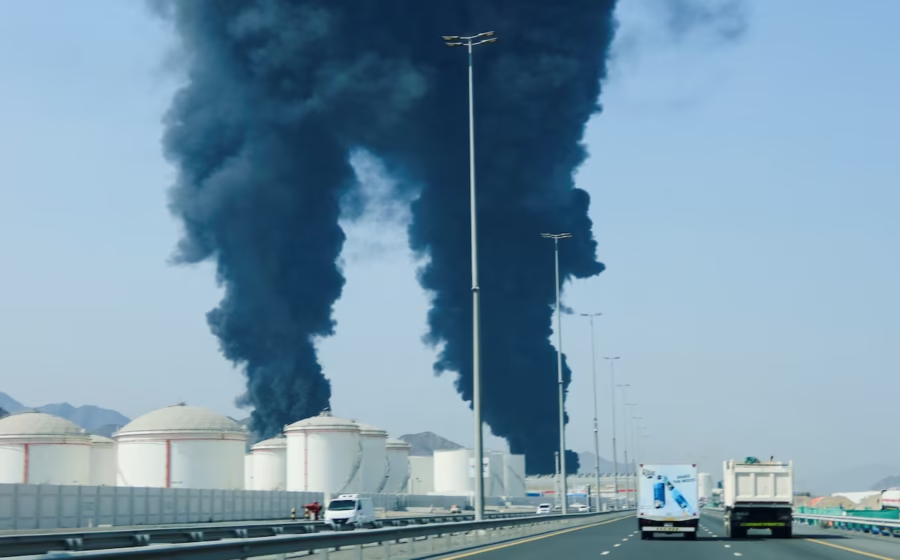


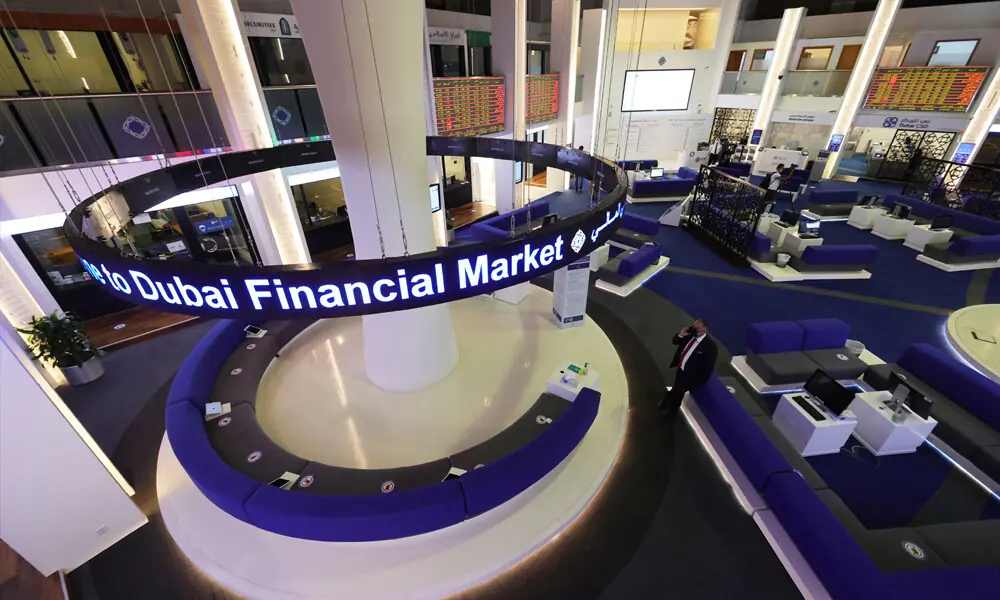
DUBAI — Most major Gulf stock markets moved lower on Wednesday as renewed regional hostilities, shipping threats near the Strait of Hormuz and fresh uncertainty over Iranian oil exports returned geopolitical risk to the centre of investor attention.
Reuters reported that the Saudi benchmark slipped 0.2 percent, Dubai fell 1 percent, Abu Dhabi lost 0.7 percent and Qatar declined 0.4 percent. Brent crude prices moved higher as markets reacted to renewed risk around shipping and energy supplies.
What changed
The market signal was not one of panic, but it was broad enough to show that investors are again pricing political risk into Gulf assets. When conflict risk touches tankers, oil exports, military facilities and sanctions at the same time, portfolio managers tend to reduce exposure to companies most sensitive to confidence and liquidity.
Dubai’s decline was linked partly to weakness in real estate and banking counters, while Abu Dhabi and Qatar also showed pressure in large-cap names. Saudi Arabia’s fall was smaller, helped by the scale of the domestic market and energy-linked resilience, but even Riyadh was not fully insulated from the regional risk premium.
Why it matters for the Gulf
For the Gulf, the equity reaction matters because listed markets are one of the fastest indicators of how investors interpret security events. A military incident may begin at sea or across a border, but it can quickly affect banks, developers, logistics companies and consumer stocks when investors start questioning growth visibility.
Higher oil prices do not automatically protect every Gulf asset. When crude rises because global demand is strong, exporters benefit in a cleaner way. When crude rises because ships are under threat and sanctions are tightening, the same price movement carries a warning about insurance costs, freight delays and investor caution.
The economic reading
The latest moves therefore need to be read as a risk-pricing event rather than a simple oil-market response. Gulf economies remain liquid and well capitalised, but their public markets are sensitive to the perception that regional confrontation could become prolonged or unpredictable.
Banks and property companies are particularly exposed to sentiment because their valuations depend on credit conditions, project confidence and foreign participation. If uncertainty persists, investors may demand higher risk premiums even from companies with stable earnings and strong domestic franchises.
What to watch next
The next indicators will be corporate earnings, the behaviour of oil prices, shipping-insurance rates and any official signs of de-escalation. Investors will also watch whether foreign funds continue to hold regional equities or reduce exposure until the security picture improves.
For now, the Gulf market reaction is measured but meaningful. It shows that regional investors have not abandoned the growth story, but they are unwilling to ignore the cost of renewed confrontation. Until shipping lanes and diplomacy stabilise, equities are likely to remain sensitive to every development around Hormuz and US-Iran tensions.
The Telegraph Middle East reading
The central question is not whether Gulf markets can absorb a single volatile session. They can. The more important issue is whether investors begin to treat regional risk as a recurring cost that must be priced into valuations. If that happens, even strong companies may trade at a discount until the diplomatic and maritime environment becomes more predictable.
That is why today’s movement deserves attention beyond the index numbers. Equity markets are acting as a transmission channel between geopolitics and the real economy. They reflect expectations about lending, property demand, consumer confidence, cross-border capital and the ability of governments to preserve stability without slowing their growth agendas.
For long-term investors, the Gulf remains supported by strong sovereign balance sheets, ambitious public investment and deep pools of domestic capital. But near-term positioning is likely to favour selectivity. Balance-sheet quality, dividend reliability, exposure to government spending and the ability to manage higher input costs will matter more than broad regional optimism.
The story will remain important because it connects policy decisions with boardroom planning. Companies operating in the Gulf increasingly need to understand not only what happened, but how it changes risk, cost, demand and the timing of investment decisions across the region.
The story will remain important because it connects policy decisions with boardroom planning. Companies operating in the Gulf increasingly need to understand not only what happened, but how it changes risk, cost, demand and the timing of investment decisions across the region.