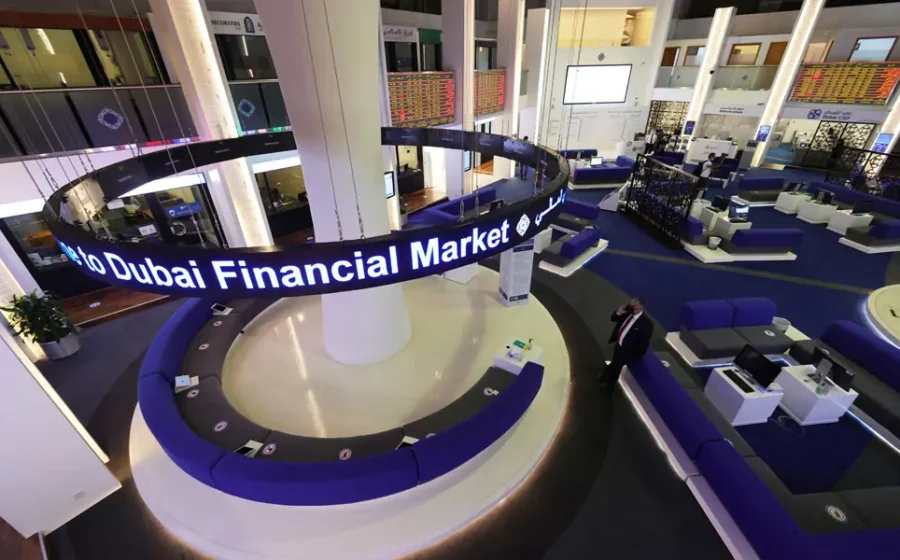


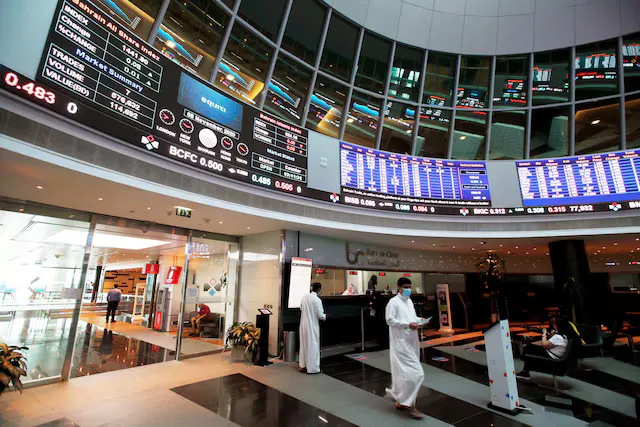
DUBAI — Saudi and Qatari shares advanced as investors reduced regional risk, while lower oil prices weighed on the energy sector.
Regional indices advance
Most Gulf stock markets moved higher after the announcement of the preliminary US-Iran framework. Reuters reported that Saudi Arabia’s benchmark gained 0.5%, while Qatar’s index rose 1%. UAE markets were closed for a public holiday.
The rally reflected lower expectations of prolonged conflict and disruption to the Strait of Hormuz.
Banks lead, energy weakens
Saudi National Bank supported the Saudi index, while Saudi Aramco fell 1.1%. The divergence illustrates how a reduction in geopolitical risk can support financial and consumer sectors while lowering the oil-price premium that benefits producers.
In Qatar, Qatar National Bank gained 1.9%, helping the broader market.
Oil price effect
Brent crude fell more than 4% during the market reaction. Lower oil can ease inflation and operating costs, but it can also reduce revenue expectations for energy companies and exporting governments.
The overall impact on Gulf equities depends on whether economic confidence and lower costs outweigh weaker crude prices.
Is the rally durable?
A single positive session does not establish a new trend. Investors will watch whether the agreement is signed, whether shipping resumes and whether regional military fronts remain quiet.
Turnover and foreign participation will help show whether the move reflects durable allocation or short-term relief.
Sector implications
Banks may benefit from improved confidence and lower credit risk. Airlines, logistics and consumer companies could gain if fuel and insurance costs fall. Petrochemical and energy businesses face a more complex mix of lower input costs and lower product prices.
The next phase will be driven by company fundamentals as well as diplomacy.
Editorial context
The first market reaction is a repricing of probability, not proof that every economic consequence has disappeared. Investors reduce the premium attached to war, disrupted shipping and higher inflation. They then reassess earnings, interest rates, government spending and the speed at which supply chains can return to normal.
What to watch
Banks, transport companies and consumer-facing businesses can benefit when geopolitical risk falls, while oil producers may lose some of the windfall associated with elevated crude prices. This produces a mixed regional picture: broader indices can rise even as energy shares weaken.
Central-bank expectations are another transmission channel. Lower oil prices can reduce future inflation pressure, but policymakers will also consider the earlier shock, government subsidies, wage behaviour and the time required to rebuild inventories. One day of market relief does not automatically translate into an immediate change in interest-rate policy.
Liquidity and foreign participation matter as much as index direction. A durable improvement would normally be accompanied by stronger turnover, narrower risk spreads and sustained buying across sectors. A short rally driven mainly by headlines can reverse if implementation is delayed.
The first market reaction is a repricing of probability, not proof that every economic consequence has disappeared. Investors reduce the premium attached to war, disrupted shipping and higher inflation. They then reassess earnings, interest rates, government spending and the speed at which supply chains can return to normal.
Banks, transport companies and consumer-facing businesses can benefit when geopolitical risk falls, while oil producers may lose some of the windfall associated with elevated crude prices. This produces a mixed regional picture: broader indices can rise even as energy shares weaken.
Central-bank expectations are another transmission channel. Lower oil prices can reduce future inflation pressure, but policymakers will also consider the earlier shock, government subsidies, wage behaviour and the time required to rebuild inventories. One day of market relief does not automatically translate into an immediate change in interest-rate policy.
Liquidity and foreign participation matter as much as index direction. A durable improvement would normally be accompanied by stronger turnover, narrower risk spreads and sustained buying across sectors. A short rally driven mainly by headlines can reverse if implementation is delayed.
The first market reaction is a repricing of probability, not proof that every economic consequence has disappeared. Investors reduce the premium attached to war, disrupted shipping and higher inflation. They then reassess earnings, interest rates, government spending and the speed at which supply chains can return to normal.
Banks, transport companies and consumer-facing businesses can benefit when geopolitical risk falls, while oil producers may lose some of the windfall associated with elevated crude prices. This produces a mixed regional picture: broader indices can rise even as energy shares weaken.
Central-bank expectations are another transmission channel. Lower oil prices can reduce future inflation pressure, but policymakers will also consider the earlier shock, government subsidies, wage behaviour and the time required to rebuild inventories. One day of market relief does not automatically translate into an immediate change in interest-rate policy.