

First-quarter growth was broadly distributed across the economy, although a sharp quarterly decline in oil activity shows that Saudi Arabia remains exposed to energy-sector volatility.
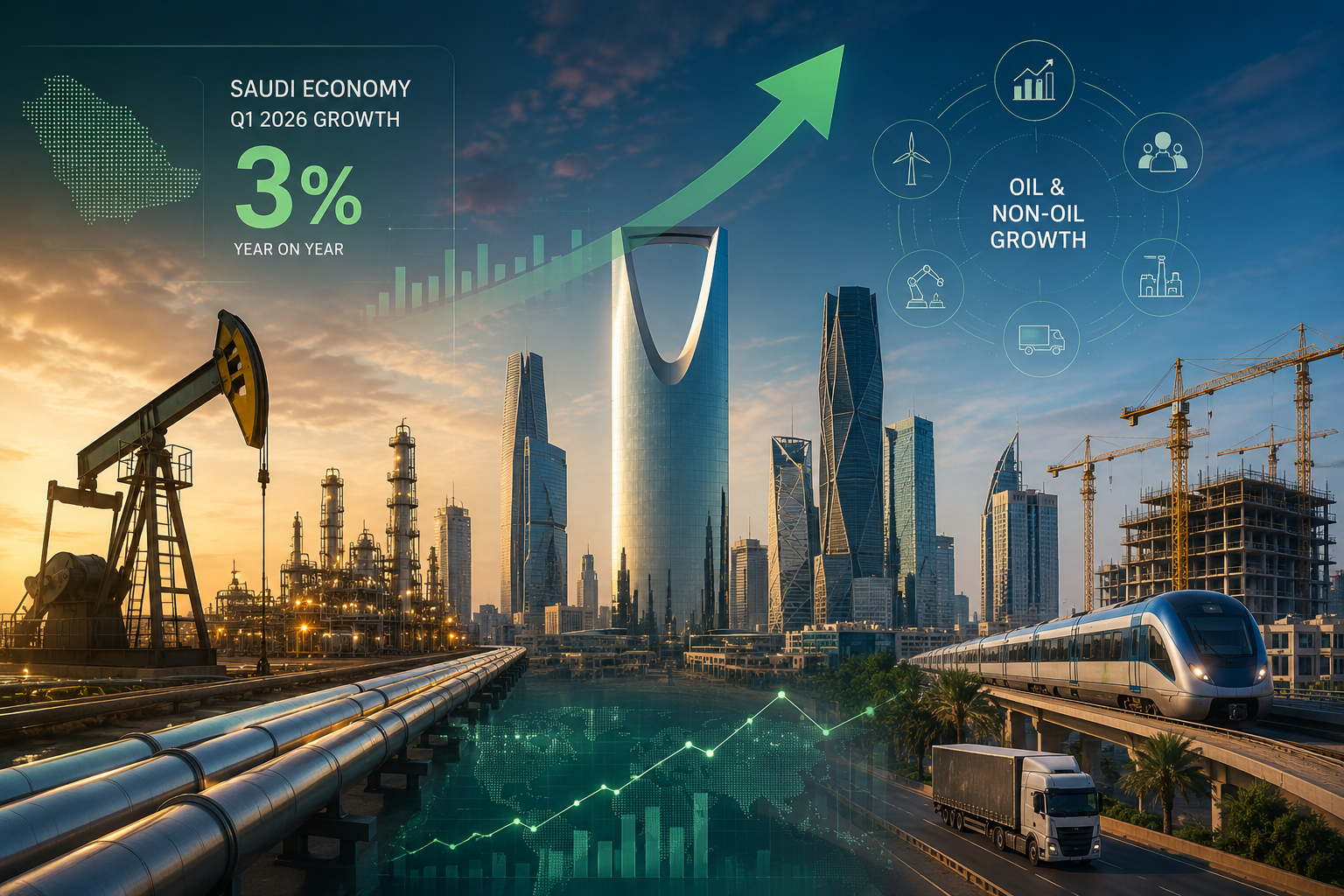
RIYADH — June 13, 2026: Saudi Arabia’s economy expanded by 3% during the first quarter of 2026, supported by simultaneous growth across oil, non-oil and government activities, according to final data released by the General Authority for Statistics.
Real gross domestic product increased by 3% compared with the same quarter of 2025. Oil and non-oil activities each grew by 2.9% year on year, while government activities advanced by 1.5%. [1]
The figures present a picture of broad-based annual growth at a time when the Kingdom is attempting to strengthen sectors beyond hydrocarbons without abandoning the economic advantages generated by its energy industry.
The composition of the expansion is particularly significant.
Non-oil activities contributed 1.7 percentage points to overall GDP growth, making them the largest source of the annual increase. Oil activities contributed 0.8 percentage points, government activities added 0.3 percentage points and net taxes on products accounted for a further 0.2 percentage points.
This means more than half of the headline growth came from non-oil industries.
However, the quarterly data provide a more cautious reading. On a seasonally adjusted basis, real GDP declined by 1.2% from the final quarter of 2025, largely because oil activity contracted sharply.
The contrast between annual expansion and quarterly contraction illustrates both the progress and the limits of Saudi Arabia’s economic transformation.
Final growth exceeds the preliminary estimate
The final 3% reading represents an upward revision from the preliminary estimate published in April, which placed first-quarter growth at 2.8%.
The earlier estimate had indicated increases of 2.8% in non-oil activities and 2.3% in oil activities. The final release raised both components to 2.9%, resulting in a stronger overall GDP figure. [2]
Revisions between preliminary and final national-accounts data are not unusual. Early estimates are produced before all sectoral, expenditure and administrative information becomes available.
The final data offer a more complete assessment of economic activity during the quarter and show that oil-sector performance was stronger on an annual basis than initially calculated.
They also confirm that the economy entered 2026 with growth distributed across all major activity groups rather than concentrated in a single sector.
Non-oil industries make the largest contribution
The most important figure for Saudi Arabia’s long-term transformation is not necessarily the 2.9% non-oil growth rate alone, but its contribution to the total expansion.
Because non-oil activities now represent a substantial share of domestic economic output, their 2.9% increase added 1.7 percentage points to GDP growth. That was more than twice the contribution made by oil activities.
This distinction matters when assessing progress under Vision 2030.
Economic diversification does not require the oil sector to disappear from national growth. Saudi Arabia remains one of the world’s most important energy producers, and hydrocarbons will continue to influence its exports, public finances and investment capacity.
The strategic objective is instead to build a broader economic base capable of generating output, employment and investment across multiple industries.
The first-quarter figures suggest that this process remains active.
Financial, insurance and business services recorded the strongest annual sectoral growth, expanding by 5.4%. Manufacturing excluding petroleum refining grew by 4%, while transport, storage and communication activities increased by 3.3%.
Other mining and quarrying grew by 3%, while community, social and personal services advanced by 2.8%.
Construction expanded by 2.3%, and wholesale and retail trade, restaurants and hotels grew by 2.2%.
The figures indicate that growth was present across finance, manufacturing, logistics, services, construction and consumer-facing industries. These are among the sectors most closely associated with Saudi Arabia’s attempts to attract private investment and create a more diverse commercial economy.
Oil supports annual growth but drives the quarterly decline
Oil activities expanded by 2.9% from the corresponding quarter of 2025, making a positive contribution to annual GDP growth.
Within the sector, crude petroleum and natural-gas activity increased by 3.6% year on year. Petroleum refining, however, recorded considerably weaker annual growth of 0.3%.
The position changed sharply when measured against the previous quarter.
Seasonally adjusted oil activity contracted by 6.8% from the fourth quarter of 2025. Crude petroleum and natural gas declined by 7%, while petroleum refining fell by 5.7%.
This contraction was the principal reason total GDP decreased by 1.2% on a quarterly basis.
Oil activities made a negative contribution of 1.6 percentage points to quarter-on-quarter GDP performance. By comparison, non-oil and government activities each contributed a positive 0.2 percentage points.
The figures demonstrate that progress in diversification has strengthened the economy’s internal balance, but has not removed its exposure to changes in oil production and energy-sector logistics.
A relatively modest increase in non-oil activity was not sufficient to offset the scale of the quarterly oil decline.
Non-oil activity remains positive from the previous quarter
Non-oil activities grew by 0.3% on a seasonally adjusted quarterly basis.
The increase was limited, but it remained positive despite wider uncertainty affecting business confidence, trade routes and regional economic conditions.
Several industries recorded stronger quarterly gains.
Manufacturing excluding petroleum refining increased by 1.4%, while electricity, gas and water activity also grew by 1.4%. Finance, insurance and business services expanded by 1.1%, as did transport, storage and communication.
Some sectors lost momentum. Construction activity declined by 1.1% from the previous quarter, wholesale and retail trade, restaurants and hotels decreased by 0.4%, and real-estate activity contracted by 0.5%.
This uneven performance suggests that the non-oil economy continued expanding but did not move forward at the same pace across every industry.
Financial and manufacturing services displayed relative strength, while parts of the property, construction and consumer economy experienced quarterly pressure.
Government spending provides substantial support
The expenditure side of the national accounts shows the scale of public-sector support during the quarter.
Government final consumption expenditure increased by 11.3% year on year and by 5.9% from the previous quarter.
Private consumption also remained positive, growing by 5.3% annually and 0.2% quarterly.
The increase in household consumption suggests that domestic demand continued to support economic activity, even as some business sectors reported weaker quarter-on-quarter performance.
Government spending, however, grew at a significantly faster rate.
This reflects the continuing role of the state in Saudi Arabia’s economic development. Public expenditure remains central to infrastructure, services and strategic transformation programmes, even as policymakers seek to expand private-sector participation.
The scale of government consumption also means that the quality and efficiency of public spending will remain important to the sustainability of future growth.
Investment rises annually but falls from the previous quarter
Gross fixed capital formation increased by 3.9% compared with the first quarter of 2025.
The annual rise points to continued investment in buildings, machinery, infrastructure and other productive assets.
On a quarterly basis, however, capital formation declined by 4.7%.
The difference suggests that investment remained above its year-earlier level but slowed meaningfully after the final quarter of 2025.
Large investment programmes can produce uneven quarterly patterns, particularly when major contracts, equipment purchases and project milestones are recorded at different stages.
Nevertheless, the quarterly decline will attract attention because capital formation is essential to the Kingdom’s diversification ambitions.
Saudi Arabia’s emerging industries require sustained investment in industrial capacity, tourism infrastructure, transport, technology, housing and public services. A prolonged slowdown in capital formation would therefore carry greater significance than a single quarterly movement.
Exports grow annually as imports decline
Exports increased by 1.4% year on year but declined by 2.2% from the previous quarter.
Imports fell by 5.5% annually and by 12.6% on a quarterly basis.
A fall in imports can improve the mathematical contribution of net trade to GDP, but it should not automatically be interpreted as an economic improvement.
Imports include machinery, vehicles, industrial inputs, technology and consumer products. A sharp decline may reflect weaker demand, logistical disruption, inventory adjustments or changes in the timing of major purchases.
The underlying composition of the decline will therefore be important when assessing its wider economic meaning.
Similarly, the annual increase in exports must be considered alongside the quarterly contraction in oil activity. Export values and export volumes can move differently depending on energy prices, production and transport conditions.
What the figures say about Vision 2030
The first-quarter results offer evidence for two conclusions that can appear contradictory but are both valid.
Saudi Arabia’s economy is becoming more diversified. Non-oil activity generated the largest contribution to annual growth, while finance, business services and non-oil manufacturing were among its fastest-growing sectors.
At the same time, oil activity remains powerful enough to determine the direction of quarterly GDP.
The 6.8% quarterly contraction in oil activities outweighed continued growth in non-oil and government sectors, pulling the overall economy into a 1.2% decline from the previous quarter.
This does not indicate that diversification has failed. It shows that structural transformation takes place gradually and that a broader non-oil base cannot immediately eliminate the economic effects of a major movement in hydrocarbon output.
The more important long-term test is whether non-oil sectors continue to expand, generate private investment and become less dependent on government expenditure.
A resilient annual picture with near-term caution
Saudi Arabia’s 3% annual growth rate demonstrates resilience across a difficult opening quarter.
Oil and non-oil activities moved forward together compared with the previous year, while government expenditure and private consumption provided additional support.
The internal composition of growth was also encouraging for diversification. Non-oil industries accounted for the largest share of the expansion, with financial services and manufacturing recording particularly strong annual performances.
Yet the quarter-on-quarter decline prevents an entirely optimistic reading.
Falling oil activity, weaker capital formation and declines in selected construction, real-estate and consumer-facing industries show that momentum was not uniform.
The outlook for the remainder of 2026 will depend on whether oil production stabilises, non-oil private-sector demand strengthens and investment maintains sufficient momentum to support the Kingdom’s major transformation programmes.
For now, the first-quarter data reveal an economy that is broader than it once was, but still deeply influenced by the sector that financed its rise.