

Israeli settlers used a bulldozer to damage the foundations of two Palestinian homes in the occupied West Bank, intensifying a months-long dispute over a displaced family’s right to return to its properties despite an Israeli court ruling.
The incident took place at around 1am on Thursday, 26 November, in the village of Jaloud, near Nablus. Security-camera footage reviewed by Reuters showed settlers bringing a bulldozer to two two-storey houses belonging to the Tubasi family and damaging the buildings for approximately an hour.
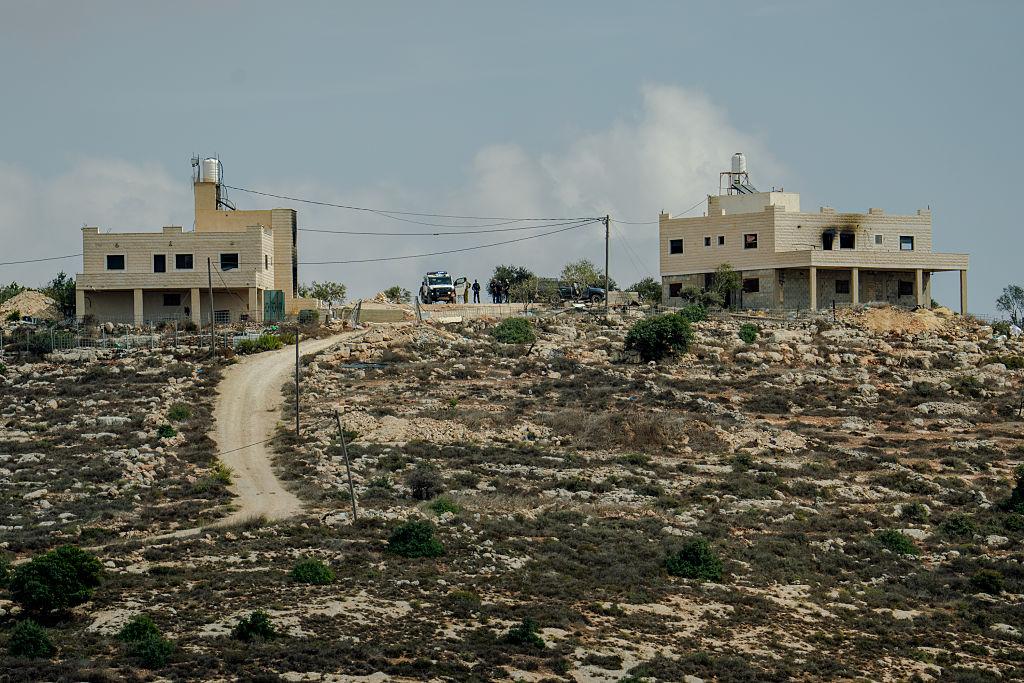
Reuters journalists who visited the location later that day confirmed that sections of the concrete foundations had been broken. The damage followed months of reported harassment, threats, property destruction and restrictions on the family’s access to its homes.
The Israel Defense Forces (IDF) condemned the latest incident, describing it as a serious criminal act involving deliberate property damage. It said an investigation was under way and that security forces were working to seize the engineering vehicle used in the demolition.
The incident has renewed scrutiny of settler violence in the West Bank, the enforcement of Israeli court decisions and the protection of Palestinian residents living near settlement outposts.
Bulldozer damages two homes in Jaloud
The two properties are located on a hilltop in Jaloud, with each house standing on one side of a local road.
Security-camera footage reviewed by Reuters showed a bulldozer arriving at approximately 1am on Thursday. The vehicle remained at the location for around an hour while the buildings were damaged.
Reuters reporters subsequently inspected the properties and found that portions of their concrete foundations had been broken.
The homes belong to the Tubasi family, whose members had been unable to return to the properties for several months after repeated confrontations with Israeli settlers.
Wael Tubasi, one of the homeowners, said the latest damage appeared intended to prevent the family from returning permanently.
He said settlers continued to occupy or move around the properties while the family remained displaced in another part of the village.
Ghiath Nasser, the lawyer representing the homeowners, blamed the incident on inadequate law enforcement and what he described as a sense of impunity among those responsible for attacks against Palestinians.
The latest damage was particularly significant because it occurred after legal proceedings intended to establish conditions for the family’s return.
A family displaced after months of harassment
The dispute surrounding the Tubasi properties began in April 2026, according to the family.
They said settlers established a tent close to their homes before beginning a campaign of harassment. The alleged incidents included attacks on family members, damage to property, cutting water and electricity connections and blocking roads leading to the houses.
The family also said settlers set fire to the properties and threatened residents, warning them that they had an hour to leave or face violence.
Aedah Tubasi, a member of the family, recalled that the threats included a reference to the Dawabsheh family, whose house was set on fire by Israeli settlers in 2015 in the West Bank village of Duma.
That attack killed an 18-month-old child, Ali Dawabsheh, and his parents, Saad and Riham. The incident became one of the most prominent examples of lethal settler violence against Palestinian civilians.
The Tubasi family eventually left their homes and moved into a smaller property within Jaloud.
Their displacement did not end the dispute. Family members told Reuters that settlers continued moving around the original properties, while they watched the houses from their temporary accommodation.
The family said the loss of access to water, electricity and surrounding roads made returning increasingly difficult.
September court-backed return fails after settler confrontation
The family’s attempt to return became possible in September after an Israeli court ruling required the state to ensure conditions for their return.
The Israeli military subsequently escorted family members back to the properties.
However, the return lasted only a short time.
According to the family, approximately 200 settlers arrived around 10 minutes after they reached the houses and attacked the group. The confrontation forced both the family and the soldiers accompanying them to retreat.
Family members said settlers subsequently set fire to the buildings and damaged furniture, doors, windows and other belongings.
The properties remained unoccupied after the confrontation.
The September incident raised questions about the state’s ability to enforce the court’s decision and protect residents attempting to exercise their legal rights.
A court ruling does not automatically resolve a security dispute if the authorities cannot ensure that the affected family can safely return.
The November bulldozer incident has now added another layer of damage to the properties and further complicated the prospect of restoring the family’s access.
Wael Tubasi said the family continued to face restrictions while settlers remained in the vicinity of their homes.
Israeli military condemns latest attack
The Israel Defense Forces confirmed that troops were sent to Jaloud on Thursday after receiving reports and reviewing footage showing suspects using a civilian engineering vehicle to damage a structure.
The military described the incident as a serious criminal act involving deliberate property damage.
It also said that a command-level inquiry had been opened and that senior military officials, including Chief of Staff Lieutenant General Eyal Zamir, had been briefed.
The military stated that security forces were working with the Civil Administration to confiscate the engineering vehicle and bring those responsible to justice.
It further said that a closed military-zone order was in effect in the area, meaning settlers were not permitted to enter. According to the military, the settlers dispersed after troops arrived.
However, Reuters reporters said settlers were still visible in the surrounding area during their visit on Thursday.
The military’s condemnation marks an official acknowledgement of the seriousness of the incident. Nevertheless, the investigation had not resulted in publicly announced arrests or prosecutions by 27 November.
The case will therefore be closely watched by the family, rights organisations and other residents concerned about the enforcement of restrictions on settler activity.
West Bank settler violence continues to rise
The attack in Jaloud comes amid a wider increase in settler violence across the occupied West Bank.
According to the United Nations Office for the Coordination of Humanitarian Affairs (OCHA), an average of 53 settler attacks per week resulting in Palestinian casualties or property damage have been recorded in 2026.
OCHA reported that 55 such attacks took place between 17 and 23 November alone, affecting 46 Palestinian communities.
The incidents have included physical assaults, damage to homes, destruction of agricultural property, vehicle arson, attacks on livestock and damage to essential infrastructure.
The impact extends beyond immediate physical injuries.
Repeated attacks and restrictions on movement can prevent families from reaching their homes, farms, schools, workplaces and essential services. In some communities, disruptions to electricity and water supplies have created additional humanitarian difficulties.
The United Nations has repeatedly warned that settler violence and associated restrictions are contributing to displacement and worsening living conditions for Palestinians.
The Tubasi family’s experience reflects several of these problems: repeated intimidation, destruction of residential property, disrupted utilities and an inability to return despite legal intervention.
Accountability remains a central concern
The investigation into the Jaloud incident has renewed attention on whether perpetrators of settler violence are consistently held accountable.
Ghiath Nasser, the family’s lawyer, argued that inadequate enforcement had contributed to the latest escalation.
Israeli human rights organisation Yesh Din has also documented low prosecution rates in cases involving settler violence.
According to figures cited by Reuters, 93.6 per cent of investigations into such incidents are closed without indictments.
These figures have strengthened criticism from Palestinian rights advocates and international organisations, which argue that weak enforcement encourages further attacks.
The Israeli military has rejected the idea that such criminal conduct is acceptable. Its latest statement acknowledged the damage caused in Jaloud and promised to pursue those responsible.
The outcome of the investigation will therefore be important in assessing whether the military’s public condemnation is followed by concrete enforcement measures.
For the Tubasi family, the immediate concern is not only the investigation but also the ability to return safely to their properties.
The existence of a legal ruling has provided them with a basis for claiming their rights. However, the repeated destruction and continued presence of settlers around the houses demonstrate how difficult it can be to translate a judicial decision into security on the ground.
The wider legal dispute over West Bank settlements
The Jaloud incident also forms part of a broader dispute concerning Israeli settlements and outposts in the occupied West Bank.
Israel captured the West Bank during the 1967 Middle East war and has since established hundreds of settlements and outposts across the territory.
Most countries and United Nations bodies consider Israeli settlements in occupied Palestinian territory illegal under international law. Israel disputes this interpretation, arguing that the territory’s legal status is contested and that historical and security considerations must also be considered.
The international legal debate has intensified in recent years as settlement expansion and land disputes have contributed to tensions between Israeli settlers and Palestinian communities.
In many areas, Palestinian residents face restrictions on movement and access to agricultural land, while the expansion of settlement infrastructure has increased pressure on neighbouring villages.
The dispute in Jaloud illustrates how these broader political and legal issues can affect individual households.
For the Tubasi family, the central issue is straightforward: they want to return to their homes and live without threats, attacks or restrictions.
Other incidents reported across the West Bank
The Jaloud bulldozer attack was not the only incident reported on Thursday.
Israeli media reported that settlers gathered around a Palestinian resident’s home in the village of Umm Safa, although no injuries or direct confrontations were reported.
Palestinian media also published footage showing two masked individuals setting fire to a Palestinian-owned vehicle in Beita, south of Nablus.
The Israeli military separately acknowledged the presence of violent individuals operating from nearby unauthorised outposts in the Jaloud area.
These incidents have contributed to wider concerns about the security of Palestinian communities, particularly during a period when attacks against residential properties and agricultural assets have remained frequent.
They also place pressure on Israeli authorities to ensure that security forces respond consistently to violence, regardless of whether those involved are Palestinian or Israeli civilians.
What happens next?
The immediate priority is the investigation into the bulldozer attack and the recovery of the equipment used to damage the properties.
The Israeli military has said that it intends to confiscate the engineering vehicle and identify those responsible.
The Tubasi family’s legal representatives are also likely to continue pressing authorities to enforce the court ruling and guarantee safe access to the homes.
However, the family faces a difficult situation. The houses have suffered repeated damage, their foundations have now been partially broken and settlers have continued to appear in the surrounding area.
A meaningful resolution will require more than another public statement. It will depend on whether the family can return safely and whether those responsible for the property damage are held accountable through the legal process.
For residents of Jaloud and other Palestinian villages, the case also highlights the importance of consistent enforcement of court decisions and protection against intimidation.
The attack has renewed a wider question facing the occupied West Bank: whether legal protections for Palestinian homeowners can be enforced effectively when settlement-related violence prevents them from accessing their own properties.
Until that question is resolved, the Tubasi family remains displaced, despite having obtained a court ruling intended to make their return possible.