

An Israeli air strike on Nasser Hospital in southern Gaza has killed at least six people, including a surgeon and a 13-year-old patient, and damaged parts of one of the territory’s few remaining functioning medical facilities.
The strike hit the hospital’s surgical wing in Khan Younis shortly after midnight on Thursday, 12 November, according to Palestinian health authorities and reports from the scene. Gaza’s Health Ministry identified surgeon Dr Rizk Abu Shaira among those killed. The Israeli military said it had targeted a senior Hamas figure and other members of the group’s armed wing, alleging that they were operating from within the hospital complex.
The number of people injured was reported differently by the agencies covering the aftermath. Gaza Civil Defence spokesman Mahmoud Basal told Reuters that 20 people had been wounded. An Associated Press report, citing Gaza’s Health Ministry, put the figure at at least 28. The six reported deaths were confirmed by the health authorities.
The attack has renewed attention on the vulnerability of medical facilities in Gaza, where hospitals have been operating under severe pressure after years of conflict, damage to infrastructure and shortages of essential supplies.
Surgical department hit in overnight attack
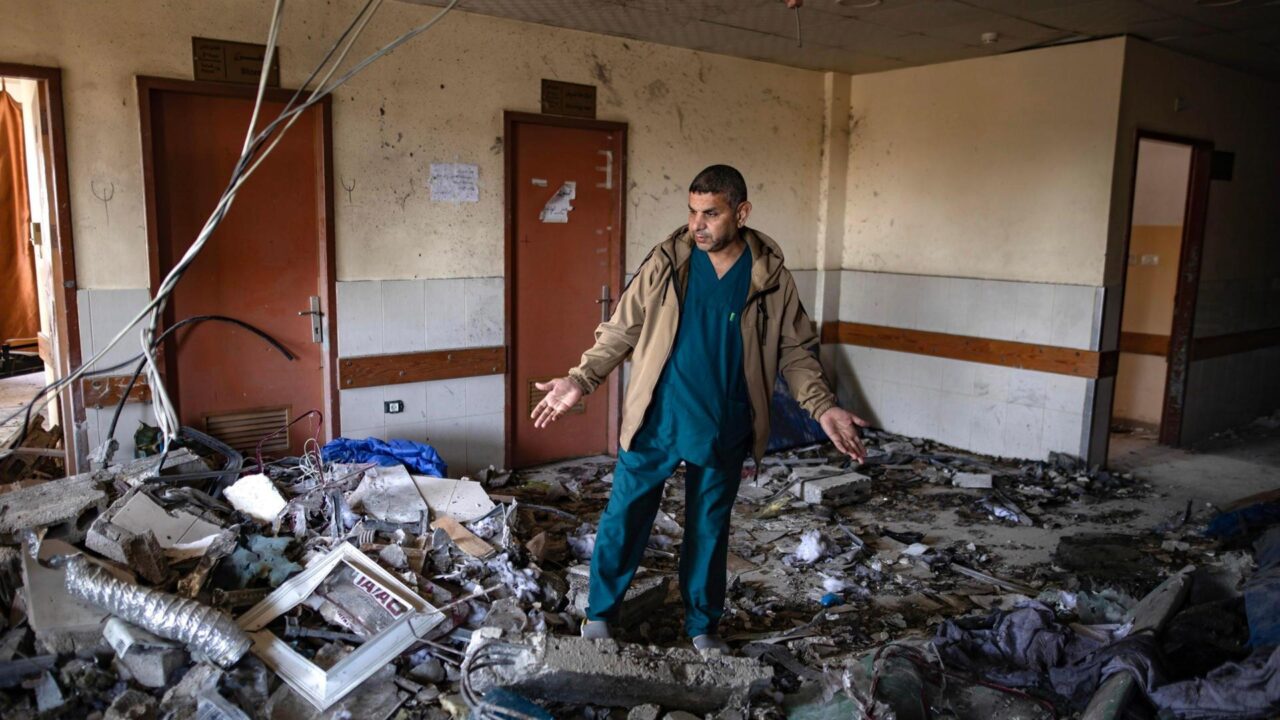
The Israeli strike struck a building housing the hospital’s surgical department, causing extensive damage to rooms and medical equipment. Images and video from inside the complex showed debris scattered across corridors, damaged ceilings and hospital furniture displaced by the blast.
Emergency workers and medical personnel were seen moving through the damaged areas as patients were carried on stretchers. The destruction affected parts of the surgical wing, including areas used for patient recovery and treatment.
The dead included Dr Abu Shaira, a general surgeon who had been working at the hospital. British surgeon Goher Rahbour, who was volunteering at Nasser Hospital, told the Associated Press that he had worked alongside Abu Shaira only hours before the strike. Rahbour described his colleague as a “lovely guy, happy and smiling”.
The Gaza Health Ministry also identified a 13-year-old patient among those killed. The presence of patients and medical staff in the affected building has intensified concerns about the consequences of attacks on healthcare facilities that continue to serve civilians despite the damage inflicted on Gaza’s health system.
Hospital director Ahmed al-Farra told the Associated Press that no warning had been received before the attack. He said work had been suspended in the surgical department, radiology unit and laboratory because of the damage.
The disruption is significant for patients requiring specialist treatment. Nasser is among the few hospitals in Gaza that remain operational, and its facilities have been important for people in the southern part of the territory. Damage to surgical services may leave patients with fewer options for emergency operations and other specialised care.
Israel says it targeted Hamas figures
The Israeli military said the strike was aimed at a senior Hamas militant and other members of the group’s armed wing. It alleged that Hamas had established a presence inside the hospital complex and was using it as a command centre for military activities.
In its account, the military said the site was being used for activities including weapons storage, command-and-control operations, observation posts and shelter for fighters. It said the operation was intended to eliminate the threat posed by the individuals it had identified.
The Associated Press reported that the Israeli military did not provide evidence for its claims. The named commander was not among the six people reported killed. Reuters also said it could not independently verify the Israeli military’s allegations about the use of the hospital.
The distinction is important. Israel’s stated military rationale remains an allegation by a party to the conflict; it has not been independently established by the reporting available so far. The hospital’s director, meanwhile, said the facility had received no warning before the strike, a claim that differs from the military’s broader account of steps it said were taken to reduce civilian harm.
Hamas condemned the attack, describing it as a war crime and accusing Israel of using claims about militant activity to justify strikes on civilian medical infrastructure. That characterisation is also an allegation and has not been established through an independent legal finding.
Medical services face further disruption
The immediate damage at Nasser Hospital comes amid a wider breakdown in Gaza’s healthcare system. Hospitals and clinics across the territory have faced repeated damage, shortages of medicines and equipment, reduced staffing and difficulties treating patients with complex injuries.
A joint assessment by the United Nations, World Bank and European Union cited by the Associated Press in April reported that more than 1,800 medical facilities in Gaza had been partially or completely destroyed since the conflict began. Nasser Hospital’s continued operation has therefore carried particular importance for patients who have limited access to alternative treatment.
Al-Farra warned that the suspension of surgical work, radiology and laboratory services would affect patients already dependent on the hospital. The loss of specialist capacity is especially consequential for people who cannot readily travel elsewhere for treatment.
The latest strike also comes after previous attacks on the same hospital complex. In August 2025, an Israeli strike at Nasser Hospital killed 22 Palestinians, including five journalists, according to previous reporting by international news organisations. The incident prompted widespread criticism and renewed scrutiny of the protection afforded to journalists and medical facilities during the conflict.
Hospitals remain protected under international law
Hospitals and medical personnel are afforded specific protection under international humanitarian law. The International Committee of the Red Cross says medical facilities must be respected and protected while carrying out their humanitarian functions.
That protection can cease in limited circumstances if a facility is used, outside its medical role, to commit acts harmful to an opposing force. The ICRC also stresses that a warning must be given before a medical facility loses its protected status, with a reasonable time limit where appropriate. Even where protection has ceased, parties remain bound by the requirements of proportionality and precautions to minimise harm to patients and medical staff.
The legal position therefore depends on the facts of the specific incident, including the nature of any alleged military use, the information available to the attacking force, the warning provided and the steps taken to protect civilians. The Israeli military’s allegation that Hamas used the hospital as a command centre has not been independently verified in the reporting available so far.
The strike has taken place despite a ceasefire that came into effect in October 2025. Gaza health authorities say that more than 1,600 Palestinians have been killed in Israeli attacks since the agreement began. The Associated Press reported that the cumulative figure had reached 1,622 by 12 November, citing local health authorities. Israel has continued to say that Hamas is attempting to regroup and rebuild its military capabilities, while Hamas says it remains committed to the ceasefire and accuses Israel of undermining it.
Questions remain over the strike and hospital’s capacity
The immediate priority at Nasser Hospital is the treatment of those wounded and the restoration of services affected by the damage. The number of patients requiring care, the extent of the disruption to specialist departments and the hospital’s ability to resume operations remain central concerns.
Further independent information is also needed to establish the circumstances behind the Israeli military’s stated target and its allegation that Hamas was using the hospital complex for military purposes. The available reporting confirms the deaths, damage to the surgical wing and disruption to medical services, but does not independently substantiate the military’s claims.
For patients in southern Gaza, the consequences extend beyond the immediate casualties. Damage to an already strained hospital reduces the capacity to provide care to people who may have few alternatives. As the ceasefire remains under pressure, the attack has again raised questions about how medical facilities can be protected and how essential healthcare can be maintained during the conflict.