

Riyadh’s decision offers Lebanese producers renewed access to a historically important Gulf market while signalling greater Saudi confidence in Beirut’s efforts to strengthen state institutions and control smuggling.
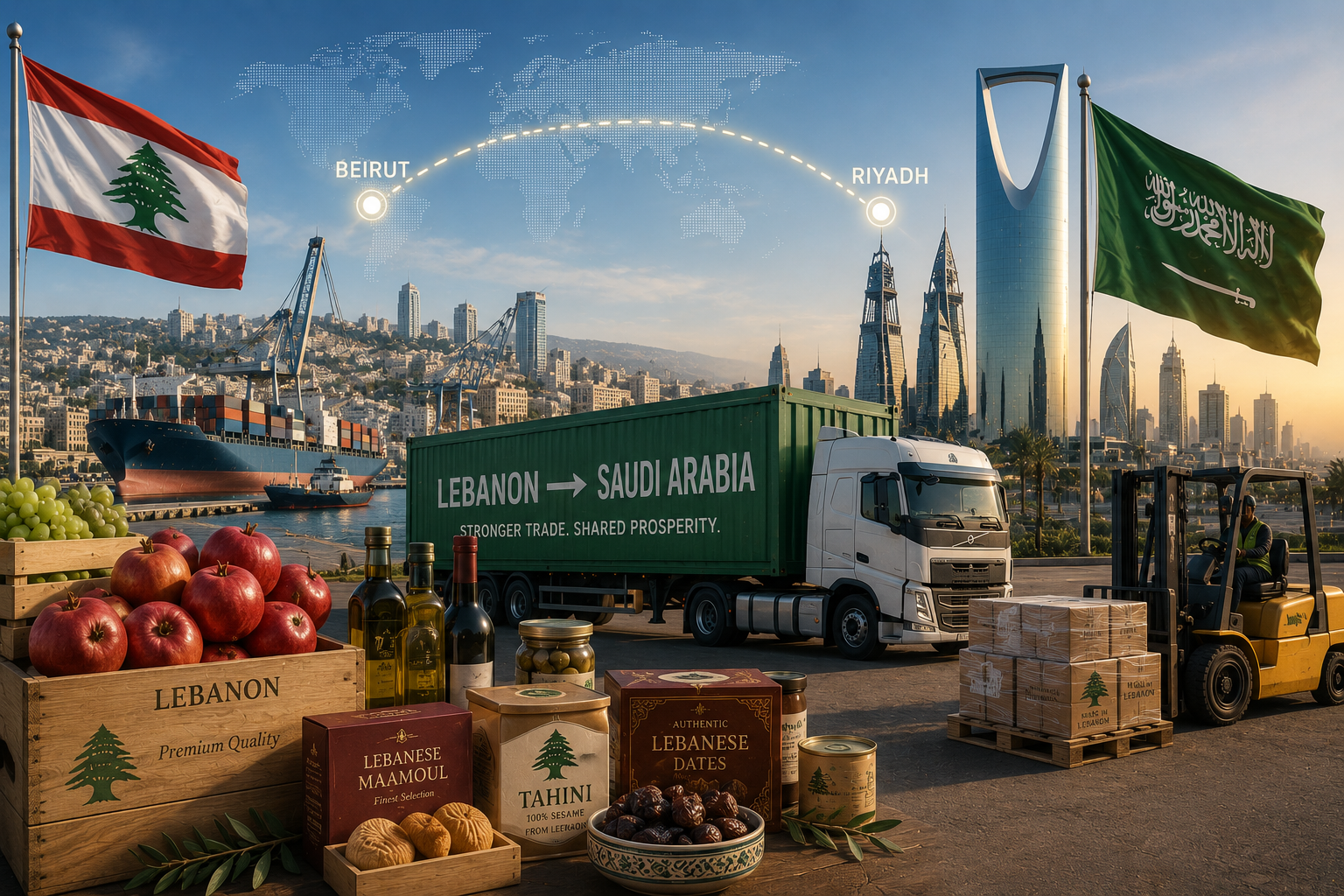
RIYADH — June 13, 2026: Saudi Arabia has reopened its market to Lebanese exports, ending restrictions that had disrupted trade between the two countries for nearly five years and placed additional pressure on Lebanon’s already weakened productive economy.
Crown Prince and Prime Minister Mohammed bin Salman directed the resumption of Lebanese exports to the Kingdom on June 10 following requests from Lebanese President Joseph Aoun and Prime Minister Nawaf Salam.
The Saudi Press Agency said the decision recognised “positive steps” taken by the Lebanese government towards rebuilding state institutions.
For Lebanese farmers, manufacturers and food producers, the reopening restores access to one of the country’s most commercially important Arab markets. It also marks a significant diplomatic development in relations between Riyadh and Beirut after years of tension shaped by narcotics smuggling, regional rivalry and concerns over the authority of the Lebanese state.
The immediate economic opportunity is substantial, but recovery will not be automatic.
Exporters will still need to satisfy Saudi customs, health, safety and origin requirements. Lebanese authorities will also be expected to demonstrate that improvements in border enforcement and anti-smuggling operations can be sustained.
The decision therefore represents both an opening and a test.
From pomegranate shipments to a nationwide restriction
Saudi Arabia first suspended imports of Lebanese fruits and vegetables in April 2021 after customs authorities intercepted more than five million Captagon pills concealed in a shipment of pomegranates.
The restriction also covered the transit of Lebanese agricultural produce through Saudi territory.
At the time, Riyadh said Lebanese authorities had failed to provide sufficient guarantees that exports would not be used as a channel for narcotics trafficking.
The dispute subsequently expanded beyond agriculture.
Later in 2021, Saudi Arabia prohibited Lebanese imports more broadly amid a diplomatic crisis involving comments made by Lebanon’s then-information minister, George Kordahi, about the Saudi-led military campaign in Yemen.
The controversy intensified existing Saudi concerns over the influence of Iran-backed Hezbollah in Lebanon’s political and security institutions.
What began as a customs and narcotics-enforcement measure consequently became part of a wider political rupture.
For Lebanese businesses, the result was the loss of a valuable export destination at a time when the country was already confronting financial collapse, currency depreciation, weakened consumer demand and restricted access to bank deposits.
Why the Saudi market matters
Before the restrictions, Saudi Arabia was among Lebanon’s most important export markets.
Lebanese exports to the Kingdom were valued at approximately $240 million in 2020, according to figures cited by Reuters. Separate analysis of Lebanese customs data placed the value close to $230 million and showed that Saudi Arabia accounted for around 5.6% of Lebanon’s worldwide goods exports that year.
The commercial relationship extended considerably beyond fresh produce.
Lebanese companies supplied the Saudi market with prepared foodstuffs, beverages, cosmetics, chemicals, machinery, printed material, jewellery and other manufactured products.
Saudi Arabia was especially important for selected industries whose exports depended heavily on access to Gulf consumers.
Food products represented a large share of the trade. Lebanese chocolate, confectionery, fruit preparations, beverages and specialised agricultural goods had established demand among Saudi consumers and within the Kingdom’s hospitality and retail sectors.
The restrictions therefore affected businesses far beyond the farming community.
Manufacturers lost established distributors. Exporters had to redirect goods to smaller or less profitable markets. Some companies faced higher transport and compliance costs when attempting to maintain access to the wider Gulf.
Saudi Arabia had also functioned as an important commercial gateway into the region. Losing that access weakened the position of Lebanese products across interconnected Gulf distribution networks.
Relief for producers, but not an instant recovery
The reopening offers an opportunity to rebuild those connections.
Lebanese agricultural producers may benefit from renewed demand for fruit, vegetables and food products. Manufacturers could return to relationships with Saudi importers, retailers and hospitality companies.
The decision may also improve confidence among Lebanese businesses that had postponed investment because of uncertainty over their access to Gulf markets.
However, the economic effect should not be overstated.
Trade volumes are unlikely to return immediately to their pre-ban level. Commercial relationships that remained inactive for five years will need to be reconstructed. Importers may have replaced Lebanese suppliers with producers from other countries, while some Lebanese companies may no longer possess the working capital or production capacity required to serve large foreign orders.
Lebanon’s banking crisis remains another constraint.
Exporters need access to trade finance, reliable payments, insurance and credit facilities. A market may be formally open while companies remain unable to finance production or guarantee delivery.
Transport conditions and regional security can also affect the movement of goods. Lebanese exporters depend on functioning ports, roads and border crossings, while importers require predictable delivery schedules.
The Saudi decision removes a major political barrier, but it cannot by itself resolve Lebanon’s broader economic and institutional difficulties.
Security controls will shape implementation
The durability of the reopening will depend heavily on enforcement.
Captagon trafficking was central to the original Saudi decision. The stimulant had been concealed in agricultural products, industrial materials and consumer goods moving through regional supply chains.
Saudi authorities viewed the repeated seizures not simply as isolated crimes but as evidence of a wider failure to secure exports originating in or passing through Lebanon.
Lebanese authorities will therefore be expected to maintain stronger inspection procedures at ports, airports and land borders.
Export documentation, container controls, cargo scanning and cooperation between customs, security services and importing countries will become essential to sustaining confidence.
The Lebanese government must also ensure that legitimate producers are protected from criminal networks seeking to exploit commercial shipments.
A renewed smuggling incident involving Lebanese exports could damage the credibility of the entire sector, even where the exporter had no connection to the prohibited goods.
Industry associations and chambers of commerce may consequently need to work with authorities on traceability systems, verified supply chains and clearer certification.
For Saudi Arabia, reopening the market does not imply weaker enforcement. It indicates that Riyadh presently considers Lebanon’s progress sufficient to permit trade to resume under continued regulatory supervision.
A diplomatic signal from Riyadh
The decision carries significance beyond its direct economic value.
Saudi Arabia was historically one of Lebanon’s most influential Arab partners, providing political support, investment, tourism and financial assistance.
Relations deteriorated as Riyadh became increasingly concerned that Lebanese institutions could not act independently of Hezbollah and that the country’s territory and commercial systems were being used in ways that threatened Gulf security.
The election of Joseph Aoun as president and the appointment of Nawaf Salam as prime minister in January 2025 created an opening for renewed engagement.
Both leaders have emphasised the authority of the Lebanese state, institutional reform and stronger relations with Arab countries.
Saudi Foreign Minister Prince Faisal bin Farhan visited Beirut in January 2025, the first such visit by the Kingdom’s foreign minister in approximately 15 years. His message was supportive but conditional: meaningful external assistance would depend on genuine Lebanese reform.
By November 2025, a senior Saudi official said Riyadh was preparing to strengthen commercial ties after Lebanese authorities demonstrated greater effectiveness in limiting drug smuggling to the Kingdom.
The June 2026 reopening can therefore be understood as the result of a gradual process rather than an isolated gesture.
Riyadh is rewarding what it considers constructive steps while preserving leverage over future cooperation.
State authority remains the central question
Saudi Arabia’s reference to rebuilding Lebanese state institutions is particularly important.
The relationship between Riyadh and Beirut has never been limited to bilateral trade. It has been shaped by a larger question: whether the Lebanese state can exercise authority over borders, security decisions and armed groups operating within its territory.
The reopening suggests that Saudi leaders recognise progress, but it does not mean those concerns have disappeared.
Lebanon continues to face the challenge of restoring confidence in institutions damaged by political division, financial collapse and prolonged conflict.
Its government must demonstrate that customs enforcement can operate consistently, that judicial and regulatory bodies can function, and that economic reform can progress beyond public commitments.
For Saudi Arabia and other potential partners, reliable institutions are necessary not only for political stability but also for trade and investment.
Companies are more likely to enter long-term agreements when contracts can be enforced, payments can move through functioning banks and goods can cross borders without unpredictable disruption.
The import decision therefore provides Lebanon with an economic opportunity tied directly to institutional performance.
Could other Gulf markets follow?
Saudi Arabia’s reopening may influence how other Gulf countries assess commercial engagement with Lebanon.
The Kingdom is the region’s largest economy and often plays a central role in shaping Gulf policy towards Beirut. Its decision may encourage greater confidence among businesses elsewhere in the Gulf.
However, each country maintains its own customs, security and foreign-policy considerations.
It would therefore be premature to assume that Saudi Arabia’s decision will automatically produce equivalent measures across every GCC market.
What it does provide is a positive signal.
Lebanese exporters can point to the reopening as evidence that improvements in enforcement and state cooperation are being recognised by a major regional partner.
A sustained record of secure shipments could gradually support wider commercial normalisation.
Producers must now rebuild the market
Lebanese businesses will need to treat the reopening as a competitive opportunity rather than a guaranteed return to their former position.
Saudi Arabia’s retail and consumer markets have changed considerably since 2021.
International food brands have expanded, local production has grown and importers have developed alternative supply relationships. Saudi consumers also have greater access to premium products through supermarkets, hospitality groups and digital commerce.
Lebanese companies will need to compete on quality, price, packaging, reliability and regulatory compliance.
The reputation of Lebanese cuisine and agricultural products provides a strong starting point, particularly in premium food, beverages, confectionery and hospitality supply.
But reputation alone will not be sufficient.
Exporters will need Saudi distribution partners, updated product registrations, Arabic labelling, efficient logistics and the ability to fulfil orders consistently.
The most successful companies may be those that view Saudi Arabia not merely as a destination for occasional shipments but as a market requiring long-term local relationships.
A meaningful opening with conditions attached
Saudi Arabia’s decision is one of the most tangible signs of improving relations between Riyadh and Lebanon in recent years.
It provides relief to producers who lost access to a major market and creates a path towards restoring broader commercial ties.
For Lebanon, the move arrives at a moment when export earnings, productive employment and foreign currency are urgently needed.
For Saudi Arabia, it demonstrates a willingness to support Lebanese institutions when measurable progress aligns with the Kingdom’s security and political priorities.
Yet the reopening is not a declaration that every underlying dispute has been resolved.
Its success will depend on secure supply chains, functioning institutions, continued anti-smuggling cooperation and the ability of Lebanese companies to rebuild commercial trust.
The ban ended through a political decision. A durable trade recovery will have to be earned through performance.