

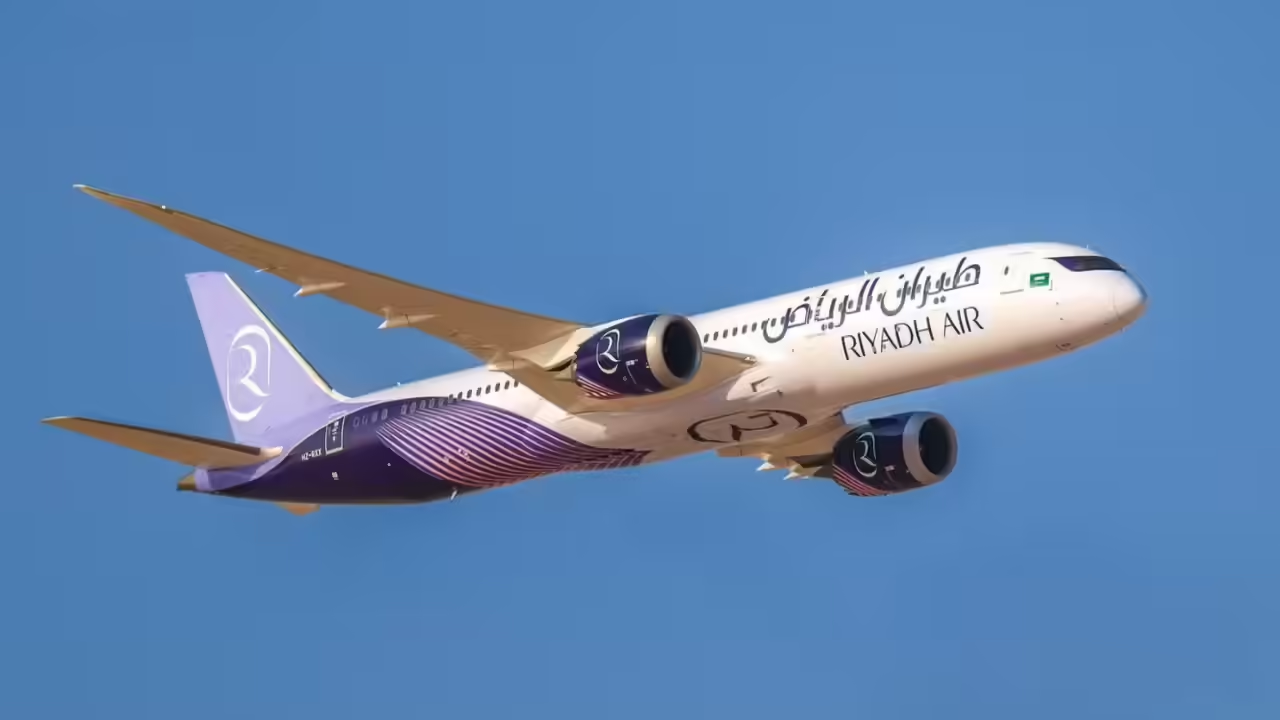
The arrival of Riyadh Air’s new Boeing 787 service at Heathrow moves the Kingdom’s aviation ambitions from planning into visible international competition.
RIYADH — June 13, 2026: Riyadh Air’s latest flight to London Heathrow represents more than the opening of another air connection between Saudi Arabia and the United Kingdom.
It marks the point at which one of the Kingdom’s most closely watched national projects begins moving from brand-building and operational preparation towards full-scale international airline operations.
The Public Investment Fund-owned carrier completed its first London flight using its new Boeing 787 Dreamliner fleet on June 10. The milestone came ahead of the wider public service that Riyadh Air had previously announced for July, when its signature aircraft, cabins and passenger experience are expected to become available on the established Riyadh–London route.
The airline has operated daily flights to Heathrow Terminal 4 since October 26, 2025, using “Jamila”, a Boeing 787 leased as a technical spare and training aircraft. Those initial services were part of what Riyadh Air called its “Pathway to Perfect” programme and were available primarily through approved travel partners and to selected passenger groups.
The arrival of the airline’s own production aircraft therefore represents the beginning of a different phase.
Riyadh Air is no longer only testing systems, training crews and introducing its brand. It is preparing to compete for international passengers on one of the world’s most prominent aviation corridors.
Why London matters
London was a deliberate choice for Riyadh Air’s early international expansion.
The route connects two G20 capitals and links Saudi Arabia’s rapidly expanding commercial centre with one of the world’s leading financial, diplomatic and cultural hubs.
Demand between the two cities is supported by business travel, government relations, tourism, education, investment and family connections. London also provides significant global visibility for a carrier seeking to establish itself as a premium international airline.
For Riyadh Air, Heathrow offers more than point-to-point passenger traffic.
A successful presence at the airport can strengthen the carrier’s credibility with corporate travel managers, international partners and premium passengers. It also gives the airline access to a market in which service reputation, schedule reliability and brand recognition carry considerable commercial value.
The route is expected to support Riyadh’s development as an international connecting hub. As the airline adds more destinations, passengers arriving from London could transfer through the Saudi capital to cities across the Middle East, Africa, Asia and the Indian subcontinent.
That connecting model will be essential to Riyadh Air’s long-term scale.
Saudi domestic demand is substantial, but an airline aspiring to serve more than 100 destinations will also need to attract travellers who may not begin or end their journeys in the Kingdom.
A new fleet enters service
The Boeing 787-9 Dreamliner is central to Riyadh Air’s early international strategy.
Its long-range capability allows the carrier to connect Riyadh with major destinations across Europe, Asia and North America. The aircraft is also designed to offer lower fuel consumption than older generations of comparable wide-body jets, an important consideration as airlines face volatile fuel prices and growing pressure to improve operational efficiency.
Riyadh Air has presented its passenger experience as a combination of digital technology, premium design and Saudi hospitality.
The introduction of the new aircraft allows the airline to move beyond concept images and promotional displays. Passengers will now begin judging the product through the ordinary realities of commercial aviation: seat comfort, punctuality, catering, baggage handling, digital services and responses to disruption.
That transition can be more demanding than launching an attractive brand.
New airlines must build operational consistency while simultaneously expanding their fleets, recruiting staff, opening destinations and establishing relationships across airports and regulatory systems.
Riyadh Air chief executive Tony Douglas has said aircraft deliveries are expected to bring the fleet to eight by the end of July. The airline plans to serve 22 cities by March 2027.
The pace is ambitious, but the relatively small starting fleet may also offer flexibility. Aircraft and schedules can be adjusted more quickly than at a carrier operating hundreds of jets across an established network.
Launching during regional uncertainty
The London milestone arrives during a difficult period for Middle Eastern aviation.
Regional conflict has caused airport closures, airspace restrictions, route diversions and widespread flight cancellations. Airlines have faced higher fuel costs, longer flight paths and concerns among passengers about travelling through affected areas.
Riyadh Air has so far avoided the scale of direct disruption experienced by several other regional operators.
Riyadh’s continued accessibility has allowed the airline to position the Saudi capital as a relatively stable gateway during a period of uncertainty. Douglas has suggested that some travellers may increasingly view the city as a dependable entry and exit point for the region.
That perception could provide a short-term commercial opportunity.
However, regional instability remains a material risk. Aviation depends on predictable airspace, passenger confidence, manageable fuel costs and reliable international connections. An airline may avoid airport closure while still facing indirect pressure from reduced regional demand, higher operating expenses or difficulty routing aircraft.
Riyadh Air’s early performance will therefore be assessed not only by how quickly it adds destinations, but by how effectively it manages disruption.
More than a second national airline
Riyadh Air is often described as Saudi Arabia’s second national carrier after Saudia, but the relationship between the two airlines is more strategic than a simple duplication of services.
Saudia has an established international network and plays a central role in religious, domestic and international travel, particularly through Jeddah.
Riyadh Air is being built around the Saudi capital and the Kingdom’s future ambitions for Riyadh as a global business, tourism and logistics centre.
This creates the potential for a multi-hub aviation system.
Jeddah can continue serving as a gateway for pilgrimage, Red Sea tourism and western Saudi Arabia, while Riyadh develops into a larger international connecting and commercial hub.
The Kingdom’s plans extend well beyond the two airlines.
Saudi aviation authorities are targeting 330 million passengers annually and connections to more than 250 international destinations by 2030. King Salman International Airport, planned for Riyadh, is intended to provide the capacity and infrastructure required to support that growth.
Riyadh Air is therefore one component of a larger aviation ecosystem involving airports, cargo, logistics, hospitality, tourism, aircraft services, technology and workforce development.
Aviation as an economic instrument
The airline’s importance lies partly in its expected contribution to the non-oil economy.
Aviation creates direct employment for pilots, cabin crew, engineers, ground handlers and corporate staff. Its wider economic effect can extend to hotels, restaurants, retail, logistics, maintenance, technology and tourism.
GACA has estimated that Riyadh Air could create more than 200,000 direct and indirect jobs and contribute SAR75 billion to Saudi Arabia’s non-oil GDP.
Those projections remain long-term expectations rather than realised results. Their achievement will depend on passenger demand, operational execution, airport capacity and the airline’s ability to build a financially sustainable network.
Nevertheless, the strategic logic is clear.
Saudi Arabia wants a greater share of the passenger and cargo traffic moving between Asia, Africa and Europe. Its geographical position gives it access to those flows, but geography alone does not create an aviation hub.
Success requires frequent routes, efficient transfers, attractive pricing, dependable service and an airport experience capable of supporting large numbers of connecting passengers.
Riyadh Air will be expected to help build each part of that proposition.
Competition will be intense
The new carrier is entering one of the world’s most competitive aviation regions.
Emirates, Qatar Airways, Etihad Airways and Turkish Airlines have spent years developing extensive international networks and recognised premium-service brands. Saudia itself is expanding and modernising.
Riyadh Air cannot depend solely on national backing or new aircraft to distinguish itself.
It must persuade travellers to select Riyadh as a connecting point when other established hubs already offer extensive schedules, loyalty programmes and operational experience.
The airline’s digital-first model is intended to become one point of differentiation.
Riyadh Air has promoted simplified booking, integrated travel services and its Sfeer loyalty programme, which includes community features, digital rewards and complimentary Wi-Fi benefits for eligible early members.
The strategy appears designed partly around Saudi Arabia’s young population, whose expectations have been shaped by mobile commerce and digitally delivered services.
Yet digital convenience will only be valuable when supported by reliable physical operations. A sophisticated application cannot compensate for repeated delays, weak airport transfers or inconsistent service.
Building a network around Riyadh
The carrier has announced or discussed services connecting Riyadh with destinations including Cairo, Dubai, Jeddah, Madrid, Manchester and London. Cities in India are expected to follow as its aircraft fleet grows.
India would represent a particularly important market because of its population, business links, tourism potential and geographical position within the airline’s planned east–west network.
Riyadh Air has said it ultimately aims to serve more than 100 destinations by 2030.
Reaching that target will require disciplined sequencing.
Early routes must provide enough demand to support aircraft utilisation while also feeding passengers into the wider network. Opening destinations too quickly can raise costs and weaken reliability. Expanding too slowly can prevent the airline from creating the connectivity required to compete as a hub carrier.
The planned increase to 22 destinations by March 2027 will provide the first meaningful test of that balance.
London is the beginning, not the conclusion
The visibility surrounding the London launch is important, but the airline’s long-term success will not be decided by a single inaugural flight.
The greater challenge begins after the ceremonies have ended.
Riyadh Air must take delivery of aircraft on schedule, train sufficient crews, secure airport slots, maintain service standards and build passenger confidence across multiple markets.
It must also operate within an industry where margins can be narrow and where fuel prices, geopolitics, aircraft availability and economic conditions can change rapidly.
The carrier has several advantages.
It has the backing of the Public Investment Fund, a large domestic market, new aircraft and a clear position within Saudi Arabia’s national development strategy. It is also entering service as Riyadh attracts more corporate investment, international events and tourism demand.
But state backing does not remove the need for commercial discipline.
The London service is significant because it turns an ambitious aviation strategy into a product passengers can experience and evaluate.
It signals that Saudi Arabia is no longer merely planning to become a global aviation centre. Through Riyadh Air, it is beginning to test that ambition in the international market.