

The United States and Venezuela have agreed to restore military cooperation, marking a dramatic shift in relations between the two countries less than a year after American forces captured former Venezuelan president Nicolás Maduro.
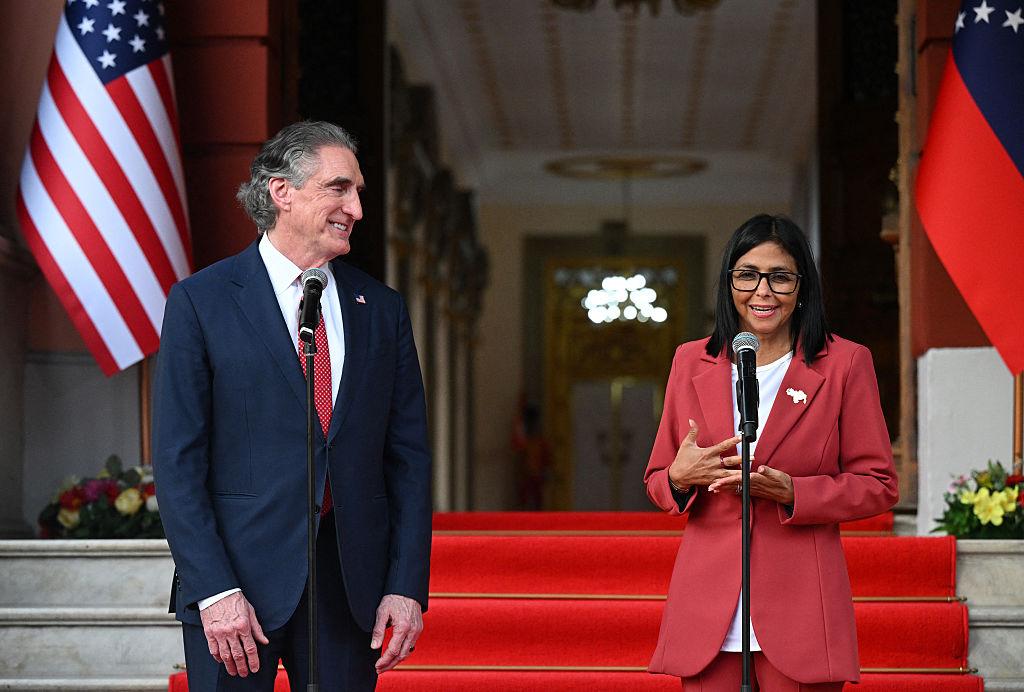
US Defence Secretary Pete Hegseth announced the agreement during an unannounced visit to Caracas on Wednesday, 18 November, where he met Venezuela’s interim president, Delcy Rodríguez, at the Miraflores presidential palace. The arrangement is intended to reopen military channels between Washington and Caracas after years of hostility and a period of intense political upheaval.
Hegseth said the agreement would cover joint military training, intelligence sharing and greater cooperation on defence equipment and capabilities. Rodríguez welcomed the initiative, saying it could strengthen the training and technological capacity of Venezuela’s armed forces while helping both governments address shared security threats.
The announcement represents one of the clearest signs yet that the Trump administration is seeking to turn its intervention in Venezuela into a longer-term strategic partnership. However, the agreement’s full terms have not been published, leaving questions over its operational scope, political conditions and the extent of American involvement in rebuilding the Venezuelan military.
A striking reversal in US-Venezuela relations
The agreement would have been difficult to imagine before the dramatic events of January 2026, when US forces captured Maduro during a military operation in Caracas. His removal ended his presidency but did not bring an immediate change of government structure: the ruling political movement remained in power, with Rodríguez taking over as the country’s interim leader.
The United States had spent years accusing Maduro and senior figures in his administration of corruption, organised crime and involvement in drug trafficking. Maduro rejected the accusations. Washington also imposed sanctions on Venezuelan officials and pursued legal cases against members of the country’s political and military establishment.
The military agreement now places the two governments on a markedly different footing. Hegseth described Venezuela as having moved from being one of Washington’s most serious regional security threats to becoming a cooperative partner.
His remarks were particularly striking because they were delivered in the same city where American forces had carried out the operation that removed Maduro. Hegseth also praised Rodríguez for working with Washington to stabilise the country and confront criminal networks.
The US Department of Defence said Hegseth and Venezuelan Defence Minister Gustavo González López signed a defence cooperation document during the visit. The department linked the agreement to the Trump administration’s stated approach of stabilisation, economic recovery, political reconciliation and eventual democratic transition.
Yet the continued presence of Maduro’s former allies in senior positions highlights the complexity of the transition. Washington is now seeking cooperation from institutions and officials that it previously treated as central to the security problems it wanted to address.
What the agreement is expected to cover
The publicly described provisions focus on practical military cooperation rather than a formal mutual-defence commitment.
Hegseth said the two armed forces would train together, share intelligence and explore cooperation involving defence equipment and military capabilities. Rodríguez said the agreement could improve the Venezuelan military’s training, equipment and access to technology.
The US Defence Department also said the document was intended to advance combined operations. Hegseth indicated that cooperation could involve security and defence reforms aimed at modernising and professionalising Venezuela’s armed forces.
Drug trafficking is likely to be a central area of coordination. The Trump administration has increasingly treated organised criminal networks in Latin America as a national security priority, arguing that groups operating across the region threaten US security and contribute to the flow of illegal drugs.
Hegseth said the partnership would increase joint action against trafficking organisations and other criminal groups. He called on those he described as narco-terrorists to leave the country or face action.
However, neither government has released a detailed operational framework. It remains unclear whether the agreement will lead to regular joint exercises, permanent liaison arrangements, intelligence-sharing mechanisms, equipment transfers or a larger American advisory presence.
There has also been no public confirmation of the financial commitments involved, the timetable for implementation or the safeguards governing the use of shared intelligence.
Those unanswered questions will be important in determining whether the agreement becomes a lasting military partnership or remains a broad political declaration.
Washington’s wider strategic interests
The military agreement is part of a much wider expansion of American engagement in Venezuela since Maduro’s removal. US officials have increasingly focused on the country’s oil reserves, critical minerals and strategic position in the Caribbean and northern South America.
The Trump administration has pursued a separate energy arrangement involving North American Blue Energy Partners, a company granted long-term access to 17 Venezuelan oilfields. Reuters reported that the fields contain about one-fifth of Venezuela’s oil reserves and that the US government secured a 35 per cent stake in the company’s parent, alongside rights to a share of production.
The company has said it intends to increase output to more than 250,000 barrels per day by the end of the year. Any increase would depend on investment, infrastructure, operational conditions and the stability of the Venezuelan oil sector.
Hegseth linked the energy arrangement to the disruption of global oil supplies caused by the war involving Iran. He argued that greater Venezuelan production could reduce the Western Hemisphere’s exposure to instability around the Strait of Hormuz, a critical route for international energy shipments.
The connection between energy and defence policy is significant. A more stable Venezuela could offer Washington access to substantial oil resources while also giving it a stronger position in a region where security, migration, organised crime and competition for influence remain major concerns.
Hegseth also invoked what he called the “Donroe Doctrine”, a reference to President Donald Trump’s name and the nineteenth-century Monroe Doctrine, which asserted that outside powers should not interfere in the Americas. The language signals the administration’s intention to give the Western Hemisphere a more prominent place in US foreign and security policy.
Critics, however, may view the approach as a return to a more interventionist interpretation of American influence in Latin America.
The challenge of rebuilding Venezuela’s armed forces
Restoring military cooperation will not automatically resolve the problems facing Venezuela’s security institutions.
The country’s armed forces have operated through years of political polarisation, economic decline and international sanctions. Senior officers have been accused by the United States and other critics of involvement in corruption and criminal networks, allegations that have been contested by the Venezuelan government.
Analysts have also questioned the military’s capacity to re-establish effective control in areas where organised criminal groups have developed significant influence.
Phil Gunson, a senior analyst with the International Crisis Group in Caracas, told The Washington Post that the Venezuelan military faced serious weaknesses, including allegations of corruption and human rights abuses. He also questioned its ability to regain control of territory held by powerful criminal organisations.
The potential reforms outlined by Hegseth could therefore prove difficult to implement. Modernising equipment and improving training would require more than a signed document: it would depend on institutional changes, reliable funding, oversight and confidence between the two governments.
There is also a political sensitivity surrounding the partnership. The Venezuelan armed forces remain a central institution in the country’s political system. Any attempt to restructure their command, leadership or internal security responsibilities could create resistance among officials whose positions and influence depend on the existing system.
For Washington, the challenge will be to build a working relationship without appearing to legitimise practices it has previously criticised. For Rodríguez, cooperation could bring resources and diplomatic support, but it may also expose her government to accusations that it is allowing the United States excessive influence over national security.
Political uncertainty remains unresolved
The military agreement comes as Venezuela continues to face uncertainty over its political future.
Rodríguez assumed leadership after Maduro’s capture and remains in office, but the country has not announced a date for its next presidential election. Her continued leadership has raised questions about the timetable and credibility of the promised political transition.
Opposition leader María Corina Machado has recently returned to Venezuela after spending time in exile. Her return has added pressure for a clearer path towards competitive elections and political reform.
US Secretary of State Marco Rubio has described the return as part of reconciliation efforts supported by Washington. The Trump administration has presented political transition as one of its objectives, but the immediate priority of stabilisation and economic recovery has also shaped its dealings with Rodríguez.
That balance has generated debate inside Venezuela. Some citizens welcome Maduro’s removal, while others remain concerned that Washington is prioritising access to oil and strategic resources over democratic reforms and accountability.
The absence of a clear election timetable is likely to remain a major issue. A defence partnership may improve cooperation between the two governments, but it cannot by itself resolve questions over political legitimacy, civil liberties or the future structure of Venezuela’s institutions.
A new phase, with important questions unanswered
The agreement marks a significant change in the relationship between Washington and Caracas. For the United States, it offers an opportunity to expand security cooperation, strengthen its regional influence and connect military engagement with broader energy and economic interests.
For Venezuela’s interim government, the deal could provide access to training, equipment and technical support at a time when its armed forces face pressure to improve their capabilities and confront criminal networks.
But the partnership remains at an early stage. Neither side has disclosed the full agreement, and the practical arrangements required to implement it have yet to be made public.
The most important test will be whether the renewed relationship produces measurable improvements in security while supporting a credible political transition. Without transparency, institutional reform and clear limits on military cooperation, the agreement could deepen existing tensions rather than resolve them.
For now, the signing of the defence document signals a remarkable reversal: the governments that were recently adversaries are preparing to work together on military matters. Whether that shift becomes a stable partnership will depend on what follows the announcement in Caracas.