


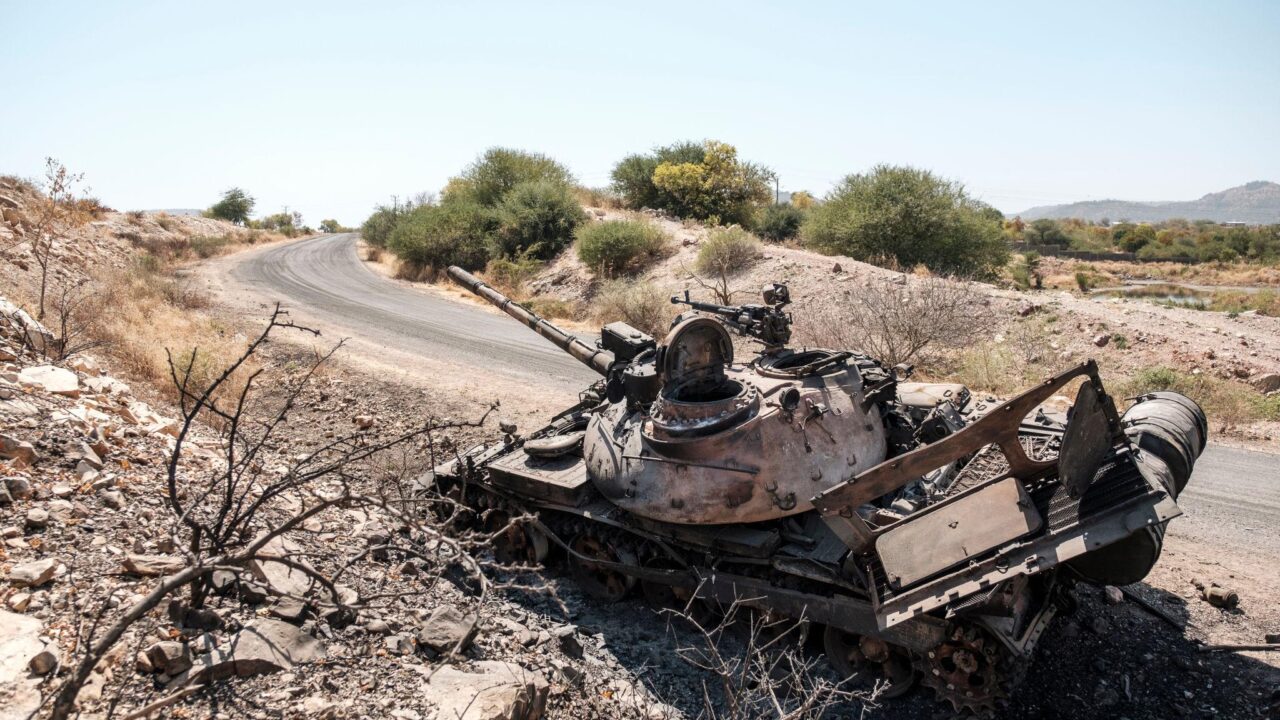
Ethiopia and Eritrea have concentrated military forces along their shared border, raising fears that renewed fighting in northern Ethiopia could escalate into a direct confrontation between the two neighbouring countries. The reported build-up has brought their armies within striking distance of one another, according to conflict monitors and people familiar with armed groups operating in the Tigray region.
The developments come amid a renewed conflict between Ethiopia’s federal government and Tigrayan rebels, which began in September. Reports of artillery exchanges, drone activity and possible clashes near the disputed border town of Badme have heightened concerns about a wider regional war. However, reports of direct fighting between Ethiopian and Eritrean forces remain disputed and have not been independently verified by Reuters.
The deteriorating situation threatens to undo the fragile reconciliation achieved in 2018, when Ethiopian Prime Minister Abiy Ahmed and Eritrean President Isaias Afwerki signed a peace agreement ending two decades of hostility. It also raises the prospect of a wider crisis in the Horn of Africa, a region already affected by conflict, displacement and competing regional alliances.
Military build-up raises fears of direct confrontation
Conflict monitors and sources connected to rival armed groups in Tigray have reported that both countries are strengthening their military positions near the border.
The Armed Conflict Location and Event Data project (ACLED) and the International Crisis Group have described the build-up as bringing the two armies dangerously close to one another. Sources with links to opposing factions in Tigray have also provided accounts of military movements, although they disagree over whether Ethiopian and Eritrean forces have directly exchanged fire.
According to ACLED, Ethiopian drones targeted positions believed to be associated with Eritrean forces around Badme on 12 November. Eritrean troops subsequently fired artillery towards Ethiopian positions, the organisation reported. On 13 November, the two armies allegedly clashed on the Ethiopian side of the border.
Reuters said it could not independently verify the reported exchanges. A source close to anti-government rebels in Tigray supported accounts of sporadic clashes, while a person associated with the pro-government Tigray Peace Force disputed that the two national armies had fought directly.
The distinction is important. Military movements and clashes involving local armed groups do not necessarily establish that Ethiopia and Eritrea have entered a new interstate war.
Eritrean Information Minister Yemane Gebremeskel dismissed statements from Ethiopia’s ruling party about developments near the border as propaganda, without directly addressing the reported military build-up. Ethiopian government representatives did not immediately respond to requests for comment.
Tigray conflict creates a dangerous regional flashpoint
The border tensions are closely connected to renewed fighting inside Ethiopia’s northern Tigray region.
The Tigray People’s Liberation Front (TPLF), which dominated Ethiopian politics for decades before Abiy came to power in 2018, has again become involved in armed confrontation with federal forces.
The current conflict escalated in September, when the TPLF joined several other opposition groups in an alliance known as the Alliance for Survival. The coalition includes armed organisations from different parts of Ethiopia and has called for the removal of Abiy’s government.
The federal government has responded with military operations against the alliance. Fighting has spread across parts of northern Ethiopia, while drone strikes and artillery attacks have added to the security risks facing civilians.
Ethiopia’s government has accused Eritrea of supporting Tigrayan rebels and allowing its forces to enter Ethiopian territory. Witnesses and Ethiopian officials said Eritrean troops crossed into Tigray in early October.
Eritrea has denied the allegations, accusing Addis Ababa of using claims of foreign interference to justify possible aggression against its smaller neighbour.
The two countries have also accused other regional governments of supporting opposing armed groups. Ethiopia has alleged that Sudan and Egypt are assisting rebels, while both countries have rejected the accusations.
These competing claims have made the conflict increasingly difficult to contain. What began as an internal political and military confrontation in Ethiopia now carries the risk of drawing neighbouring states into a broader regional struggle.
Badme remains a symbol of unresolved tensions
The border town of Badme occupies an important place in the history of Ethiopia-Eritrea relations.
The dispute over the town was one of the principal triggers of the 1998–2000 border war, which killed tens of thousands of people and displaced large numbers of civilians.
Following the conflict, an international boundary commission determined that Badme belonged to Eritrea. However, the implementation of the ruling remained unresolved for years, contributing to a prolonged period of hostility between the two countries.
The 2018 peace agreement appeared to bring that chapter to a close. Abiy’s decision to pursue reconciliation with Asmara was widely welcomed internationally and earned him the Nobel Peace Prize in 2019.
During the 2020–2022 Tigray war, Ethiopia and Eritrea once again fought on the same side against Tigrayan forces. Eritrean troops played a significant role in the conflict, which resulted in widespread destruction, displacement and allegations of serious human rights abuses.
The relationship has since deteriorated. Disagreements over regional security, Ethiopia’s ambitions for maritime access and the changing political situation in Tigray have weakened the earlier partnership.
Badme’s strategic and symbolic importance means that any renewed military confrontation in its vicinity could carry consequences beyond the immediate battlefield.
Ethiopia’s pursuit of sea access adds to tensions
A major source of friction between the two countries is Ethiopia’s determination to secure reliable access to the sea.
Ethiopia became landlocked when Eritrea gained independence in 1993. It now depends heavily on neighbouring countries, particularly Djibouti, for access to international shipping routes.
Abiy has increasingly described maritime access as a strategic necessity for Ethiopia, one of Africa’s largest countries by population. His government has argued that the country’s dependence on foreign ports creates economic and security vulnerabilities.
Eritrea has viewed some of these statements with suspicion, interpreting Ethiopia’s ambitions as a possible threat to its sovereignty.
The Eritrean government has warned that attempts to obtain access to its coastline through military pressure would be unacceptable. Abiy, however, has repeatedly stated that Ethiopia intends to pursue maritime access through peaceful means.
The issue has become particularly sensitive because Eritrea controls a strategically important stretch of Red Sea coastline, including the port of Assab. Any attempt by Ethiopia to obtain a military or political advantage over that territory could transform an existing diplomatic disagreement into a direct security crisis.
The dispute also has wider international significance. The Red Sea and Gulf of Aden are critical routes for global shipping, energy supplies and military movements. A conflict between Ethiopia and Eritrea could therefore affect regional trade and security beyond the two countries.
A wider Horn of Africa crisis could emerge
The possibility of a renewed Ethiopia-Eritrea war is particularly concerning because of the number of overlapping conflicts and political disputes across the Horn of Africa.
Sudan remains engulfed in a devastating civil war between the Sudanese Armed Forces and the Rapid Support Forces. The conflict has created one of the world’s largest displacement crises and has attracted involvement from external powers.
Ethiopia and Sudan have exchanged accusations over support for armed groups operating inside each other’s territories. Ethiopia has also accused Egypt of supporting forces opposed to its government. Cairo and Khartoum have rejected allegations of interference.
Egypt has its own longstanding dispute with Ethiopia over the Grand Ethiopian Renaissance Dam, which has raised concerns about the future management of Nile waters.
Relations among these countries have become increasingly complicated as governments seek security partnerships and political support across the region.
Eritrea has strengthened its relationships with countries that have disagreements with Ethiopia, while Addis Ababa has sought to maintain its own strategic partnerships.
Analysts warn that a direct war between Ethiopia and Eritrea could encourage further involvement by regional powers, turning an already unstable security environment into a much larger confrontation.
The United States has sought to encourage restraint and diplomatic engagement. The US Congressional Research Service has warned that the overlapping conflicts in Ethiopia and tensions with neighbouring states could destabilise the wider Horn of Africa and place additional pressure on an already strained humanitarian system.
Humanitarian consequences could be severe
A new war would have serious consequences for civilians, particularly in Tigray, where communities are still recovering from the 2020–2022 conflict.
The earlier war caused extensive destruction of homes, hospitals, schools and other essential infrastructure. Hundreds of thousands of people were displaced, while humanitarian organisations documented severe food insecurity and widespread allegations of abuses by different armed actors.
The 2022 Cessation of Hostilities Agreement ended the main fighting between the federal government and the TPLF, but it did not resolve every political and territorial dispute.
The withdrawal of foreign and non-federal forces from Tigray, the return of displaced people and the disarmament of combatants remained difficult and incomplete processes.
A renewed conflict could further restrict humanitarian access and disrupt the delivery of food, medicine and other essential supplies.
The danger extends beyond Tigray. If fighting spreads towards the Eritrean border or involves additional armed groups, civilians in neighbouring regions could face new displacement and shortages.
The United Nations and international aid organisations would also face greater difficulties responding to multiple emergencies across Ethiopia, Sudan and other parts of the region.
Diplomacy remains the only route to preventing escalation
Despite the growing military tension, a direct war between Ethiopia and Eritrea is not inevitable.
Both governments have significant economic and security interests that could be damaged by another prolonged conflict. The memory of the 1998–2000 war and the devastation of the recent Tigray conflict provide powerful reasons to avoid a return to large-scale fighting.
International Crisis Group analyst Magnus Taylor has warned that renewed fighting near the border could draw Eritrea further into the Tigray conflict and trigger a direct confrontation between the neighbouring states.
Diplomatic engagement will therefore be critical. International partners could seek to establish communication between the two governments, reduce the risk of accidental clashes and encourage the withdrawal of forces from particularly sensitive areas.
Any lasting agreement would also need to address the political disputes within Ethiopia, the future of Tigray and the unresolved questions surrounding border security and maritime access.
The immediate challenge is to prevent military movements and local clashes from developing into a wider conflict.
For now, the reported concentration of forces along the border is a warning sign rather than confirmation that another war has begun. But with relations deteriorating, armed groups operating close to the frontier and competing regional interests intensifying, the margin for diplomatic miscalculation is becoming increasingly narrow.