

The European Union is considering a significant expansion of its political, economic and security ties with Syria, as Brussels seeks to support the country’s post-war recovery while reducing the influence Russia retains after the fall of Bashar al-Assad.
A discussion paper prepared by the European External Action Service (EEAS), the bloc’s diplomatic service, outlines proposals ranging from security-sector reform and police training with Jordan to renewed trade negotiations and greater access to European investment. The document, seen by Reuters, is due to be considered by EU foreign ministers at a meeting on 16 November.
The proposals represent a potential shift in the EU’s relationship with Damascus: from an approach dominated by humanitarian assistance and diplomatic caution towards a broader partnership aimed at reconstruction, institutional development and regional stability.
The paper also identifies the continuing influence of Russia and other foreign actors as a concern, arguing that stronger European engagement could help bring Syria closer to Europe. However, the proposals have not yet been adopted as EU policy, and their implementation will depend on agreement among member states and progress by Syria’s transitional authorities.
Brussels seeks a broader role in Syria’s transition
The EU has gradually reopened formal relations with Syria since Assad’s government collapsed in December 2024. The change in leadership created an opportunity for Western governments to reassess a relationship that had been largely defined by sanctions, political isolation and humanitarian support during the civil war.
The new Syrian leadership, headed by President Ahmed al-Sharaa, has sought international recognition, investment and assistance to rebuild infrastructure and revive an economy weakened by years of conflict.
For European governments, the transition offers both an opportunity and a strategic challenge. Syria’s stability has implications for refugee returns, regional security, trade routes and the wider balance of power in the eastern Mediterranean.
The EEAS paper acknowledges that the transition is progressing but warns that major challenges remain. Economic recovery, national reconciliation and the reintegration of internally displaced people and refugees are among the issues identified as requiring faster progress.
The EU is therefore considering a relationship that would extend beyond emergency assistance. Its proposed approach combines economic engagement with institutional reform, on the understanding that reconstruction and private investment will be difficult without reliable public institutions and a more predictable security environment.
Security-sector reform and cooperation with Jordan
One of the proposals is to support reform of Syria’s security institutions, including cooperation with Jordan to train Syrian police recruits.
The proposed trilateral arrangement would give the EU a role in helping develop police capabilities while involving a neighbouring country with direct interests in Syria’s stability. Jordan has faced the consequences of the Syrian conflict through refugee movements, cross-border insecurity and disruptions to regional trade.
Police training would form part of a wider effort to strengthen state institutions and improve the ability of the Syrian authorities to maintain public order. The initiative is not presented as a completed programme, but as an area for potential cooperation.
The security dimension also reflects the EU’s concern that weak institutions could leave space for foreign powers and armed actors to retain influence. Brussels has repeatedly stressed that Syria’s transition should be inclusive and should respect the country’s sovereignty and territorial integrity.
Russia’s military presence remains a strategic concern
Russia’s position in Syria has changed considerably since Assad’s overthrow, but Moscow has not disappeared from the country. During the civil war, Russian military intervention helped preserve Assad’s government and gave Moscow a central role in the conflict. Its facilities on the Mediterranean coast also provided a strategic platform for operations in the Middle East and beyond.
The future of the Hmeimim air base and the naval facility at Tartus became a key issue after the change of government.
In August 2026, Syria’s Foreign Ministry announced that Damascus and Moscow had reached a memorandum of understanding after 18 months of negotiations. Under the arrangement, the Syrian state would assume management of civilian facilities, including Hmeimim airport and the commercial section of Tartus port. Military facilities were to be repurposed as joint Russian-Syrian training and qualification centres.
The agreement therefore reorganised Russia’s presence rather than ending all military cooperation. It gave the Syrian authorities a greater role in managing civilian infrastructure while leaving room for a continuing Russian military relationship through the proposed joint facilities.
Kallas says Syria needs alternatives to dependence on Moscow
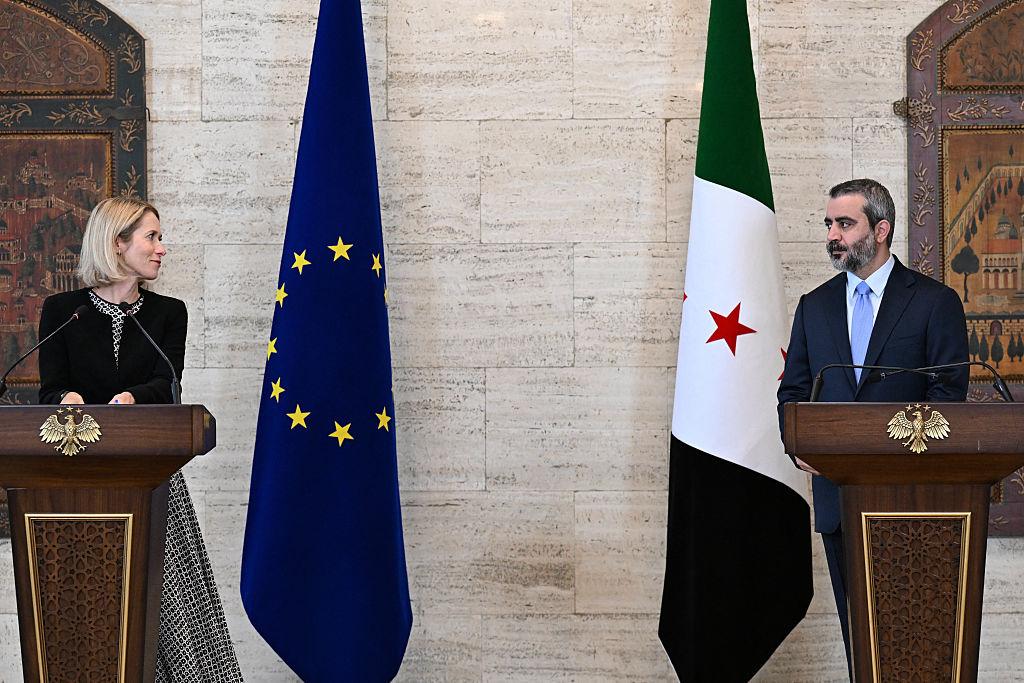
The EU’s concerns were made explicit during a visit to Damascus by foreign policy chief Kaja Kallas on 29 September. Speaking alongside Syrian Foreign Minister Asaad al-Shaibani, Kallas said the bloc hoped the recent memorandum with Russia would lead to a reduction in Moscow’s military presence and influence.
She also argued that Syria had credible alternatives to dependence on Russia, while making clear that closer European engagement would require progress on the Syrian side.
Kallas identified security, the rule of law and functioning institutions as important conditions for attracting foreign investment. She also stressed the importance of national reconciliation, accountability for past abuses and the safe, dignified and durable return of refugees.
The November discussion paper gives these concerns a more developed economic and security framework. Rather than relying solely on diplomatic pressure, the EU is seeking to expand its role in sectors that could make European institutions and businesses more relevant to Syria’s recovery.
Russia’s continuing military role is not the only issue. Moscow also retains economic and political leverage, while Syria’s new authorities are attempting to balance relationships with several international partners. The EU’s strategy is intended to widen Damascus’s alternatives, although the extent to which European engagement can displace Russian influence remains uncertain.
Trade agreement and reconstruction finance are central to the proposals
The economic proposals are among the most substantial elements of the discussion paper. Syria faces enormous reconstruction requirements after nearly 14 years of civil war, which damaged infrastructure, disrupted trade and weakened public services.
The EU is considering reviving an Association Agreement with Syria that was initialled in December 2008 but never signed. The proposed agreement would provide a framework for free trade, political dialogue and broader cooperation between Brussels and Damascus.
EU diplomats would seek a fresh mandate from member states to negotiate revisions to the text. The existing draft could provide a starting point for closer relations, but the proposal remains subject to political approval and negotiation.
It is important to distinguish this proposed Association Agreement from the separate Cooperation Agreement that already governs parts of the EU-Syria relationship.
A trade framework that has remained unfinished since 2008
The 1977 EU-Syria Cooperation Agreement was partially suspended in 2011 in response to serious human rights violations under the Assad government. In May 2026, the EU Council ended that partial suspension, restoring the full application of the agreement and signalling a further step towards normalising bilateral relations.
The Association Agreement is a different instrument. Although it was initialled in 2008, it was never signed because of concerns over the former Syrian government’s human rights record.
The distinction matters because the EU has already restored the operation of an existing agreement, while the November proposals concern the possible revival and revision of a separate, more ambitious trade and political framework.
Beyond trade, Brussels wants to reconnect Syria with Euro-Mediterranean cooperation structures and wider international markets. Transport, energy and digital connectivity are identified as areas where stronger links could support economic recovery.
The EU is also encouraging the European Investment Bank to resume engagement with Syria and supporting Damascus’s efforts to become a shareholder in the European Bank for Reconstruction and Development. Both steps could eventually improve access to financing for reconstruction projects, although neither should be interpreted as an immediate funding commitment.
Damascus forum to prepare ground for investment conference
The next stage of the EU’s engagement is expected to take place in Damascus on 17 November, when an EU-led Syria Partnership Co-ordination Forum is scheduled to focus on investment and private-sector participation.
Syrian Foreign Minister Asaad al-Shaibani and European Commissioner for the Mediterranean Dubravka Šuica are expected to co-chair the meeting. Representatives of European and Gulf states, development banks and United Nations agencies are also expected to attend.
The forum is intended primarily to improve coordination rather than announce new financial pledges. According to reporting by The National, its aim is to prepare the ground for a possible EU-Syria business and investment conference in 2027.
The European Investment Bank is expected to return to Syria through the participation of its vice-president, Gelsomina Vigliotti, marking its first such engagement in the country in 15 years, according to the newspaper. The World Bank is also expected to present its recently established START trust fund, a multi-donor mechanism intended to support recovery and reconstruction.
The EU has already committed €620 million for Syria in 2026 and 2027, covering humanitarian needs, socio-economic recovery and institutional support, according to Kallas. That existing commitment is separate from the November forum, which is not expected to serve as a new pledging conference.
Investment will depend on institutional and banking reforms
One of the practical obstacles to reconstruction is Syria’s limited integration into international financial networks. European officials have highlighted the difficulties of transferring funds into the country, including the lack of corresponding banking relationships that would allow transactions between Syrian institutions and overseas financial systems.
The EU has been assisting the Syrian central bank with reform efforts, although progress has been slow, according to The National.
For private investors, access to financial services is only one part of the equation. Predictable regulation, functioning courts, clear rules and confidence in public institutions are also essential before companies commit substantial capital to a country emerging from conflict.
The EU has indicated that its support for economic recovery will therefore be linked to institutional development. Kallas has said that investment and security must advance together, with the rule of law and reliable public institutions helping create the conditions for businesses to operate.
A partnership shaped by opportunity and caution
The proposed expansion of EU-Syria relations reflects a wider effort to shape the country’s direction after years of war and international isolation. A stronger European role could provide Damascus with additional sources of finance, trade and technical assistance while giving Brussels greater influence over the country’s economic and institutional recovery.
But the strategy also carries political risks. Syria’s transition remains fragile, reconciliation is incomplete and the authorities face difficult questions over accountability, the treatment of communities and the integration of displaced people. European investment will depend not only on diplomatic goodwill but also on whether the government can establish credible institutions and provide assurances to businesses and international partners.
The EU’s approach is also not a straightforward attempt to remove Russia from Syria. The August memorandum has reshaped Moscow’s position, but joint military arrangements leave open the possibility of continued Russian involvement. Brussels is seeking to reduce that dependence by offering Syria alternative partnerships rather than relying on sanctions or political isolation alone.
EU foreign ministers are due to consider the proposals on 16 November, followed by the Damascus coordination forum a day later. Those discussions will indicate how far member states are prepared to take the relationship.
For Syria, the challenge will be to turn renewed diplomatic interest into practical investment and lasting recovery. For Europe, the test will be whether deeper engagement can strengthen the country’s institutions and stability while limiting the influence of outside powers without compromising the inclusive political transition it says it supports.