
DAMASCUS — July 4, 2026: The approval gives Damascus its first national GCF project and opens a channel for climate finance focused on water security, agriculture and adaptation. The development is relevant to Telegraph Middle East readers because it connects directly with the publication’s core coverage of Gulf business, public policy, investment, markets and regional affairs.
The story is not only about a headline figure or a single official decision. It is about how the Middle East is adjusting to a period in which energy routes, capital flows, government policy, consumer confidence and geopolitical risk are moving together. In that environment, a development in one sector can quickly shape decisions in another.
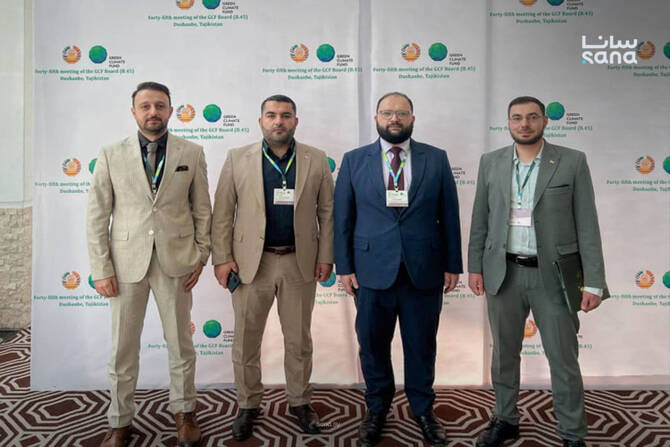
The Green Climate Fund approved $27.7 million for Syria’s first national project.
The project targets water scarcity risks in areas hit hardest by climate change.
Approval came during the GCF’s 45th Board meeting in Dushanbe, held from June 29 to July 3.
The GCF is the financial arm of the UN Framework Convention on Climate Change.
Taken together, these details indicate that the region is moving through a phase of cautious adjustment rather than simple recovery or deterioration. The facts point to measurable activity, but they also show why decision-makers remain careful about treating one week of data as a lasting trend.
Climate finance is becoming increasingly important in the Middle East because water scarcity, heat stress and food-security pressures are no longer distant risks. They are already affecting agriculture, cities, power systems and public health. Funding from multilateral institutions can help countries build technical capacity, but implementation remains the central test.
Water projects carry special weight because they connect environmental adaptation with livelihoods. Agriculture, rural incomes, urban supply and migration pressures can all be influenced by the availability and management of water. In fragile states, climate adaptation is therefore also a stability question.
The approval of a project is only the beginning. Success will depend on procurement, local capacity, monitoring, transparency and the ability to convert international financing into measurable resilience for communities.
For Syria, climate finance is also a reconstruction and institutional-capacity issue.
Water scarcity affects agriculture, livelihoods, urban resilience and migration pressure.
The approval could become a template for future projects if implementation capacity and governance standards are maintained.
For policymakers, the priority is to preserve confidence while avoiding overstatement. For companies, the priority is operational flexibility: the ability to adapt procurement, pricing, staffing, financing and customer strategy as conditions change. For investors, the key question is whether short-term uncertainty is masking durable structural growth or exposing weaknesses that were previously hidden by abundant liquidity.
The next indicators to watch will be official follow-up data, sector-level statements, shipping and travel activity, lending conditions, company guidance and the tone of regional diplomacy. Telegraph Middle East will continue to treat confirmed data as the basis for analysis and will avoid presenting projections or source-based claims as settled outcomes.
The wider context is that the Gulf is attempting to protect its reputation as a reliable centre for capital, trade and services while operating in a region where security developments can change the cost of doing business quickly. The strongest economies will be those able to maintain institutional clarity, transparent communication and practical continuity during periods of stress. That is why today’s news should be read as part of a wider operating picture rather than as an isolated event.
The wider context is that the Gulf is attempting to protect its reputation as a reliable centre for capital, trade and services while operating in a region where security developments can change the cost of doing business quickly. The strongest economies will be those able to maintain institutional clarity, transparent communication and practical continuity during periods of stress. That is why today’s news should be read as part of a wider operating picture rather than as an isolated event.
The wider context is that the Gulf is attempting to protect its reputation as a reliable centre for capital, trade and services while operating in a region where security developments can change the cost of doing business quickly. The strongest economies will be those able to maintain institutional clarity, transparent communication and practical continuity during periods of stress. That is why today’s news should be read as part of a wider operating picture rather than as an isolated event.