


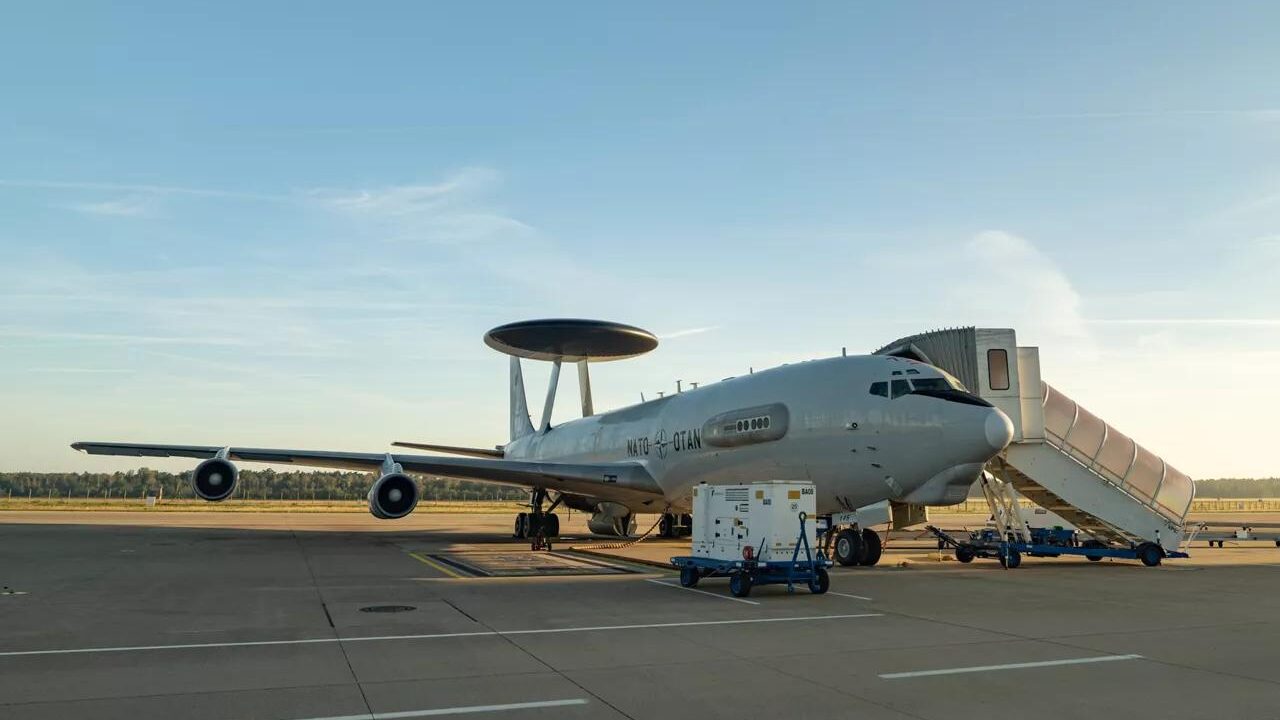
NATO has authorised the forward deployment of an airborne early-warning and surveillance aircraft to Poland after three Russian cruise missiles landed on Polish territory during a major overnight attack on Ukraine, raising fresh concerns about the risk of the war spreading beyond Ukraine’s borders.
The decision, announced on Monday, 23 November, follows an incident three days earlier in which Russian Kh-101 missiles fell at three locations in southeastern Poland, close to the Ukrainian border. Polish prosecutors have identified missile fragments at all three sites, while NATO has confirmed that its senior military commander authorised the deployment of an Airborne Warning and Control System (AWACS) aircraft to reinforce surveillance and improve the alliance’s ability to respond to potential threats.
Polish Deputy Defence Minister Pawel Zalewski said the aircraft would provide additional operational awareness and strengthen the country’s ability to monitor developments along its eastern border. NATO has also indicated that further military assets could be considered as it reviews its deterrence and defence posture in Poland and elsewhere.
The decision comes amid repeated Russian attacks on Ukraine and growing concern among eastern European members of the alliance that missiles and drones could increasingly cross into NATO airspace.
Three Russian Kh-101 missiles identified
The incident occurred on the morning of Friday, 20 November, during a large-scale Russian aerial assault on Ukraine.
Polish authorities initially reported that three unidentified flying objects had fallen in the country’s southeastern regions. The locations were identified as Nowy Lipowiec in the Lublin region, and Rudnik and Mołodycz in the neighbouring Podkarpackie region.
Early assessments suggested that two of the objects were Russian cruise missiles, while the third may have been a jet-powered drone. However, subsequent examinations led to a revised assessment.
On Sunday, 22 November, the District Prosecutor’s Office in Lublin announced that preliminary findings indicated that fragments recovered at all three locations belonged to Russian Kh-101 cruise missiles. Prosecutors also said the missiles appeared to have been manufactured during the fourth quarter of 2026 at a facility in Dubna, in Russia’s Moscow region.
The findings were based on inspections involving military technology and weapons specialists. Investigators said recovered fragments and forensic evidence would undergo additional specialist examinations before further conclusions were released.
The locations of the three impacts heightened concerns because they were close to the Ukrainian border and not far from military activity involving European countries supporting Kyiv.
Polish officials confirmed that nobody was injured and that no damage to critical infrastructure had been reported. At one location, debris fell in a field near woodland, while another impact occurred in a wooded area. The third object came down in an undeveloped area.
NATO authorises AWACS deployment
Following discussions among alliance representatives in Brussels, NATO authorised the forward deployment of an AWACS aircraft to Poland.
Zalewski announced the decision after a meeting of the North Atlantic Council, NATO’s main political decision-making body. He described the aircraft as an important addition to Poland’s surveillance capabilities, saying that it would provide deeper operational awareness and help the country respond more effectively to similar incidents.
NATO spokesperson Allison Hart subsequently confirmed that Supreme Allied Commander Europe General Alexus Grynkewich had authorised the deployment.
Hart said the NATO commander was also examining the possible deployment of additional assets as part of a wider assessment of the alliance’s deterrence and defence position in Poland and elsewhere. She described the airspace incidents as dangerous, stated that Russia bore full responsibility and reiterated that NATO members stood in solidarity with Poland.
The announcement does not amount to a declaration of war or an announcement that NATO is preparing an offensive operation against Russia. It represents an additional surveillance and early-warning measure intended to improve the alliance’s ability to identify and assess potential threats.
The timing is nevertheless significant. The deployment comes as NATO seeks to reinforce its eastern flank while avoiding a direct military confrontation with Moscow.
What AWACS aircraft bring to Poland’s defences
Airborne Warning and Control System aircraft are among NATO’s most important surveillance and command-and-control platforms.
The alliance operates a fleet of 14 Boeing E-3A Sentry AWACS aircraft, based primarily at Geilenkirchen air base in Germany. Their most recognisable feature is a large rotating radar dome mounted above the fuselage, which allows the aircraft to monitor a wide area from high altitude.
Unlike conventional fighter aircraft, AWACS platforms are designed to provide an extended picture of activity in the air and, in certain circumstances, across maritime environments. They can detect, track and identify potentially hostile aircraft, including targets operating at low altitudes, and transmit information to military command centres and allied forces.
The aircraft also support the coordination of fighter operations, helping commanders establish a shared understanding of the air situation across several countries.
According to NATO, one E-3A operating at approximately 30,000 feet can provide surveillance coverage of more than 120,000 square miles, broadly comparable to the area of Poland. Its radar systems can detect low-altitude targets at substantial distances, although actual coverage depends on terrain, atmospheric conditions and the nature of the target.
The aircraft are unarmed. Their principal value lies in gathering and sharing information rather than directly intercepting incoming missiles. They can help military commanders establish where a threat is coming from, assess its direction and coordinate an appropriate response with ground-based air defences and fighter aircraft.
For Poland, the additional surveillance capability could be particularly valuable because of the country’s position along NATO’s eastern border and its proximity to the ongoing conflict in Ukraine.
Warsaw describes the incident as a serious Russian provocation
Polish Prime Minister Donald Tusk has described the missile incidents as a likely intentional provocation by Russia.
His assessment was influenced partly by the timing and location of the impacts. The missiles landed in southeastern Poland while countries supporting Ukraine through the Coalition of the Willing were conducting military exercises in the country.
The exercises involved military personnel from several European countries and were designed to improve cooperation and operational readiness in the event of a possible future deployment connected to Ukraine.
Tusk said the proximity of the incidents to the exercises made it difficult to dismiss the events as accidental. However, the public findings available so far establish the missiles’ Russian origin and landing locations; they do not independently establish that the exercises were deliberately targeted.
NATO Secretary-General Mark Rutte also condemned the incident. Speaking alongside German Chancellor Friedrich Merz on 23 November, Rutte described it as dangerous and unacceptable, saying that the events were clearly connected to Russia and its war against Ukraine.
He said NATO remained in close contact with Polish leaders and that the alliance’s military command continuously assessed whether adjustments to its deterrence and defence posture were necessary.
The alliance has not announced that the incident automatically triggers its collective-defence provisions. Instead, its immediate response has centred on additional surveillance, military coordination and consultations with Poland.
Another Russian drone enters Polish airspace
Concerns about further incursions increased after a separate incident reported on 24 November.
Polish armed forces said a Russian unmanned aerial vehicle briefly entered the country’s airspace during another Russian overnight attack on western Ukraine. According to the military, authorisation had been given to shoot down the object.
However, the drone changed course and began moving east. After assessing the potential danger to civilians and the possible consequences of using weapons, Polish forces decided not to fire.
The episode illustrated the difficult decisions facing air-defence personnel when unidentified or hostile objects enter national airspace close to populated areas. Although military forces may have the authority to engage such targets, the risks associated with interception and falling debris must also be considered.
The separate drone incident, following the three missile impacts earlier in the week, has strengthened calls for improved monitoring and quicker coordination between national and NATO defence systems.
NATO’s eastern flank faces continued pressure
The latest incidents come as NATO continues to strengthen its military presence and surveillance capabilities along its eastern flank following Russia’s full-scale invasion of Ukraine in February 2022.
Countries including Poland, Romania, Lithuania, Latvia and Estonia have repeatedly raised concerns over Russian military activity near alliance territory. Missile and drone movements close to borders have become a recurring security challenge, particularly during large Russian attacks on Ukrainian infrastructure.
Poland occupies a strategically important position in NATO’s eastern defence arrangements. It borders Ukraine, Belarus and Russia’s Kaliningrad exclave, while also serving as a major logistical route for international assistance to Kyiv.
The country’s government has invested heavily in military modernisation, air defence and cooperation with NATO allies. The AWACS deployment is intended to complement those capabilities by providing a wider picture of aerial movements and helping allied forces respond to potential threats.
The alliance is also pursuing longer-term improvements to its airborne surveillance systems. In July 2026, NATO announced a multinational programme to acquire Saab GlobalEye aircraft as part of the replacement and modernisation of its ageing airborne early-warning capabilities.
For now, however, the immediate priority is to strengthen existing surveillance arrangements and ensure that Poland can detect potential threats before they pose a danger to its population or infrastructure.
A security test for the alliance
The missile incidents have created another difficult test for NATO as it attempts to protect member territory while avoiding escalation with Russia.
The deployment of an AWACS aircraft represents a measured military response, providing additional surveillance rather than signalling an immediate move towards direct confrontation. Its effectiveness will depend on how well information from the aircraft is integrated with Polish radar networks, ground-based defence systems and allied fighter operations.
Polish prosecutors are continuing to examine the recovered missile fragments, while NATO’s military leadership assesses whether further deployments are necessary.
The latest drone incursion also suggests that the pressure on Poland’s airspace has not ended with the three missile impacts.
As Russia’s war in Ukraine continues, the distinction between combat operations inside Ukraine and potential spillover into neighbouring NATO territory remains a central concern for European security. The alliance’s response will therefore be closely watched by its members, Ukraine and Moscow.
For Warsaw, the immediate objective is to strengthen protection of its airspace. For NATO, the challenge is broader: demonstrating that its eastern border remains secure without allowing repeated incidents to push the conflict towards a direct confrontation between Russia and the alliance.


