


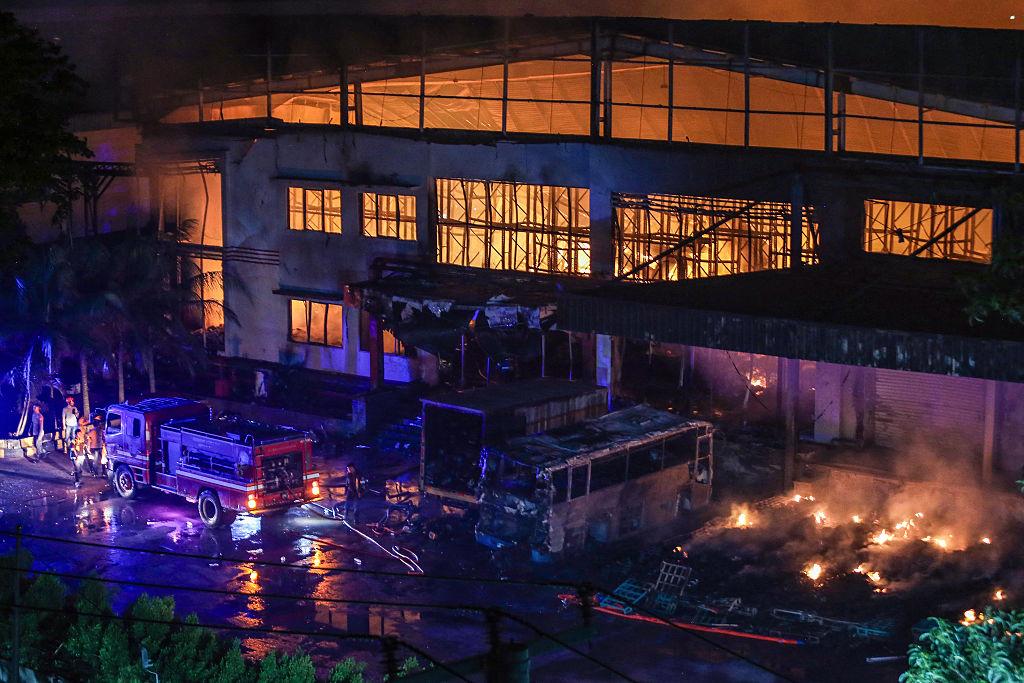
Indonesian rescuers are continuing to search the wreckage of a confectionery factory in Banten province after a devastating fire killed at least 24 people and left dozens of workers unaccounted for, prompting renewed scrutiny of industrial workplace safety and emergency preparedness.
The fire swept through the PT Fonusa Agung Mulia factory in the Pancatama Industrial Estate, Cikande district, in Serang regency, west of Jakarta, on Saturday, 21 November. The blaze destroyed large sections of the facility and left parts of the structure unstable, complicating efforts to reach workers believed to have been trapped inside.
By Tuesday, 24 November, search teams had recovered human remains in 26 body bags. Company employment records cited in local reporting indicated that 34 workers were still missing, while 31 had been accounted for as safe, including four receiving medical treatment. The remains are undergoing forensic examination, and the final number of victims has not yet been established through identification.
Search operation continues amid unstable ruins
The fire reportedly began at about 4.30pm to 5pm local time on Saturday and spread through the factory’s office, production and warehouse areas. Firefighters battled the flames for approximately 14 hours before the main blaze was brought under control early on Sunday.
Rescue operations have since been complicated by collapsed sections of the building, damaged materials and remaining hot spots. Officials have warned that entering parts of the structure before it is considered safe could put emergency personnel at risk.
The scale of the incident has also made the identification of victims particularly difficult. Police have said that some recovered remains cannot be identified through visual examination. Disaster victim identification teams are therefore relying on scientific procedures, including DNA comparisons with relatives, alongside other forensic methods where possible.
The Indonesian National Police has deployed forensic specialists and identification personnel to assist with the recovery operation. Authorities have also been collecting information from families and company records to establish who was present when the fire broke out.
The latest figures have varied as rescue agencies and the company reconcile employee records. Earlier reports referred to around 30 missing workers, while subsequent company data cited by local media placed the number at 34. The 26 bags recovered by Tuesday contain human remains, but they do not provide a direct count of individual victims because identification and forensic sorting remain incomplete.
Questions over alarms and evacuation procedures
Attention is increasingly turning to the factory’s fire-safety arrangements and the circumstances in which workers attempted to escape.
The factory is operated by PT Fonusa Agung Mulia, part of Indonesia’s United Family Food group. Around 300 people were reportedly present across the factory complex during the Saturday shift, although company and rescue records indicated that approximately 65 workers were believed to have been in the area most severely affected by the fire.
Some workers who escaped have raised questions about whether the factory’s warning systems operated as expected. One employee told the Associated Press that he heard other workers shouting about the fire rather than hearing a warning siren. Other workers reportedly gave local media similar accounts.
The company has presented a different account of its safety arrangements. Chief executive Steven Wijaya said the facility conducted emergency and evacuation drills with local firefighters and had evacuation routes and fire-protection equipment, including hydrants and water reserves, that met applicable standards. He said those systems were functioning at the time of the incident.
The accounts have not yet been reconciled through an independent investigation. Whether alarms sounded, how quickly workers were alerted, and whether escape routes remained accessible are among the issues investigators and safety inspectors will need to examine.
Cause of the fire remains under investigation
The precise cause of the blaze has not been formally established. Preliminary information cited by Indonesian labour adviser Said Iqbal suggested that an electrical short circuit involving an air-conditioning unit may have triggered the fire. Earlier reporting also referred to a cooling unit in the area where flames were believed to have started.
Police have said that the cause and any possible breaches of occupational safety procedures are being investigated. Forensic teams are examining the site and collecting evidence, while officers have interviewed witnesses and are reviewing relevant workplace and company information.
The distinction between a possible ignition source and the broader causes of a disaster will be important. Even if an electrical fault is ultimately established, investigators will still need to determine whether detection systems, fire suppression equipment, emergency exits and evacuation procedures worked as intended.
The Banten regional authorities have coordinated the emergency response with the national search-and-rescue agency, police, military personnel, firefighters and other local services. The operation has involved hundreds of personnel, with teams working through damaged sections of the site while taking precautions against further structural collapse.
Company pledges support as families await answers
The factory produces Milkita, a milk-based confectionery brand sold in Indonesia and exported to international markets. It is part of United Family Food, a consumer-goods group whose products also include Lemonilo instant noodles.
Wijaya has apologised for the tragedy and said the company would help affected workers and their families. The company has also established a channel for relatives seeking information about missing employees and said it was maintaining communication with families.
For relatives waiting for confirmation, however, the process remains deeply uncertain. DNA testing and other forensic procedures may take time, particularly where remains have been severely damaged and personal identification cannot be established visually.
Indonesia’s Ombudsman has urged the company and relevant authorities to ensure that workers and their families receive clear information about employment status, outstanding wages, social-security coverage and compensation entitlements. It has stressed that support for families should proceed alongside the search and the investigation.
Industrial safety under renewed scrutiny
The disaster has renewed debate about the enforcement of workplace-safety standards in Indonesia’s manufacturing sector. Industrial fires and other factory accidents have previously exposed concerns over emergency planning, equipment maintenance, evacuation access and the oversight of high-risk facilities.
In a statement following the fire, the Ombudsman called for a comprehensive review of the factory’s occupational health and safety systems. It said investigators should examine whether fire alarms and early-warning systems, extinguishers, hydrants, emergency lighting, evacuation routes and response procedures were adequate and functioning when they were needed.
The review will be significant not only for determining responsibility in this case but also for assessing whether inspections and safety requirements are being effectively enforced across industrial estates.
The tragedy also raises questions about how factories account for workers during a fast-moving emergency. Accurate shift records, reliable communication with families and clearly communicated evacuation procedures can be critical when emergency services must establish who remains inside a damaged building.
For now, the immediate priority remains the search for those still missing and the identification of recovered victims. Police have yet to announce a final forensic count, and the cause of the fire remains unresolved.
As families wait for answers, the investigation will need to establish not only how the fire began, but whether warning systems and workplace protections were sufficient to give workers a chance to escape.


