


Iraq’s prime minister has ordered the armed forces to enter Jurf al-Sakher, a strategic area south of Baghdad long controlled by the Iran-backed Kataib Hezbollah faction, following an investigation into alleged oil smuggling that has intensified tensions between the government and one of the country’s most powerful armed groups.
Prime Minister Ali al-Zaidi ordered the deployment after an investigative committee reported evidence of illegal activity involving oil pipelines in the area, government spokesman Haidar al-Aboudi told the state-run Iraqi News Agency. He said a deadline had been set for the armed faction to leave the area, while a security source told Agence France-Presse that the deadline was Friday.
The move represents a significant challenge to Kataib Hezbollah’s influence in Jurf al-Sakher, also known as Jurf al-Nasr, in Babil province. The group has maintained a strong presence there for years, and the government’s attempt to establish direct security control could test al-Zaidi’s ability to assert the authority of state institutions over armed factions.
The order followed the dismissal of nine security and oil officials in connection with the investigation. The government has also directed that individuals suspected of involvement in the alleged smuggling operations be referred to the judiciary, although authorities have not publicly identified those accused.
Investigation puts militia stronghold under scrutiny
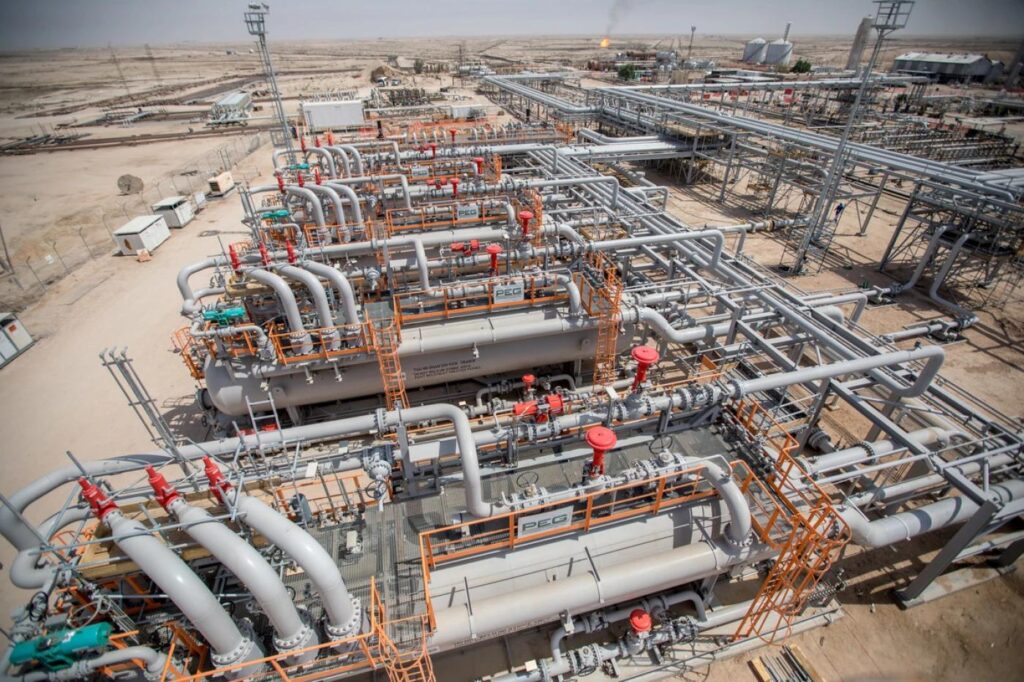
The investigation centres on allegations that crude oil and petroleum products were being diverted through unauthorised connections to pipelines in Jurf al-Sakher.
Iraqi state media reported earlier in the week that intelligence documents, including satellite imagery, indicated that an armed faction had been involved in smuggling crude oil and oil derivatives from the area. The government did not initially identify the faction in its public account.
A committee investigating the allegations entered the area on Friday accompanied by members of Kataib Hezbollah. The government subsequently said the investigation had established evidence of oil smuggling and ordered legal action against those implicated.
Al-Aboudi said investigators had found evidence of pipeline tampering. The authorities have not, however, released a complete public account of the evidence, identified the individuals allegedly responsible or provided an independently verifiable estimate of the volume of oil involved.
The nine officials removed from their positions reportedly included security and intelligence personnel in Babil province, an Interior Ministry commander and the director of the Oil Pipelines Company. Their dismissal signals that the inquiry is also examining possible failures or complicity within state institutions.
The government has not publicly detailed the alleged roles of each official, and their dismissal should not be treated as proof of criminal responsibility.
Kataib Hezbollah rejects the allegations
Kataib Hezbollah has strongly denied involvement in oil smuggling and accused the prime minister’s office of using the investigation to pressure the group.
In a statement reported by Al Arabiya, the faction said the committee that visited Jurf al-Sakher had found no violations of the oil pipelines. It described the allegations as fabricated and portrayed the government’s actions as an attempt to force it to surrender its weapons.
The group has also accused al-Zaidi’s office of breaking commitments made to the faction. Its response highlights the wider political dispute behind the investigation: the government is seeking to strengthen state control over armed formations, while powerful groups have resisted demands to give up their independent military capabilities.
The competing accounts have not been independently reconciled. The government says its committee found evidence of illegal activity, while the faction disputes that conclusion. The allegations will ultimately require transparent investigation and judicial scrutiny.
A test of Baghdad’s authority
Jurf al-Sakher has particular strategic importance because of its location south of Baghdad and its long association with Kataib Hezbollah. The area has remained under the influence of the faction since Iraqi forces and allied groups retook it from Islamic State in 2014.
Its status has also been shaped by the displacement of residents during the campaign against Islamic State. The area’s security arrangements and control have remained politically sensitive, illustrating the difficulty Baghdad has faced in restoring ordinary state administration in territories where armed groups have built substantial influence.
The latest order is therefore about more than an investigation into petroleum infrastructure. It raises questions about who exercises authority over security, transport routes and economic assets in parts of Iraq where powerful armed organisations operate alongside formal state institutions.
Al-Zaidi has previously signalled that armed factions should come under the authority of the state. The dispute over Jurf al-Sakher gives that position a concrete test: whether government forces can take control of a strategically sensitive area without triggering a wider confrontation.
Iraqi officials cited by Reuters have alleged that Kataib Hezbollah operated an oil-smuggling network for years, generating hundreds of millions of dollars since 2021. Those figures remain allegations attributed to officials and have not been established through a public judicial finding.
The reported network also points to the broader challenge of policing Iraq’s oil sector, where opaque commercial arrangements, weak oversight and the influence of armed groups have repeatedly raised concerns about the diversion of public resources.
Oil revenues and regional pressure
Oil is central to Iraq’s public finances, making allegations of organised smuggling particularly serious. Any diversion of crude or petroleum products can deprive the state of revenue and undermine confidence in the institutions responsible for managing the sector.
The investigation also comes amid continuing international pressure on Baghdad to prevent Iraqi territory and financial networks from being used to facilitate sanctions evasion. Washington has previously accused armed groups and commercial entities in Iraq of helping move Iranian oil or disguising its origin.
The United States has imposed sanctions on individuals and companies it accused of participating in such activities. The wider scrutiny has increased the political and economic stakes for the Iraqi government as it attempts to demonstrate that its oil industry is subject to effective state oversight.
However, the allegations concerning Jurf al-Sakher should not be conflated with every separate case of suspected Iranian oil-smuggling activity. The government has yet to publish enough detail to establish the full extent of the network or any cross-border connections.
For al-Zaidi, the immediate question is whether the order will lead to a genuine transfer of security control or remain a political declaration. A deployment could strengthen the government’s position if it is followed by the restoration of state administration and a credible legal process. A limited or negotiated withdrawal by the faction, on the other hand, could leave the underlying balance of power largely unchanged.
The coming days will show whether Kataib Hezbollah complies with the deadline and whether Iraqi forces can enter the area without a confrontation. The government will also face pressure to demonstrate that the investigation is being pursued consistently, with evidence presented in court rather than used solely as a tool in a political dispute.
The outcome could become an important measure of how far Baghdad is prepared to go in challenging the influence of armed groups that remain deeply embedded in Iraq’s security and political landscape.