

Egyptian authorities have detained a 21-year-old driver following a catastrophic fuel tanker crash that killed 31 people and injured 26 others on Cairo’s Ring Road, intensifying public demands for accountability and stronger road-safety enforcement.
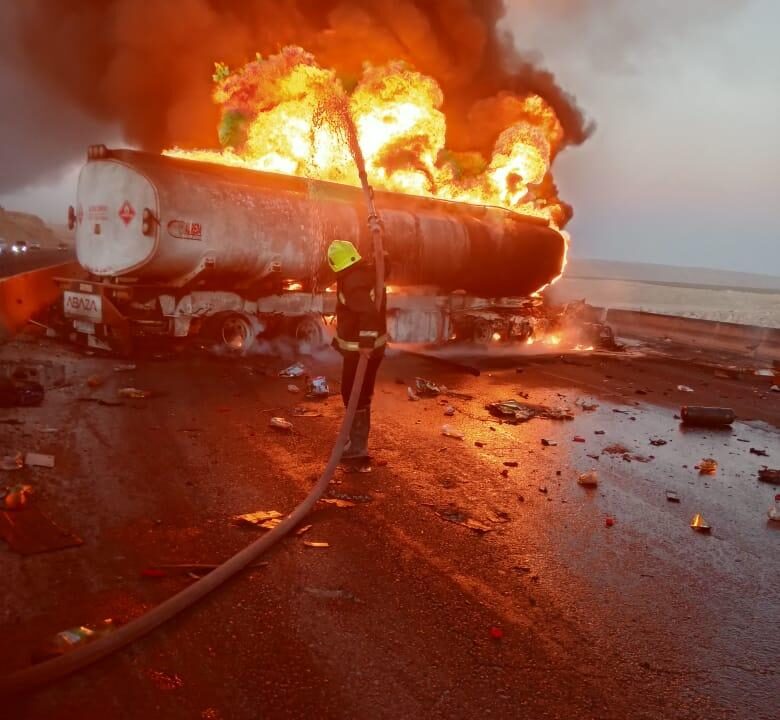
The accident occurred on Wednesday evening, 25 November, in the Al-Warraq district of Giza, on the western outskirts of Cairo. A tanker carrying petroleum products overturned and caught fire, sending flames across the busy highway and engulfing surrounding vehicles.
The Egyptian Public Prosecution said the incident destroyed 27 vehicles, including cars and motorcycles. Emergency services deployed 39 ambulances to transport injured people to nearby hospitals.
Investigators allege that the driver of a private car struck the rear of the tanker while changing lanes and overtaking traffic. According to prosecutors, the suspect told investigators that he was travelling at approximately 110 kilometres per hour when the collision occurred.
The prosecution has ordered his four-day pre-trial detention and referred him for drug testing. Investigators are continuing to establish the full circumstances of the crash and determine criminal responsibility.
The disaster has renewed debate over Egypt’s road-safety record, the movement of fuel tankers through densely populated areas and the effectiveness of regulations governing hazardous cargo.
How the Cairo Ring Road tanker fire happened
The crash occurred at approximately 6.30pm local time above Tunnel 10 on the Ring Road in Al-Warraq, a densely populated district of Giza.
The highway is one of Greater Cairo’s major transport routes, connecting the capital with surrounding areas, including Giza and Qalyubia.
According to the Public Prosecution, the suspected driver was travelling from El-Marg towards El-Haram with his father in the car.
During questioning, he reportedly said he was changing lanes and overtaking other vehicles when the front-left side of his car struck the rear-right side of the petroleum tanker.
He told investigators that he subsequently lost control of the car and moved towards the right side of the highway. At approximately the same time, one of the tanker’s tyres burst.
The tanker then struck a concrete barrier, overturned and spilled petrol onto the roadway. The fuel ignited, producing a rapidly spreading fire that engulfed nearby vehicles.
Prosecutors said the suspect’s account was examined alongside witness statements, a technical inspection of the accident site and other available evidence.
However, the investigation has not yet established every factor that contributed to the disaster. The driver’s account remains part of the evidence being examined, and his criminal responsibility must be determined through the legal process.
31 dead and 26 injured as 27 vehicles burn
Egypt’s Ministry of Health and Population confirmed that 31 people were killed and 26 injured.
The casualties made the incident one of the country’s most serious recent road disasters.
The fire spread rapidly across the highway, trapping motorists inside vehicles and forcing other drivers and passengers to flee.
Witnesses described enormous flames and thick black smoke rising above the road. Several people who attempted to help those trapped by the fire were unable to approach the vehicles because of the intensity of the heat.
The flames also reached the nearby elevated structures and prompted the evacuation of three residential buildings, according to residents interviewed by the Associated Press.
Authorities said 27 vehicles, including motorcycles and private cars, were destroyed or severely damaged.
Thirty-nine ambulances were dispatched to transport casualties to hospitals across the surrounding area.
The injured were initially taken to several medical facilities, including Imbaba General Hospital, Warraq Central Hospital and Sheikh Zayed Specialist Hospital.
According to the latest Health Ministry figures reported on 26 November, five injured people had been discharged, while 21 remained under medical treatment. Eight patients were transferred for specialist burn care.
Some patients suffered extensive burns, placing additional pressure on specialist medical teams.
Forensic investigators have also collected DNA samples from relatives of the deceased to help identify victims whose remains could not be identified through normal procedures.
Driver ordered into pre-trial detention
The investigation entered a new phase on Thursday, 26 November, when the Public Prosecution ordered the detention of the 21-year-old driver.
The four-day detention order is intended to allow investigators to continue questioning the suspect and examine the evidence surrounding the collision.
The prosecution also referred him to the Egyptian Forensic Medicine Authority for tests to determine whether he had consumed narcotic substances.
According to the official account, the suspect acknowledged striking the tanker’s rear section while travelling at approximately 110km/h.
Investigators also questioned injured survivors whose medical condition allowed them to provide statements.
The prosecution is examining the accident scene, assessing the financial damage and reviewing technical evidence to establish how the collision developed into a fire involving dozens of vehicles.
The suspect’s detention does not amount to a conviction. Prosecutors have not completed their investigation, and a court must determine whether criminal responsibility has been established.
The investigation is also examining the circumstances surrounding the tanker itself, including its operation, maintenance and transport arrangements.
These questions are important because a collision involving a vehicle carrying petroleum products can have consequences far beyond the initial impact.
Why was a fuel tanker travelling on the Ring Road during rush hour?
One of the central questions following the tragedy concerns the presence of a petroleum tanker on a major urban highway during the evening rush hour.
Egypt introduced restrictions in 2018 barring heavy trucks carrying five tonnes or more from using the Greater Cairo Ring Road between 6am and midnight.
However, the regulations included exceptions for vehicles transporting certain essential goods, including petroleum products and food.
Fuel tankers were therefore permitted to operate during daytime hours under the exemption.
The incident has prompted renewed calls to review this arrangement.
Ahmed El-Zeini, head of the Damietta Goods Transport Association, told Egyptian independent news outlet Al Manassa that fuel tankers should be restricted to overnight movements.
He argued that large vehicles carrying flammable substances create additional risks when travelling through congested urban traffic.
El-Zeini also called for more frequent technical inspections, suggesting that tankers should be checked before every loading operation rather than relying solely on periodic inspections.
Another proposal involves renewing the fuel-transport fleet and ensuring that vehicles meet strict mechanical and safety standards.
The General Union of Transport Workers and Services has also called for changes to operating hours for trucks carrying fuel and other hazardous materials.
These proposals have gained attention because the crash exposed the potential consequences of allowing heavily loaded petroleum vehicles to share busy urban highways with private cars and motorcycles.
However, investigators have not established that the daytime exemption itself caused the accident.
The prosecution must still determine the tanker driver’s circumstances, the condition of the vehicle and the factors that led to the collision.
Questions over tanker maintenance and safety inspections
The tragedy has also raised concerns about whether Egypt’s existing fuel-transport safety rules are being properly enforced.
The petroleum transportation sector is subject to technical requirements covering vehicle condition, tank integrity, maintenance and emergency equipment.
These measures are intended to reduce the possibility of leaks, fires and explosions during the movement of hazardous materials.
Ahmed El-Zeini told Al Manassa that the inspection system needs to be examined more closely, particularly regarding how frequently tankers are checked and whether operators consistently meet technical requirements.
A source familiar with the Ministry of Petroleum’s distribution system told the publication that the tanker involved in the Warraq accident belonged to a private company rather than a ministry-owned operator.
The source also said that existing regulations require fuel transport vehicles to meet technical standards and undergo maintenance inspections.
However, the precise operator of the tanker and its maintenance history had not been fully established in the public reporting available by 27 November.
The investigation will need to establish whether the vehicle was mechanically sound, whether its equipment met safety requirements and whether the driver and operator followed applicable transport regulations.
These questions are especially important because a relatively limited collision involving a fuel tanker can quickly develop into a large-scale disaster when the cargo catches fire.
Egypt’s road-safety record under scrutiny
The Cairo tanker disaster has renewed concerns about the country’s wider road-safety challenges.
Egypt recorded 5,829 road deaths in 2025, an increase of 10.8 per cent from the previous year, according to the official statistics agency, CAPMAS.
Although the figure remained below the 7,326 deaths recorded in 2021, it demonstrates the continuing scale of the country’s traffic-safety problem.
Speeding, dangerous overtaking, poor enforcement of traffic rules and unsafe road conditions have frequently been identified as contributing factors in serious accidents.
Cairo’s Ring Road is particularly important because it carries large volumes of commuters, commercial vehicles, buses, motorcycles and private cars.
The route connects major population centres and provides access to numerous industrial and residential areas.
However, its high traffic density and complex network of elevated sections and junctions create significant safety challenges.
The Associated Press reported that motorists regularly encounter vehicles entering unexpectedly, pedestrians crossing or walking alongside the highway and drivers moving between lanes at high speeds.
These conditions can increase the consequences of a single collision.
The government has invested heavily in new highways, bridges and transport infrastructure. Nevertheless, the latest disaster has raised questions about whether road-management systems, enforcement and vehicle inspections have developed at the same pace.
Several Egyptian lawmakers and public figures have called for greater accountability.
Former foreign minister Amr Moussa criticised what he described as a deterioration in oversight and follow-up, warning that avoiding responsibility could contribute to further accidents.
Some lawmakers also demanded political accountability from the government.
Government promises compensation and support for victims
The Egyptian government has announced measures to support families affected by the disaster.
Prime Minister Mostafa Madbouly ordered officials to assess the losses and provide financial assistance to families of those killed and injured.
The Egyptian Financial Regulatory Authority also directed the Compulsory Insurance Pool to accelerate the processing of eligible compensation claims under the country’s unified insurance law.
Businesses, charitable organisations, financial institutions and prominent individuals pledged at least 318 million Egyptian pounds in financial and in-kind assistance, according to Ahram Online.
The announced support included cash contributions, vehicles and other forms of assistance for affected families.
The Central Bank of Egypt directed the banking sector to coordinate an initial contribution of 60 million pounds.
Other government bodies, companies and charitable organisations also announced financial pledges.
These contributions are intended to help families manage the immediate consequences of the disaster, including medical expenses, loss of income and other financial difficulties.
However, announced donations and pledges should be distinguished from compensation already paid. The government and insurance authorities still need to complete the relevant documentation and eligibility procedures.
The scale of the public response reflects the impact of the tragedy and the widespread concern over the loss of so many lives in a single road accident.
Public anger grows after a series of transport disasters
The tanker fire occurred less than three weeks after another deadly transport accident in Egypt.
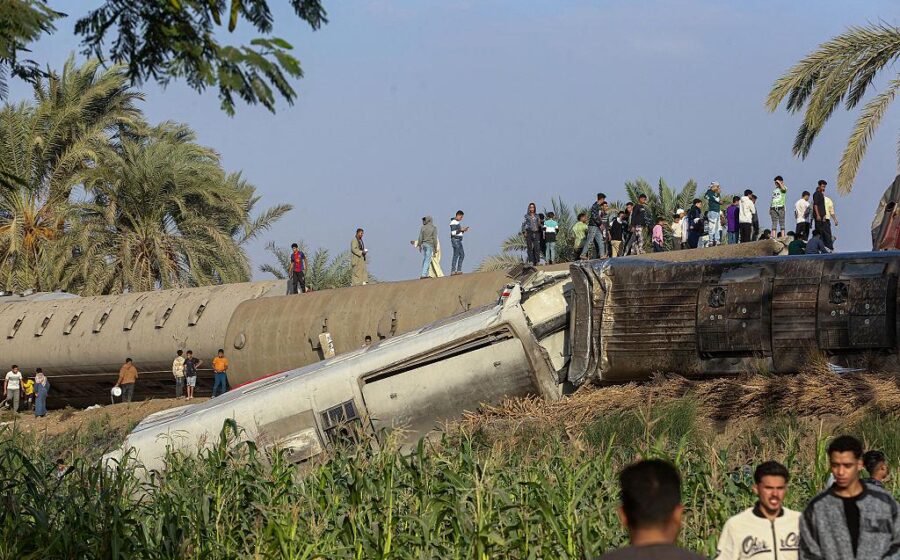
A train collision near Beni Suef killed 21 people and injured 16 in January, while other serious road and transport incidents have continued to attract criticism of safety oversight.
The latest disaster has therefore intensified public frustration over repeated accidents involving vehicles and transport infrastructure.
Some politicians have argued that the government must do more than expand highways and invest in new projects. They say road management, vehicle inspections and enforcement should receive equal attention.
Transport Minister Kamel al-Wazir has previously faced criticism following major transport accidents.
He was appointed in 2019 after a deadly train crash at Cairo’s Ramses railway station killed 25 people and prompted his predecessor to resign.
His ministry has since overseen an extensive infrastructure programme, including major highway expansion and new railway projects.
However, the latest tanker fire has renewed demands for stronger supervision of commercial transport and stricter enforcement of existing regulations.
The debate now extends beyond the responsibility of the detained driver to include the transport company, vehicle inspection arrangements and the policies governing hazardous cargo.
What happens next?
The Public Prosecution is continuing to investigate the collision and determine whether criminal responsibility extends beyond the detained driver.
The immediate steps include examining the suspect’s drug-test results, reviewing technical evidence, completing witness interviews and identifying victims through forensic procedures.
Investigators must also establish the tanker’s ownership, maintenance history and compliance with transport regulations.
Another important issue is whether the daytime exemption for petroleum tankers should be reconsidered.
The disaster has prompted calls from transport-sector representatives and road-safety advocates for changes to operating hours, more frequent vehicle inspections and improved safety arrangements on major highways.
The government will also need to ensure that compensation reaches eligible families and that those still receiving treatment have access to specialist medical care.
For the families of the 31 people killed, the priority remains identifying the victims, receiving the necessary support and obtaining answers about the circumstances of the accident.
The tragedy has exposed the consequences of a collision involving hazardous cargo on one of Egypt’s busiest roads.
The detention of the driver is an important development in the investigation, but establishing accountability will require a broader examination of the vehicles, transport rules and safety systems involved.
Whether the disaster leads to lasting changes in Egypt’s fuel-transport regulations will be one of the most important questions arising from the investigation.