


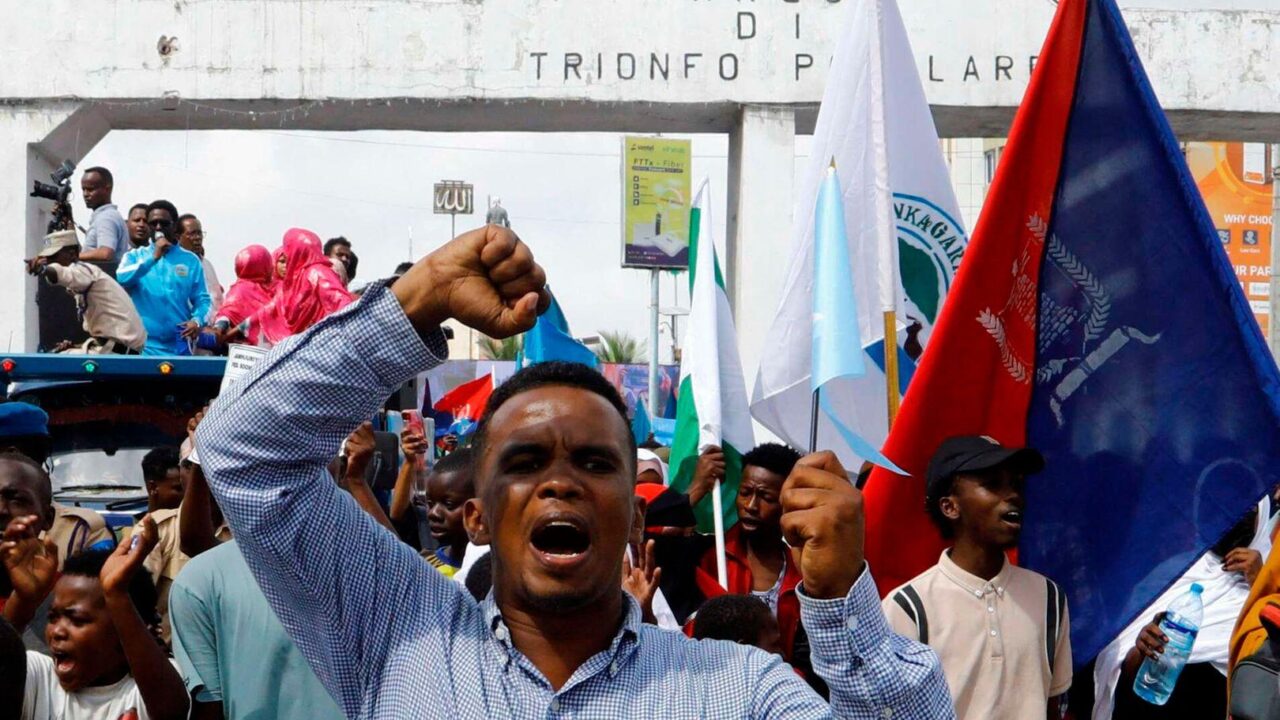
Somalia has ordered the United Arab Emirates’ ambassador to leave the country within 72 hours, marking a major escalation in a diplomatic dispute that has exposed growing tensions over national sovereignty, regional political influence and control of strategic infrastructure in the Horn of Africa.
The decision was announced on Thursday, 19 November, following a meeting of Somalia’s Council of Ministers in Mogadishu. The government also instructed its Foreign Ministry to recall Somalia’s ambassador from Abu Dhabi for consultations.
Information Minister Abdifatah Kasim Mohamud said the measures were taken in response to what the government described as violations of Somalia’s sovereignty, territorial integrity and national unity. In a televised statement carried by the state-run news agency, he characterised the alleged Emirati actions as an “open invasion” but did not identify specific incidents that had prompted the decision.
The UAE rejected Mogadishu’s accusations, describing the Somali government’s approach as “escalatory and hostile”. The diplomatic exchange marks the latest stage in a dispute that began intensifying earlier this year after Somalia cancelled a series of agreements with the Gulf state.
Somalia announces diplomatic measures against Abu Dhabi
The decision followed growing criticism from Somali President Hassan Sheikh Mohamud, who had accused the UAE of providing economic and political support to regional authorities in ways that undermined the federal government.
The president’s allegations centred on the UAE’s relationships with Somaliland, Puntland and Jubbaland. These territories and administrations have maintained direct relationships with Abu Dhabi, including commercial, infrastructure and security links.
Somalia’s federal government has argued that foreign governments must respect its national institutions and should not establish arrangements that bypass the central authorities. Mogadishu considers dealings involving its territory and national security to fall within the authority of the federal state.
Following Thursday’s cabinet meeting, the Information Ministry announced that the UAE ambassador would be instructed to leave within 72 hours. Somalia’s ambassador to the UAE was recalled for consultations, while the government said it would bring its concerns to foreign governments and international organisations.
Somali officials also warned that measures could be taken against individuals or organisations cooperating with what the government considers hostile actions against the country.
The announcement represents one of the strongest diplomatic steps taken by Mogadishu against Abu Dhabi since the relationship deteriorated in January.
UAE rejects accusations and points to its embassy closure
The UAE responded on Thursday through its Ministry of Foreign Affairs, condemning what it described as Somalia’s increasingly hostile approach.
Abu Dhabi said decisions affecting bilateral relations should be guided by shared interests rather than domestic political disputes. It also expressed regret over what it characterised as attempts by the Somali government to draw the UAE into internal power struggles.
A significant detail in the UAE’s response was its statement that the embassy in Mogadishu had already been closed and its diplomatic staff withdrawn in January 2026.
The UAE said the withdrawal followed actions by the Somali government that it considered hostile, including the cancellation of bilateral agreements. It nevertheless reaffirmed its commitment to maintaining relations with the Somali people.
This creates an important practical question surrounding the expulsion order. If the UAE’s diplomatic staff had already been withdrawn, the presence and status of its ambassador in Somalia at the time of the latest announcement require clarification.
Neither side’s public statements have established precisely what operational steps remain to be taken under the 72-hour deadline.
Port agreements lie at the centre of the dispute
The diplomatic crisis has its roots partly in the UAE’s extensive commercial and security presence in Somalia.
On 12 January 2026, Somalia announced that it was cancelling all agreements with the UAE, including arrangements involving ports, federal government institutions, defence and security cooperation.
The decision covered agreements associated with the ports of Berbera, Bosaso and Kismayo, three strategically important locations along the Horn of Africa’s coastline.
These facilities occupy commercially and strategically valuable positions near major international shipping routes connecting the Red Sea, Gulf of Aden and Indian Ocean.
The UAE has invested heavily in port infrastructure and commercial ventures in the region. Emirati-linked companies have supported major port development projects, while Abu Dhabi has also maintained security relationships with Somali forces and regional authorities.
The Somali federal government’s January decision was based on allegations that the UAE had undermined the country’s sovereignty and political independence.
However, Somaliland, Puntland and Jubbaland rejected Mogadishu’s authority to cancel agreements involving their respective territories. Their position exposed the wider constitutional and political dispute over how powers should be divided between Somalia’s federal government and regional administrations.
The disagreement is therefore not simply about commercial contracts. It also concerns who has the authority to negotiate international agreements, manage strategic assets and determine the country’s security partnerships.
The UAE’s security footprint adds to political tensions
Beyond port investment, the UAE has played a significant role in Somalia’s security sector.
The Emirates trained hundreds of Somali troops between 2014 and 2018 and has provided financial and logistical assistance to security personnel.
According to Reuters, citing senior Somali sources, the UAE has continued covering salaries and providing logistical support for approximately 3,400 Somali military police and special forces personnel in and around the capital.
That involvement has made the bilateral relationship particularly sensitive. Security cooperation can support the Somali government’s efforts against militant groups, but arrangements involving regional authorities and forces outside direct federal control have also become politically contentious.
President Hassan Sheikh Mohamud’s recent accusations suggest that Mogadishu views Abu Dhabi’s relationships with regional administrations as a challenge to federal authority.
The UAE has denied interfering in Somalia’s domestic affairs. Its government has instead presented its engagement as part of a wider relationship with the Somali people and the development of trade, infrastructure and security cooperation.
There is currently no independently established public evidence demonstrating the specific violations described by Somalia’s information minister. The allegations remain contested between the two governments.
Somalia faces wider political instability
The confrontation with the UAE is unfolding at a difficult moment for Somalia.
The federal government continues to face disputes with regional authorities over political representation, constitutional arrangements and the country’s electoral process.
The United Nations Transitional Assistance Mission in Somalia completed its mandate and closed on 31 October 2026, following a planned transition of responsibilities to the Somali government and the wider UN country team.
The end of the mission comes amid disagreement between rival political actors and concerns about the mechanisms available for resolving disputes. An election-related confrontation earlier in the year also resulted in armed clashes in Mogadishu.
The Associated Press has reported that Somalia’s Supreme Court ruled earlier this month that President Hassan Sheikh Mohamud’s term had expired and ordered elections within 90 days. The wider political dispute has added pressure to an already fragile federal arrangement.
In this environment, foreign relationships can become closely connected to domestic political competition. The UAE’s engagement with regional authorities has therefore become a particularly sensitive issue for the federal leadership.
Strategic importance extends beyond Somalia
The dispute has implications for the wider Horn of Africa, a region whose coastline overlooks important international shipping routes.
Somalia’s position along the Gulf of Aden and Indian Ocean makes its ports and coastal infrastructure strategically valuable. The region is also significant for military access, maritime security and trade between Africa, the Middle East and Asia.
The UAE has developed economic and diplomatic relationships across the Horn of Africa, using investment, port development and security partnerships to strengthen its regional position.
A prolonged breakdown in relations with Somalia could complicate those arrangements, particularly where agreements involve regional authorities whose political status is disputed by Mogadishu.
It could also place pressure on commercial operators and partners whose investments depend on stable political and legal arrangements.
For Somalia, the challenge will be to protect federal authority without damaging essential trade and security relationships. For the UAE, the immediate question will be whether it can preserve its regional interests while navigating the deteriorating relationship with Mogadishu.
Diplomatic consequences remain uncertain
Somalia’s decision to order the ambassador’s departure represents a significant escalation, but it does not automatically mean that the two countries have formally severed all diplomatic relations.
The recall of an ambassador for consultations is a serious diplomatic measure, while ordering another country’s envoy to leave is a further step towards reducing official representation.
Both governments retain a shared interest in trade, regional security and maintaining links between their populations. The UAE’s statement emphasising its relationship with the Somali people suggests that Abu Dhabi is seeking to distinguish its broader ties from the dispute with the federal government.
For now, the most important unanswered questions concern the precise allegations made by Mogadishu, the implementation of the 72-hour order and whether either side is prepared to reopen diplomatic channels.
The confrontation has highlighted a deeper problem facing Somalia: the challenge of balancing federal sovereignty with the political and economic influence of powerful external partners.
Whether the dispute leads to a prolonged diplomatic breakdown or becomes the starting point for renewed negotiations will depend on the next steps taken by both governments.