


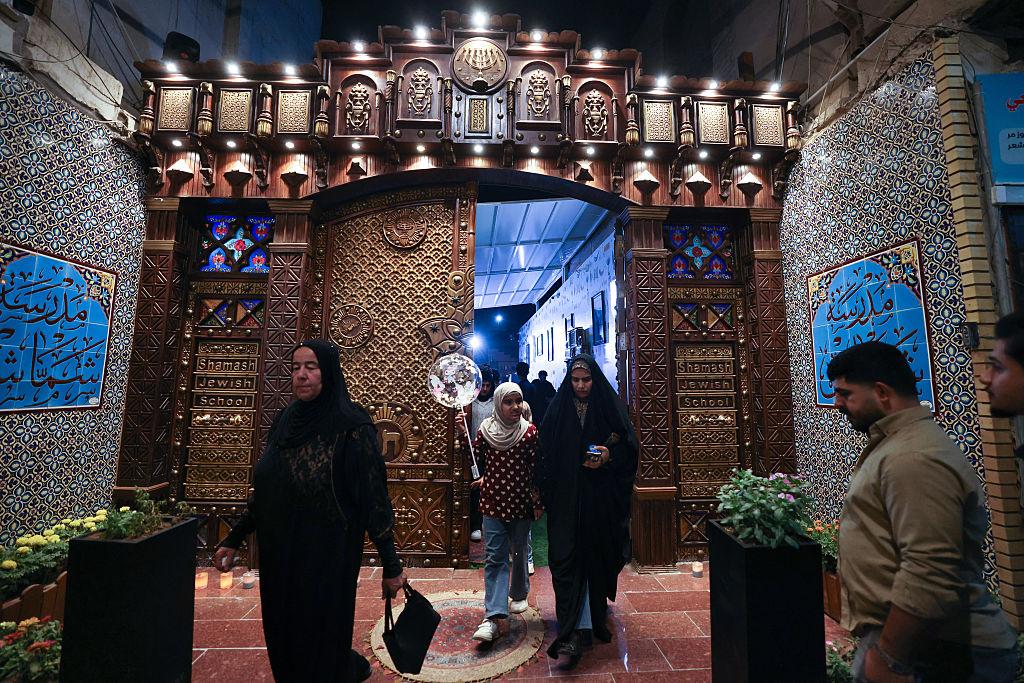
Baghdad’s newly opened Shamash Jewish Museum is attracting Iraqi visitors to a restored former school, offering a rare public window into a community that once played a central role in the country’s cultural and economic life. Its opening has also prompted a reported warning from a senior figure in the Badr Organization, exposing the sensitivities surrounding the public preservation of Jewish heritage in Iraq.
The museum, housed in the historic Shamash Jewish School on Al-Rashid Street in central Baghdad, opened to visitors on 30 October. Its displays include family photographs, handwritten documents, identity cards, school certificates and portraits of prominent Iraqi Jews. For visitors, the collection offers a tangible connection to a chapter of national history that has become increasingly distant as the country’s Jewish population has dwindled.
Dozens of Iraqis have been visiting the museum each day, according to Reuters, although the community’s representative said no Jewish visitors had yet arrived by the time of the agency’s report on 12 November.
The project has been led by Khalida Fouad Eliyahu, a Baghdad-born dentist who heads Iraq’s small remaining Jewish community. Its opening marks a significant step in efforts to preserve Jewish communal heritage, but the reaction from a powerful political and armed organisation has also underlined the challenges facing such initiatives.
A school transformed into a museum
The Shamash Jewish School was founded in 1928 by Jewish philanthropist Yacoub Shlomo Shamash. It served generations of students in Baghdad, including members of the Jewish community, and reflected the educational and commercial networks that connected Jewish families to the wider life of the city.
The building has now been restored and adapted into a museum. Its displays preserve records of former pupils and other material documenting the community’s presence in Iraq. A brass menorah stands above archival documents, while photographs and portraits recall figures whose contributions extended into public administration, medicine and the arts.
Among those commemorated is Sassoon Heskel, also known as Sassoon Eskell, a Baghdad-born Jewish politician who served as Iraq’s first finance minister after the establishment of the modern Iraqi state in 1920. The museum also recognises singer Salima Murad, one of the best-known performers in Iraqi music during the 1920s and 1930s.
Murad was celebrated for her performances of Iraqi Maqam, a classical musical tradition, as well as popular songs. Her career illustrates how Jewish artists and professionals were part of the cultural landscape shared by Iraqis of different religious backgrounds.
The collection is not simply a record of religious life. School certificates, personal photographs and identity documents also reveal the ordinary experiences of families who studied, worked and built businesses in Baghdad.
Ammar al-Tamimi, legal representative of the Jewish community in Iraq, told Reuters that the museum was established to preserve the school’s memory after demographic and economic changes transformed the surrounding district. The area has increasingly become a commercial zone, with warehouses and businesses replacing its former educational character.
A community that once shaped Baghdad
The museum’s significance is inseparable from the scale of Iraq’s former Jewish population. Jewish communities have lived in Mesopotamia for more than two millennia, forming part of the region’s social and economic life long before the creation of modern Iraq.
Under Ottoman rule and into the first half of the 20th century, Jews made up roughly one-fifth of Baghdad’s population, according to Reuters. They were active in trade, banking, medicine, education, public administration and the arts.
Iraq’s Jewish population stood at about 150,000 in 1947. That presence was dramatically reduced in the years that followed. Anti-Jewish violence, discriminatory measures and political upheaval contributed to the community’s exodus. Between 1950 and 1952, around 125,000 Iraqi Jews were airlifted to Israel.
The departure reshaped neighbourhoods, businesses and religious institutions. Families left behind homes, schools, synagogues, cemeteries and communal properties, while successive generations grew up outside the country in which their ancestors had lived.
Today, official Iraqi figures cited by Reuters indicate that only a handful of Jews remain in Baghdad, while around 90 Jews of Kurdish origin live in the Kurdistan region. The small size of the remaining community makes the preservation of buildings and records particularly important: many of the people who could have provided first-hand accounts of the city’s Jewish life now live abroad or are no longer alive.
The Shamash Museum gives visitors an opportunity to encounter that history through objects and documents rather than through distant references in textbooks or family accounts.
The restoration effort and the question of access
The museum’s creation was led by Khalida Fouad Eliyahu, who was born in Baghdad to a Jewish family and now heads the country’s small remaining Jewish community. Reuters reported that the project was financed through Jewish community resources.
The building’s history also reflects the difficulties involved in recovering and protecting communal property. According to reporting by World Israel News, the Iraqi government confiscated the school property in the 1970s and converted it into a public school. A court ordered its return to the Jewish community in 1992.
The restoration is part of a broader effort to preserve sites associated with Iraq’s Jewish past. Community representatives have expressed interest in rehabilitating other historic landmarks, including synagogues and religious buildings that have suffered from neglect or changes in ownership and use.
Historian Saadi al-Iraqi welcomed the museum’s opening and called for further preservation. He told Reuters that he hoped synagogues and other Jewish places of worship could also reopen.
Yet the question of access remains important. The museum is a public-facing cultural project, but the absence of Jewish visitors at the time of Reuters’ report highlighted the distance between preserving a community’s heritage and enabling its displaced members to reconnect with it.
The museum’s organisers have not, in the reporting available, announced a broad programme for visits by Iraqi Jews living abroad. Nor does the opening by itself resolve wider questions concerning communal property, religious freedom or the ability of descendants to return to ancestral homes.
Badr criticism exposes political sensitivities
The museum’s opening has also attracted criticism from the Badr Organization, an influential Iraqi political and armed group.
In a social media statement reported by Israel Hayom on 11 November, Muhammad Naji Muhammad, whom the publication identified as a senior Badr figure, condemned the museum and portrayed it as a political initiative linked to Israel rather than a cultural preservation project.
He described the museum as a “security and cultural breach” and said those who approved its opening should be held responsible. He also argued that Baghdad should not become a platform for what he characterised as Zionist projects.
The comments were reported by Israel Hayom and subsequently covered by World Israel News. The wording represents the position expressed by the individual identified in those reports; it does not establish that the museum is connected to Israeli political activity. The museum’s stated purpose, according to its organisers and Reuters’ reporting, is to preserve the history of Iraq’s Jewish community.
The distinction is significant in Iraq, where the question of relations with Israel carries substantial legal and political consequences. A cultural project dedicated to Jewish history can therefore become entangled in arguments about national identity and regional politics, even when its displays focus on the lives of Iraqi families and their contributions to the country.
No physical attack on the museum was reported in the coverage reviewed for this article. Nor was an official Iraqi government response to the Badr statement established in the available reporting. The reported criticism nevertheless raises questions about the security and institutional support available to those working to preserve minority heritage.
More than a building
For many Iraqi visitors, the museum appears to offer a chance to rediscover a part of Baghdad that is no longer visible in everyday public life.
Nabil Abdul Hameed, a 71-year-old Baghdad resident who visited twice, told Reuters that he had initially doubted the museum existed. He returned with his daughter and grandchildren after seeing it for himself, and said he hoped the interest generated by the collection would grow.
He described Jews as among the founders of modern Iraq and expressed the hope that they might one day return to participate in the country’s revival.
His comments reflect one strand of the response to the museum: an interest in recovering a more complete account of Iraqi history, including the communities that once lived alongside one another in the capital.
The museum cannot reverse the displacement of Iraqi Jews or restore the institutions that disappeared with their departure. It can, however, preserve evidence of their lives and make that history accessible to a new generation of visitors.
Its future significance will depend on whether the restoration becomes part of a wider and sustained effort to protect Jewish heritage sites, preserve communal records and allow historical discussion without intimidation or political distortion.
For now, the Shamash Museum stands as both a cultural achievement and a reminder of what Baghdad has lost. Its visitors are encountering not an unfamiliar foreign history, but a part of Iraq’s own past.


