

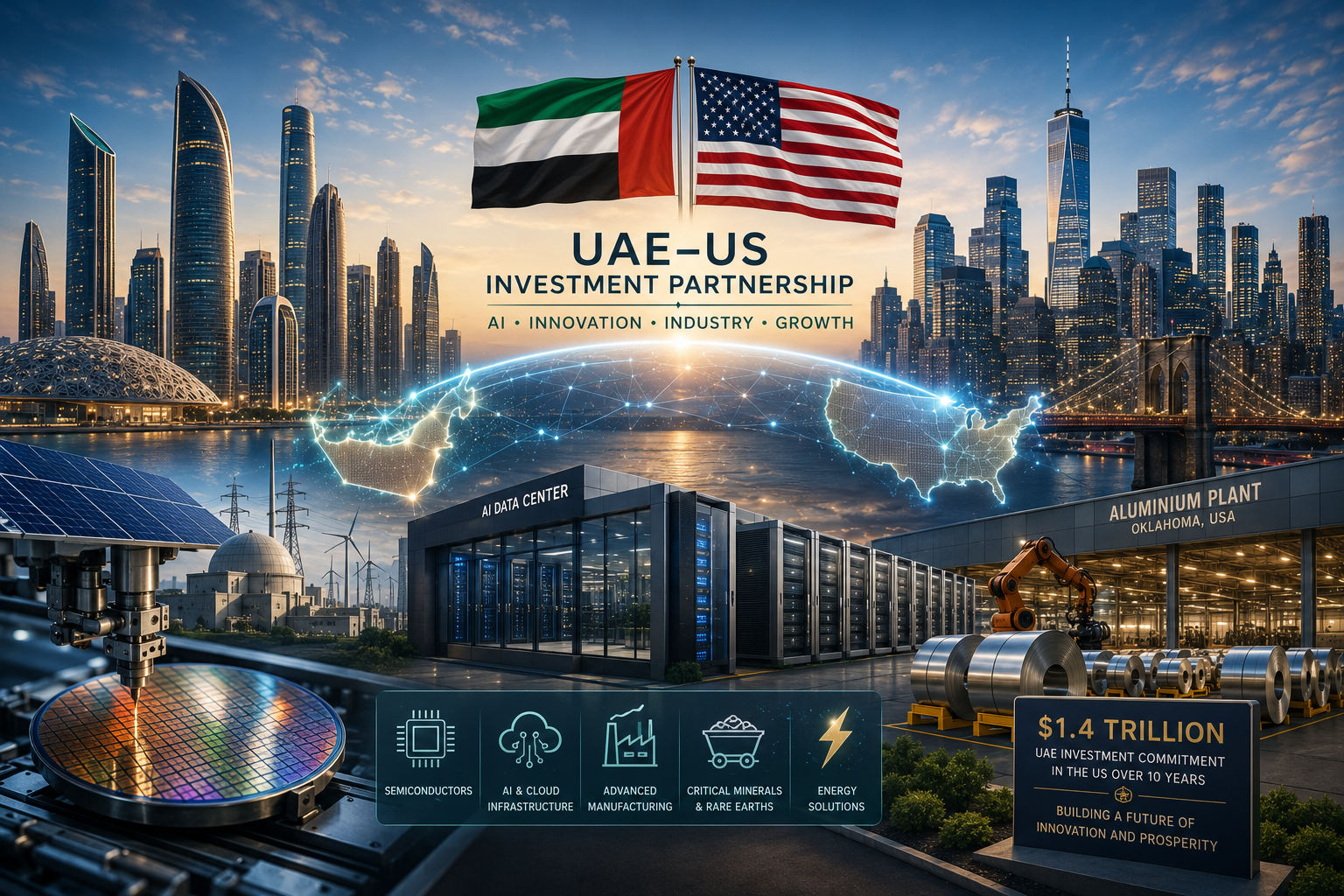
A $1.4 trillion economic framework is evolving into a two-way system of data centres, semiconductors, critical minerals, energy infrastructure and manufacturing projects.
ABU DHABI — June 13, 2026: The investment relationship between the United Arab Emirates and the United States is moving beyond traditional portfolios of property, financial assets and energy holdings towards the physical infrastructure of the artificial-intelligence economy.
A year after the two countries established an expanded bilateral economic framework, officials say UAE entities are investing across advanced semiconductors, data centres, energy, manufacturing, aviation, infrastructure and healthcare in the United States.
American companies, in return, are taking larger roles in the development of the UAE’s cloud, computing, engineering and industrial capabilities.
The partnership is anchored by a UAE commitment to invest $1.4 trillion in the US economy over ten years. The figure represents a long-term framework rather than money already transferred or deployed.
Its significance therefore depends less on the headline value than on the projects that move from announcement to financing, construction and operation.
A June progress review involving Khaldoon Khalifa Al Mubarak, chairman of the UAE Executive Affairs Authority, and US Commerce Secretary Howard Lutnick indicated that the Emirates was ahead of its first-year investment targets.
The public statement did not provide a complete audited breakdown of the capital deployed under the framework. It did, however, identify artificial intelligence and advanced industry as the central engines of the expanding relationship.
From capital investor to industrial partner
The UAE has invested in the United States for decades through sovereign funds, energy companies and strategic corporate holdings.
What is changing is the nature of that capital.
Earlier phases of the relationship often involved the acquisition of financial stakes or ownership interests in established assets. The new model increasingly combines investment with construction, operating partnerships, technology access and domestic manufacturing.
UAE capital is now being directed towards the full AI supply chain: the chips that perform advanced calculations, the data centres that house them, the power systems that support those facilities and the software companies that turn computing capacity into commercial products.
This reflects a wider shift in the global investment environment.
Artificial intelligence is no longer treated solely as a software industry. It depends on electricity generation, cooling systems, semiconductors, fibre networks, industrial metals, skilled engineers and secure supply chains.
The countries capable of bringing those components together will possess an economic advantage that extends well beyond the technology sector.
For the UAE, participating in that system supports its ambition to become a global centre for AI and advanced technology.
For the United States, Emirati capital can help finance the exceptionally expensive infrastructure required to expand domestic computing and manufacturing capacity.
AI becomes the centre of the relationship
The US–UAE AI Acceleration Partnership is the most visible component of the framework.
Under the agreement announced in May 2025, the UAE committed to invest in, build or finance data-centre capacity in the United States at least comparable in scale and computing power to the capacity developed in the Emirates.
The arrangement also included commitments relating to the security of American-origin technology.
Access to advanced AI chips has become closely connected to national security because the same computing systems used for commercial models can support defence, surveillance, cyber capabilities and scientific research.
The United States has therefore sought assurances that sensitive technology exported to the UAE will be protected against unauthorised access or diversion.
This makes the partnership different from an ordinary commercial investment agreement.
The UAE is not merely purchasing American equipment. It is aligning parts of its technology-governance system with US security expectations in return for deeper participation in the American AI ecosystem.
That alignment has enabled the two countries to pursue projects at a scale that would have been politically difficult only a few years earlier.
Abu Dhabi’s 5-gigawatt AI campus
The most ambitious physical expression of the partnership is the planned 5-gigawatt UAE–US AI Campus in Abu Dhabi.
The project is intended to host American hyperscalers and approved cloud providers, allowing them to supply computing services to customers across the Middle East, Africa and Asia.
At full scale, five gigawatts would make the site one of the largest concentrations of AI data-centre capacity in the world.
The campus is being developed by G42 and is expected to use a combination of nuclear, solar and gas-generated electricity. A science park is also planned to support AI research and commercial development.
Official updates describe the first capacity as being introduced in stages. Mubadala has referred to an initial 200-megawatt cluster beginning operations in late 2026, while a June bilateral progress statement said the first 500 megawatts would come online by the end of the year.
The difference may reflect multiple phases within the initial development, but the precise schedule will need to be clarified as construction progresses.
The larger strategic purpose is clearer.
Abu Dhabi wants to become the primary regional location in which American technology companies can provide advanced computing services close to emerging markets.
The UAE argues that the campus could provide lower-latency access to nearly half the global population.
That position could turn the Emirates from a major consumer of AI technology into an exporter of computing capacity and machine intelligence.
Emirati capital enters US data-centre infrastructure
The partnership is designed to operate in both directions.
While American technology companies participate in the Abu Dhabi campus, UAE investment organisations are expanding their exposure to digital infrastructure in the United States.
MGX, Abu Dhabi’s AI-focused investment company, has invested in data-centre platforms supporting the development of large American computing campuses.
By late 2025, MGX said it was supporting 2.3 gigawatts of planned data-centre capacity in Texas and Wisconsin through investments connected to Vantage Data Centers and the wider Stargate infrastructure programme.
It also participated in the approximately $40 billion acquisition of Aligned Data Centers alongside the AI Infrastructure Partnership and Global Infrastructure Partners.
These investments illustrate the scale of capital required by modern AI infrastructure.
Large data centres require land, grid connections, backup generation, specialised cooling, high-speed networking and enormous volumes of advanced computing equipment.
The financial returns can be attractive where long-term demand and creditworthy tenants are secured. Yet the risks are also substantial.
Power availability, planning approvals, chip supply and the possibility of technological change can affect whether a project delivers its expected value.
The UAE’s strategy therefore combines financial investment with access to the industrial knowledge required to build similar systems at home.
Semiconductors carry strategic conditions
Advanced chips sit at the centre of the partnership—and its political sensitivity.
US officials have described the economic framework as a means of mobilising capital behind the American technology stack, from advanced semiconductors to large-scale computing infrastructure and AI applications.
The United States remains a leader in chip design and AI hardware, but semiconductor production and supply chains are spread across several countries.
Washington has made the expansion of domestic semiconductor and advanced-manufacturing capacity a national-security priority.
The UAE, meanwhile, needs access to large quantities of advanced chips if it is to operate computing campuses at the planned scale.
Mubadala stated in its 2026 partner letter that approval had been secured for as many as 35,000 Nvidia Blackwell GB300 chips for Stargate UAE.
This represents a major increase in regional computing capacity, but access is expected to remain subject to regulatory controls, approved operators and security safeguards.
For the UAE, the arrangement provides access to frontier technology.
For the United States, it extends the commercial reach of American chipmakers and cloud companies while attempting to preserve control over how their most advanced systems are used.
Advanced industry moves beyond technology
The economic partnership is not limited to data centres.
Emirates Global Aluminium is advancing a project to build a primary aluminium production plant in Oklahoma in partnership with Century Aluminum.
The facility is expected to produce at least 600,000 tonnes of aluminium annually, potentially close to doubling existing US primary-production capacity.
Construction is expected to begin by the end of 2026, with production targeted before the end of the decade.
The project is still subject to development conditions, including power arrangements, incentives and final investment decisions. It should therefore not be treated as an operating facility.
Nevertheless, it demonstrates how the bilateral framework is moving into strategically important heavy industry.
Aluminium is used across aviation, automotive manufacturing, defence, construction, energy systems and electronics. The United States currently imports a large majority of the metal required by its industries.
A new domestic smelter would strengthen industrial capacity while giving the UAE a significant position within the American manufacturing supply chain.
The plant is also expected to use technology developed by EGA, showing that the flow of expertise is not exclusively from the United States to the Emirates.
Critical minerals become an economic-security priority
In February 2026, the UAE and the United States signed a framework covering critical minerals and rare-earth supply chains.
The agreement is intended to mobilise public and private capital across mining, processing, separation, recycling and downstream manufacturing.
These materials are essential to semiconductors, batteries, defence systems, renewable-energy technologies and advanced electronics.
The framework includes potential financing, guarantees, equity investment, insurance, offtake agreements and regulatory support for projects in both countries.
It also calls for the joint identification of priority projects designed to address gaps in strategic supply chains.
This area may become one of the most consequential parts of the relationship.
AI systems depend on physical materials whose production is often concentrated in a small number of markets. Diversifying those supplies is increasingly treated as a matter of industrial and national security.
The UAE brings capital, logistics capabilities and relationships across Africa, Asia and the Middle East. The United States brings a large industrial market, technology and political demand for less concentrated supply chains.
Combining those strengths could give the partnership influence across industries extending far beyond AI.
American companies expand inside the UAE
The bilateral arrangement also creates commercial opportunities for US companies within the Emirates.
Qualcomm announced an engineering centre in Abu Dhabi focused on artificial intelligence, data centres and industrial internet-of-things applications.
Amazon Web Services, e& and the UAE Cybersecurity Council have worked on a sovereign cloud initiative intended to support public-sector cloud adoption and cybersecurity development.
American hyperscalers are also expected to participate in the Abu Dhabi AI campus, although individual commitments and operating roles will become clearer as each stage is developed.
These projects allow US companies to reach markets across the Gulf, Africa and South Asia from a commercially connected regional base.
The UAE offers relatively advanced digital infrastructure, substantial energy capacity and a government prepared to finance long-term technology development.
It also offers a regulatory and diplomatic platform through which multinational companies can operate across emerging markets.
For Abu Dhabi, attracting those companies helps build local expertise and supports the development of an economy capable of producing, rather than merely importing, advanced technology.
Energy is the hidden foundation of AI
The growth of AI has made electricity a central element of technology policy.
Training and operating advanced models requires enormous computing capacity, and that capacity consumes substantial amounts of power.
The UAE’s energy portfolio gives it a potential advantage.
It has natural-gas resources, large solar projects and the Barakah nuclear-energy plant, which supplies approximately one-quarter of the country’s electricity.
The planned Abu Dhabi campus is expected to draw on nuclear, solar and gas power to provide reliable generation while limiting emissions.
UAE energy companies are also investing in the United States.
The June partnership update identified ADNOC, XRG and Masdar as participants in American power-generation and energy-infrastructure projects.
This connection between energy and technology is likely to deepen.
Future AI leadership may depend as much on the ability to build electricity grids and cooling systems as on the design of algorithms.
Trade provides a wider commercial foundation
The investment framework is supported by a large bilateral trade relationship.
US goods exports to the UAE reached $31.4 billion in 2025, according to figures cited by the UAE Embassy from Department of Commerce data.
Total goods trade reached a record $39 billion, leaving the United States with a $23.8 billion surplus.
The UAE remained the largest destination for American goods exports in the Middle East and North Africa for a seventeenth consecutive year.
These figures show that the relationship is not based on Emirati investment alone.
American companies already sell aircraft, machinery, technology, vehicles, medical equipment and industrial products into the UAE.
As the Emirates develops advanced infrastructure, its demand for American technology and engineering services could increase further.
Headline commitments require measurable delivery
The $1.4 trillion framework provides an indication of political ambition, but it should not be confused with realised investment.
Ten-year commitments can include transactions at different stages: completed acquisitions, planned projects, financing frameworks, memoranda of understanding and future capital dependent on market conditions.
Some projects may be delayed, altered or never reach construction.
The credibility of the partnership will therefore depend on measurable results.
Those include megawatts of data-centre capacity brought online, factories constructed, jobs created, chips delivered, supply contracts signed and investment returns generated.
Independent reporting will also be necessary to assess the progress claims made by both governments.
The June statement that the UAE was ahead of its first-year targets is important, but the absence of a complete public project-by-project accounting limits external verification.
A new model of strategic investment
The UAE–US partnership reflects a wider change in the role of sovereign capital.
Investment is increasingly being used to secure access to technology, infrastructure, energy and strategic materials rather than simply to earn financial returns.
For the UAE, the partnership supports economic diversification and provides a route into the industries expected to shape global productivity.
For the United States, it brings long-term capital into sectors where national ambitions require enormous spending.
Both sides also gain geopolitical influence.
The United States extends its technology ecosystem into a strategically located Gulf partner. The UAE strengthens its position as a bridge between American innovation and fast-growing markets across the Global South.
The relationship will still face difficult questions involving technology controls, commercial concentration, energy demand and data governance.
Its future will be determined by whether the two countries can balance access with security, speed with regulation and political ambition with commercially sustainable execution.
What has already changed is the definition of the partnership.
It is no longer simply about how much UAE capital enters the United States or how many American products are sold in the Emirates.
It is increasingly about which country provides the chips, who builds the data centres, where the electricity comes from and who controls the industrial infrastructure beneath the next phase of the global economy.