


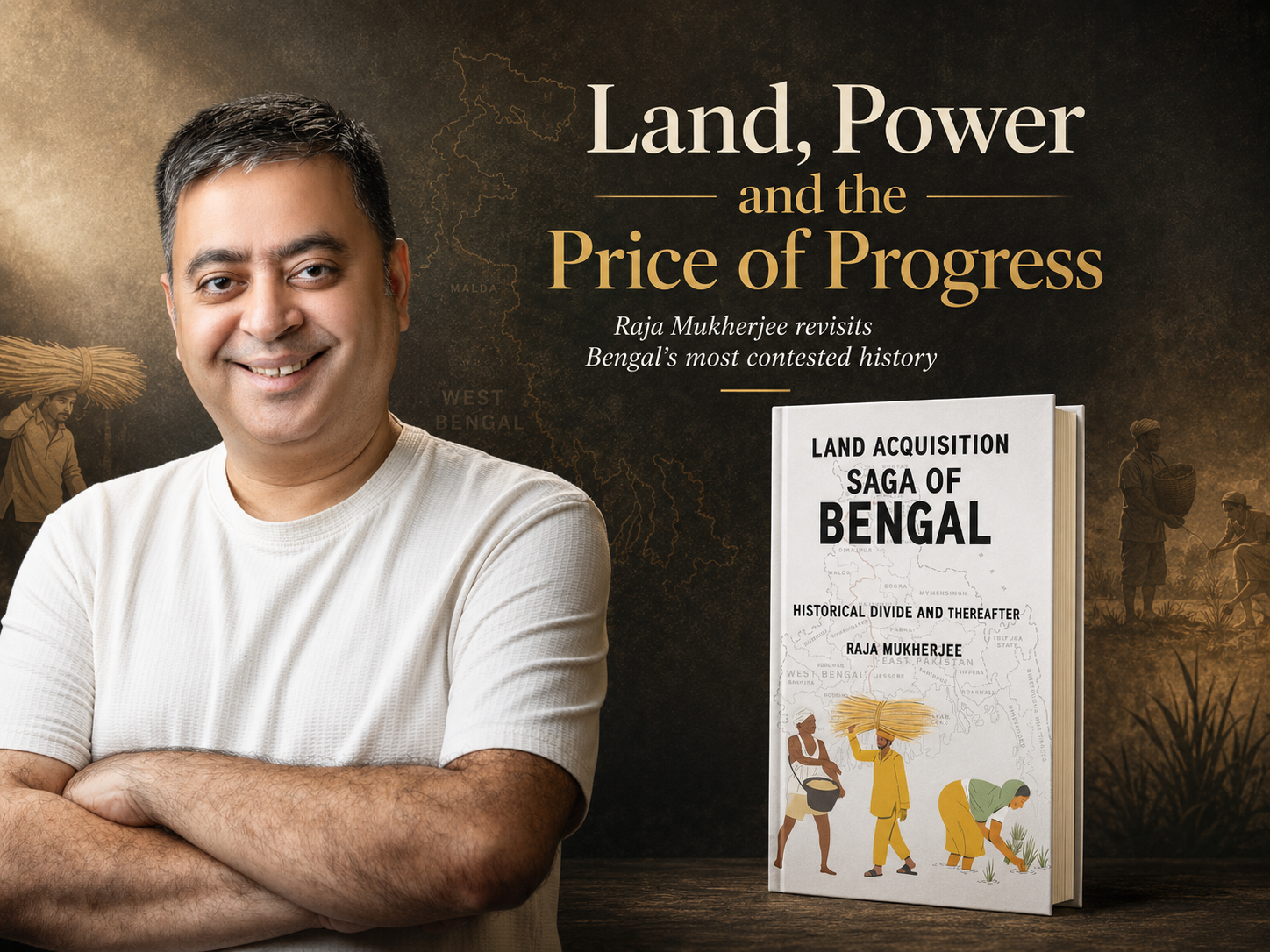
In Land Acquisition: Saga of Bengal, Historical Divide and Thereafter, author and geopolitical analyst Raja Mukherjee examines how colonial land systems, Partition, political movements and modern development transformed Bengal, and why the human cost of land acquisition remains globally relevant.
Land is rarely just property.
It is livelihood, inheritance, identity, memory and political power. Across history, struggles over land have shaped borders, displaced communities, created new centres of wealth and altered the relationship between citizens and the state.
In his book, Land Acquisition: Saga of Bengal — Historical Divide and Thereafter, Indian author and geopolitical analyst Raja Mukherjee enters one of South Asia’s most complex historical landscapes to examine the relationship between land, politics, development and human displacement in Bengal.
Published by Adhyayan Books, the work traces the changing character of land ownership and acquisition across colonial rule, Partition and the political movements that followed. It places Bengal’s agrarian history within a broader debate that remains urgent today: when governments and corporations pursue development, who benefits, who pays the price and whose voices are excluded from the final decision?
For readers in the Middle East, where cities, economic corridors, infrastructure projects and new development zones are transforming the physical and social landscape, Mukherjee’s subject carries relevance far beyond India.
His book asks a question faced by societies across the world: can economic progress be pursued without separating communities from their land, history and dignity?
Bengal as a Historical Battleground
Bengal occupies a distinctive place in the political and economic history of South Asia.
The region experienced colonial extraction, famine, peasant movements, religious division, Partition, refugee migration, industrialisation and decades of ideological conflict. Land was at the centre of many of these transformations.
Mukherjee’s book examines the historical structures that shaped land ownership in Bengal, including the legacy of the zamindari system. Under such arrangements, control over land was often concentrated among intermediaries, while cultivators remained economically vulnerable despite working the soil.
This produced a deeply unequal rural order.
Land was not only an economic resource. It defined social authority. Those who controlled it could influence employment, credit, political participation and access to security. Those without secure rights remained exposed to eviction, debt and exploitation.
By revisiting these historical arrangements, Mukherjee seeks to demonstrate that modern disputes over land cannot be understood in isolation. They are connected to long-standing patterns of ownership, class division and political power.
The book also explores how Bengal’s countryside became a site of competing ideologies. Peasant movements, anti-colonial struggles and later political organisations all recognised that control of land could determine the direction of society itself.
For some, land reform represented justice.
For others, state acquisition represented modernisation.
For affected families, however, both ideas could become abstract when decisions were made without meaningful participation from those whose homes and livelihoods were at stake.
Partition and the Reorganisation of Identity
The Partition of the Indian subcontinent was not merely the division of territory on a map. It was a human rupture that transformed the relationship between land and identity.
Communities that had lived in particular regions for generations suddenly found themselves separated by new borders. Families became refugees, properties were abandoned and social relationships were reorganised through migration, fear and political uncertainty.
In Bengal, Partition created lasting economic and demographic consequences.
Mukherjee’s study places land within this larger historical trauma. When people lose land through conflict or forced migration, the loss cannot be measured only through market price. Land contains accumulated memory. It may hold ancestral homes, religious connections, agricultural knowledge and community relationships that cannot be recreated through financial compensation alone.
This is one of the book’s most important underlying themes.
Modern administrative systems often calculate land in acres, valuations and compensation packages. Communities experience it differently. They see belonging, continuity and survival.
The gap between those two understandings frequently becomes the source of conflict.
Mukherjee’s treatment of Bengal’s history therefore moves beyond the technical meaning of acquisition. It examines what happens when the language of official policy collides with the emotional and social meaning attached to place.
Singur, Nandigram and the Politics of Development
The modern relevance of the book becomes especially clear through Bengal’s major land conflicts, including the movements associated with Singur and Nandigram.
These events became symbols of the tension between industrial development and community consent.
Supporters of industrialisation argued that new investment, factories and infrastructure were necessary for employment and economic transformation. Critics questioned the methods through which land was identified, acquired and transferred. They also raised concerns about compensation, consultation and the future of families dependent on agriculture.
The deeper question was not whether development was necessary.
It was how development should be negotiated.
Should the state decide what constitutes the best use of land? Should landowners have the right to refuse acquisition? How should tenant farmers, agricultural workers and others who depend on the land—but may not possess formal ownership documents be protected?
These questions do not produce easy answers.
Mukherjee’s book examines the political forces that emerged around them, including the role of parties, activists, farmers and local communities. It also analyses how a development project can become a larger contest over legitimacy when citizens believe that decisions have been imposed upon them.
Singur and Nandigram demonstrated that land acquisition can rapidly move beyond economics. It can become a debate about democracy, institutional trust and the right of communities to influence their own future.
Who Pays for Progress?
The word “progress” often appears neutral.
It can refer to roads, factories, housing projects, airports, industrial corridors or urban expansion. Yet each development project occupies physical space. That space may already support homes, farms, businesses, cultural sites or ecological systems.
The central moral question is therefore not only whether a project creates value.
It is also how that value and its costs are distributed.
If land is acquired for a project that benefits millions but displaces a smaller community, what obligations exist toward those who lose their homes or livelihoods? Is financial compensation sufficient? Should affected communities receive long-term participation in the economic value created by the project? What happens when formal land records fail to capture the people who actually depend upon the property?
Mukherjee’s work is especially valuable because it directs attention toward the people who are frequently reduced to statistics in major development narratives.
Farmers, labourers, small landholders, refugees and village communities appear not as obstacles to progress, but as individuals whose rights and experiences must be included in any serious assessment of development.
The book’s broader argument is that economic ambition cannot be separated from political responsibility.
A project may be legally authorised and financially viable, yet still create lasting resentment if the acquisition process is perceived as opaque or unequal.
Why the Middle East Should Read This Story
At first glance, a book about Bengal’s land history may appear geographically distant from the Middle East.
In reality, the region is confronting many of the same questions in a different context.
Across the Gulf and the wider Middle East, governments are investing in urban development, new economic zones, tourism destinations, transport networks and large-scale infrastructure. These projects are often designed to diversify national economies and create opportunities beyond traditional sectors.
Such transformation can generate extraordinary growth.
It can also alter neighbourhoods, land values, traditional livelihoods and the relationship between communities and place.
Bengal’s experience offers an important lesson: development becomes more durable when citizens understand the process, trust the institutions involved and believe that its benefits will be distributed fairly.
The historical episodes explored by Mukherjee suggest that consultation should not be viewed merely as an administrative formality. It can determine whether a project is accepted as national progress or resisted as an external imposition.
This is relevant not only to governments, but also to developers, investors, policy professionals and family offices participating in large projects.
Social legitimacy is increasingly an economic asset.
Projects that overlook local history, cultural identity or community dependency may face reputational, legal and operational risks. By contrast, projects designed around transparency, fair compensation, resettlement quality and long-term community inclusion are more likely to create sustainable value.
A Book About History and the Future
Although Land Acquisition: Saga of Bengal — Historical Divide and Thereafter is grounded in historical research, its subject is fundamentally contemporary.
Around the world, governments are attempting to reconcile industrial growth, climate adaptation, infrastructure development, housing demand and food security. Every one of these priorities involves land.
The future of development will therefore depend not only on engineering and finance, but on governance.
Mukherjee’s book reminds readers that land disputes are rarely solved through financial calculations alone. They require an understanding of history, identity and power.
A farmer may resist acquisition not because he opposes development, but because the land represents security in a system where few alternatives exist. A displaced family may reject compensation because money cannot replace social networks built over generations. A government may consider a project necessary, yet lose public confidence if its process appears coercive or politically selective.
By connecting Bengal’s colonial past with its modern political conflicts, Mukherjee demonstrates how unresolved historical structures continue to shape present-day debates.
The book also resists a simplistic division between development and resistance.
Not every acquisition is unjust, and not every project can proceed without disruption. But development that ignores justice may create new inequalities even as it produces economic growth.
Restoring the Human Voice
The lasting value of Mukherjee’s work lies in its attempt to restore human experience to a debate often dominated by law, policy and political strategy.
Behind every land record is a person.
Behind every acquisition notice is a family attempting to understand what will happen next.
Behind every industrial project are competing visions of the future.
Land Acquisition: Saga of Bengal, Historical Divide and Thereafter invites readers to look beyond the official language of development and examine the deeper structures of power that determine who is heard, who is compensated and who is forgotten.
For students of history, the book offers an exploration of Bengal’s political and agrarian evolution. For policymakers, it raises questions about consent, legitimacy and social protection. For global readers, including those in the Middle East, it provides a case study of how historical inequality can reappear within modern development.
Ultimately, Mukherjee’s book is not only about Bengal.
It is about the continuing struggle to balance growth with justice.
It is about the difference between acquiring land and earning public trust.
And it is about a principle every developing society must confront: progress can transform a nation, but its true value depends on whether the people asked to sacrifice for it are permitted to share in its future.
Book Information
Title: Land Acquisition: Saga of Bengal — Historical Divide and Thereafter
Author: Raja Mukherjee
Publisher: Adhyayan Books
Edition: First Edition
Publication date: 27 July 2025
ISBN-10: 9371646225
ISBN-13: 978-9371646222
Availability: Amazon India
